NEAR Protocol (NEAR): How NEAR Accounts, Sharding and Transactions Work
NEAR Protocol is a sharded Proof of Stake smart-contract network with named accounts, multiple access keys and asynchronous receipt execution. NEAR is the native asset used for value, gas, storage requirements and validator staking. This page focuses on how NEAR Accounts, Sharding and Transactions Work and the checks users need before sending funds, paying fees or using the network.
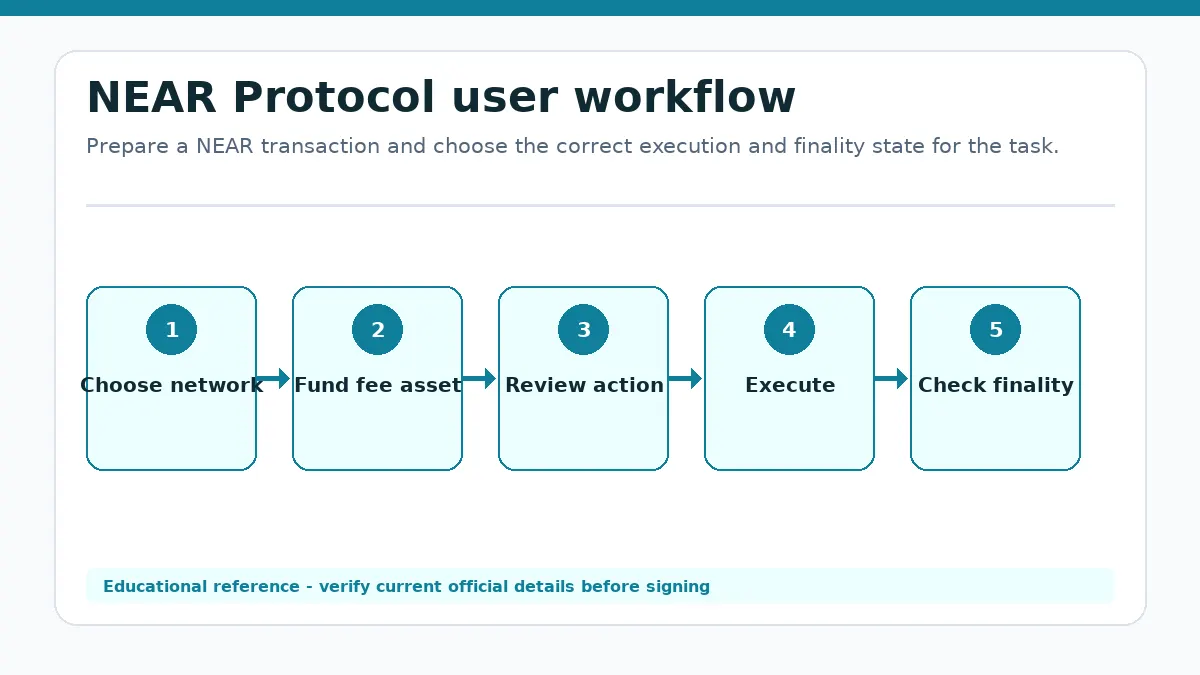
Prepare a NEAR transaction and choose the correct execution and finality state for the task.
Subject:
NEAR Protocol
Market mode:
Snapshot Only
Fee asset:
NEAR
Timezone:
UTC
This page does not simulate a contract, calculate live storage use, select a validator or guarantee one-block completion.
Content ownership: BitcoinToolkit Editorial TeamTechnical references: Official protocol and developer documentation.Review approach: Technical explanations are checked against primary sources and updated when the network or asset changes.Last content review: Data integration last tested:
How NEAR Accounts, Sharding and Transactions Work
An account can hold several keys with different authority instead of mapping permanently to one public key.
NEAR Protocol workflow from the first user decision to a verified outcome.
Named accounts and scoped permissions
NEAR accounts can use human-readable names and can hold contract code, balances, storage state and multiple access keys. Full-access keys can manage the account broadly. Function-call keys can be limited to a contract, selected methods and a gas allowance, making them useful for applications that should not receive transfer authority.
A restricted key is not automatically recoverable if every full-access path is removed. Users should understand which key a wallet or application requests and avoid treating an account name as proof of identity. Subaccounts have creation and control relationships that should be reviewed before deploying contracts or moving administrative authority.
Submission, execution and finality progress along related but distinct paths.
Asynchronous execution
A user signs a transaction containing one or more actions for a receiver. The network validates the transaction and converts work into receipts. Contract calls can create additional receipts, including cross-contract and cross-shard messages, so a complex action may continue after the original transaction block is included.
NEAR RPC exposes wait states such as inclusion, optimistic execution and final execution. An application that needs all outcomes, including refunds, should request the appropriate final state rather than showing success as soon as a transaction hash exists. Each receipt outcome must be checked for failures.
Gas, Storage and Sharded Execution
Compute fees and state storage affect a NEAR balance in different ways.
Tgas and storage staking
Each action consumes deterministic gas units, commonly expressed in Tgas. The protocol converts those units into NEAR using the network gas price. Function calls attach a gas limit; unused gas can be refunded subject to current protocol rules. Paying a higher gas price is not a normal priority-auction strategy on NEAR.
Persistent contract state also requires storage staking, locking NEAR according to data use and releasing it when storage is removed under supported flows. Nightshade sharding assigns account state and receipts across shards while presenting one network. Developers must design asynchronous calls and refunds rather than assuming synchronous shared state.
Permission scope and final receipt results matter as much as the recipient account.
Review the complete action
Confirm the network, signer, receiver, action list, attached deposit and gas limit. Inspect whether the wallet requests a full-access key or a restricted function-call key. Keep enough NEAR for gas and storage, and do not assume a successful first receipt means every downstream contract call succeeded.
For staking, review validator commission, uptime and withdrawal behavior using current tools. For contracts, simulate through a trusted RPC and monitor final execution. Named accounts improve readability but remain vulnerable to phishing with similar characters or subaccount names.
A signed transaction contains actions and is transformed into receipts that may execute across accounts and shards. Gas units are deterministic for actions, while the NEAR gas price and storage requirements determine the actual balance impact.
A NEAR Protocol transaction can execute successfully while the application state, contract permission or later exit remains wrong for the user's goal. NEAR is the market asset shown in the snapshot. NEAR pays transaction gas and funds storage requirements.
What NEAR Protocol users should verify and why this design differs
Protocol gas and storage rules can change. Cross-contract execution depends on application code.
For NEAR Protocol, the practical sequence is Choose network, Fund fee asset, Review action, Execute, Check finality. Confirm the official destination and current network, then inspect the final balance, position, receipt or documented exit state that actually completes the task: Prepare a NEAR transaction and choose the correct execution and finality state for the task.
NEAR Protocol Network use FAQ
Why can a NEAR transaction have several outcomes?
A signed transaction can create receipts, and contract calls can create more receipts across accounts or shards.
What is Tgas?
Tgas is one trillion NEAR gas units, used to express action and contract execution limits.
What is a function-call key?
It is an access key restricted to specified contract calls and optionally a gas allowance.
What pays transaction fees when using NEAR Protocol?
NEAR (NEAR) pays the applicable network fee. NEAR pays transaction gas and funds storage requirements. Verify the selected network before signing because a later approval, bridge, claim or exit can require another transaction.
Known Limitations
Protocol gas and storage rules can change.
Cross-contract execution depends on application code.
The page does not inspect an access key or receipt.
Market Data Methodology
The page uses a CoinGecko aggregated NEAR/USD snapshot. No exchange chart is rendered for this entity.
Market Snapshot Source
CoinGecko aggregated market data (NEAR/USD)
Cache
Snapshot cache is approximately 60 seconds.
Failure Handling
Verified cached data is labeled Cached or Delayed. Missing values remain unavailable.