Virtuals Protocol (VIRTUAL): How Agent Launches Use VIRTUAL
Virtuals Protocol is an ecosystem for creating, tokenizing and coordinating AI agents and agent-related businesses. VIRTUAL is the base liquidity and transaction asset for parts of that ecosystem; it is not a standalone blockchain and is different from each agent-specific token. This page focuses on how Agent Launches Use VIRTUAL and the checks users need before using the protocol or evaluating the token role.
Understand what VIRTUAL does in the agent ecosystem and what to verify before buying, staking or launching.
Subject:
Virtuals Protocol
Market mode:
Snapshot Only
Fee asset:
ETH or SOL
Timezone:
UTC
This page does not rate an AI agent, verify generated output, recommend a token launch or forecast ecosystem rewards.
Content ownership: BitcoinToolkit Editorial TeamTechnical references: Official protocol and developer documentation.Review approach: Technical explanations are checked against primary sources and updated when the network or asset changes.Last content review: Data integration last tested:
How Agent Launches Use VIRTUAL
Launch classes can pair new assets with VIRTUAL under different allocation and fee rules.
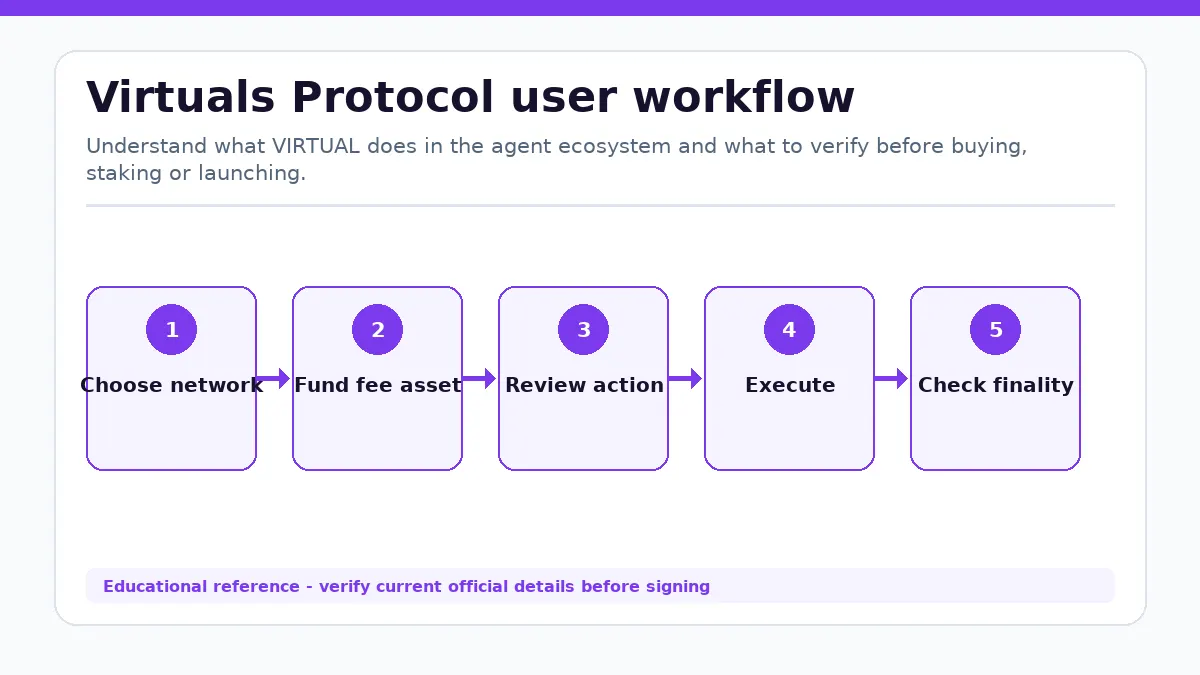
Virtuals Protocol workflow from the first user decision to a verified outcome.
Bonding curves and liquidity pools
Current Virtuals documentation describes launch classes with protocol-defined creation fees, price-discovery mechanisms and VIRTUAL liquidity pairing. Some models move from a bonding curve into a public liquidity pool after a threshold, while larger launches can use different requirements and team-defined structures.
A bonding curve or locked pool does not guarantee fair value, deep exits or agent quality. Trading taxes, allocation rules and migration terms can vary by launch class and version. Users should read the exact launch page and on-chain contracts instead of applying an older model to every new token.
Virtuals Protocol Guidance for Holders
The protocol token and each agent-specific asset represent different risks.
Base asset, applications and agents
Virtuals describes a system where AI agents can provide services, interact through the Agent Commerce Protocol and be represented by agent tokens. VIRTUAL serves as a base liquidity or transaction asset in parts of this design. Owning VIRTUAL does not create ownership of every agent or guarantee access to every service.
Each agent token has separate launch terms, liquidity, creator incentives and application behavior. An agent can produce unreliable output or fail as a business even when its token contract works. Users should evaluate the agent, team, code, permissions and market separately from VIRTUAL itself.
veVIRTUAL Governance and Host-Chain Costs
Governance weight and blockchain fees come from different assets.
Locked voting power with ETH or SOL gas
Virtuals documentation describes veVIRTUAL as voting power created through locking or staking arrangements. Governance can address protocol direction, treasury allocation and upgrades under current rules. Locking reduces liquidity and can expose users to changing reward, eligibility and unlock conditions.
VIRTUAL transactions still execute on a host chain. Base and Ethereum actions need ETH for gas, while Solana actions need SOL. A VIRTUAL balance cannot pay every host-chain fee automatically. Cross-chain representations and bridges add contract, operator and liquidity dependencies.
VIRTUAL Checks Before You Interact
Verify the chain, token and application before signing.
Agent enthusiasm is not a security review
Confirm the official VIRTUAL contract or mint for the selected network, keep the correct gas asset and inspect approvals. For an agent token, verify its launch class, liquidity pair, allocation, fees and creator authority. Avoid assuming that the agent name or social profile proves token identity.
For veVIRTUAL, review lock duration, voting rules and reward sources. For an AI service, evaluate data handling, payment conditions and output reliability. Never give a seed phrase to an agent or launch site, and do not treat automated behavior as a promise that transactions or advice are correct.
Agent launch systems pair agent tokens with VIRTUAL, while protocol products can use VIRTUAL for liquidity, payments or access. Supported representations run on host chains such as Base or Solana, and locked VIRTUAL can create veVIRTUAL for current governance and ecosystem programs.
A Virtuals Protocol transaction can execute successfully while the application state, contract permission or later exit remains wrong for the user's goal. VIRTUAL is the market-profiled ecosystem token. ETH pays Base or Ethereum gas; SOL pays Solana transaction fees.
What Virtuals Protocol users should verify and why this design differs
Launch models and governance rules evolve. The page does not audit an agent.
For Virtuals Protocol, the practical sequence is Choose network, Fund fee asset, Review action, Execute, Check finality. Confirm the official destination and current network, then inspect the final balance, position, receipt or documented exit state that actually completes the task: Understand what VIRTUAL does in the agent ecosystem and what to verify before buying, staking or launching.
Virtuals Protocol Network use FAQ
Is VIRTUAL the same as an agent token?
No. VIRTUAL is an ecosystem base asset, while each agent token has its own contract, liquidity and risks.
What pays VIRTUAL transaction fees?
The host-chain asset, such as ETH on Base or SOL on Solana.
What is veVIRTUAL?
It is voting power associated with locked VIRTUAL under current governance rules.
Known Limitations
Launch models and governance rules evolve.
The page does not audit an agent.
Cross-chain representations add risk.
Market Data Methodology
The page uses a CoinGecko aggregated VIRTUAL/USD snapshot. No exchange chart is rendered for this entity.
Market Snapshot Source
CoinGecko aggregated market data (VIRTUAL/USD)
Cache
Snapshot cache is approximately 60 seconds.
Failure Handling
Verified cached data is labeled Cached or Delayed. Missing values remain unavailable.