Skip to content
BitcoinToolkit

THORChain (RUNE): Swap Cost Combines Chain Gas, Pool Slip and Outbound Fees

THORChain is an independent Layer 1 liquidity protocol for swaps between native assets on connected chains. RUNE is its settlement, fee, liquidity and node-bond asset. This page focuses on swap Cost Combines Chain Gas, Pool Slip and Outbound Fees and the checks users need before using the protocol or evaluating the token role.

Swap native assets through THORChain while understanding pool pricing, chain fees, vault settlement and failure handling.

Subject:
THORChain
Market mode:
Snapshot Only
Fee asset:
RUNE / varies
Timezone:
UTC

This page does not quote a live swap, verify a vault address, provide liquidity, run a node, recover an invalid memo or guarantee an outbound time.

Content ownership: BitcoinToolkit Editorial Team Technical references: Official protocol and developer documentation. Review approach: Technical explanations are checked against primary sources and updated when the network or asset changes. Last content review: Data integration last tested:

Swap Cost Combines Chain Gas, Pool Slip and Outbound Fees

A displayed network fee is not the complete economic result.

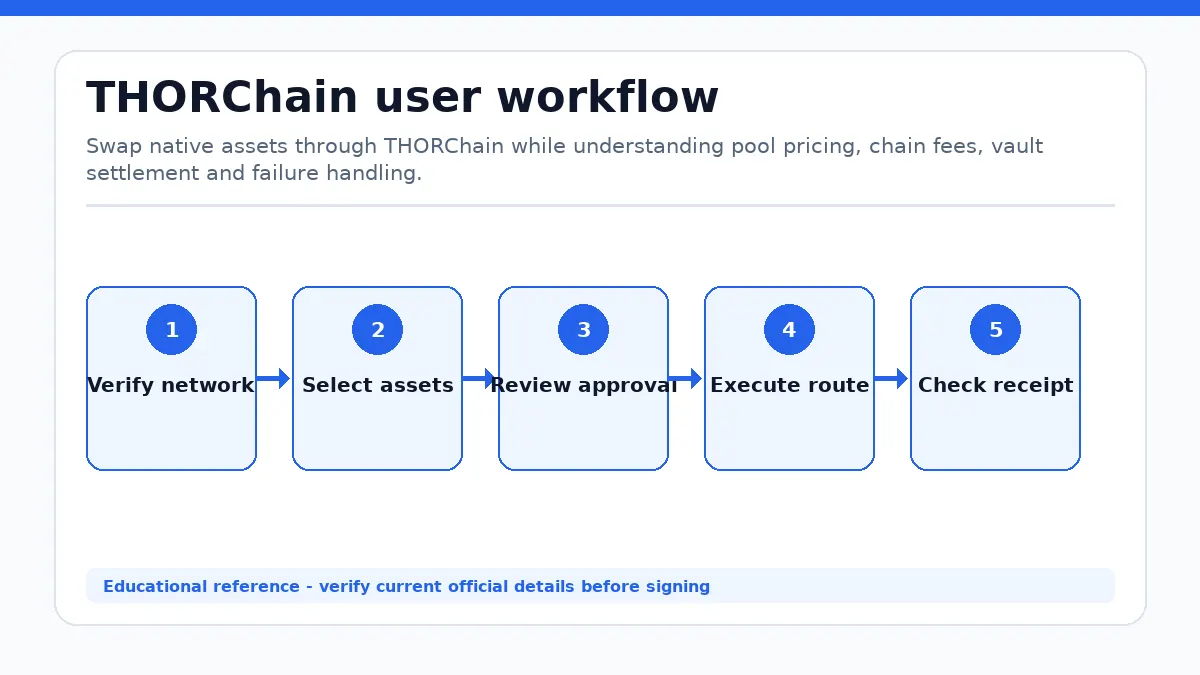
THORChain workflow showing Verify network, Select assets, Review approval, Execute route, Check receipt
THORChain workflow from the first user decision to a verified outcome.

What changes the output

The source transaction pays the source-chain network fee. THORChain pool pricing creates slip based on trade size relative to pool depth, and the outbound fee covers the destination-chain transaction. A double swap crosses two RUNE-centered pools. Streaming swaps can divide a large order over time to trade execution speed for lower aggregate price impact.

Review expected output, minimum amount, affiliate fields, memo length and refund address before sending. Fees and pool depth can change between quote and observation. A low source-chain fee does not protect against large slip, and an expired or malformed quote can produce a refund rather than the intended destination asset.
A Native Swap Has Inbound, Pool and Outbound Stages

The user receives a native destination asset without holding the internal settlement leg.

From source transaction to outbound vault

A user sends a supported source asset to the current THORChain inbound vault with a transaction memo describing the requested action and destination. THORNodes observe the source chain and reach consensus on the inbound. The state machine applies one or two pool swaps through RUNE and schedules an outbound from a threshold-controlled vault.

For a BTC-to-ETH example, BTC enters the BTC:RUNE pool and the resulting RUNE enters the RUNE:ETH pool; the user receives native ETH and does not manually hold the intermediate RUNE. Track the inbound, THORChain transaction and outbound independently because each can wait on different chain conditions.

Node Bonds and TSS Vaults Secure Connected Assets

Cross-chain custody is distributed across the active node set rather than removed entirely.

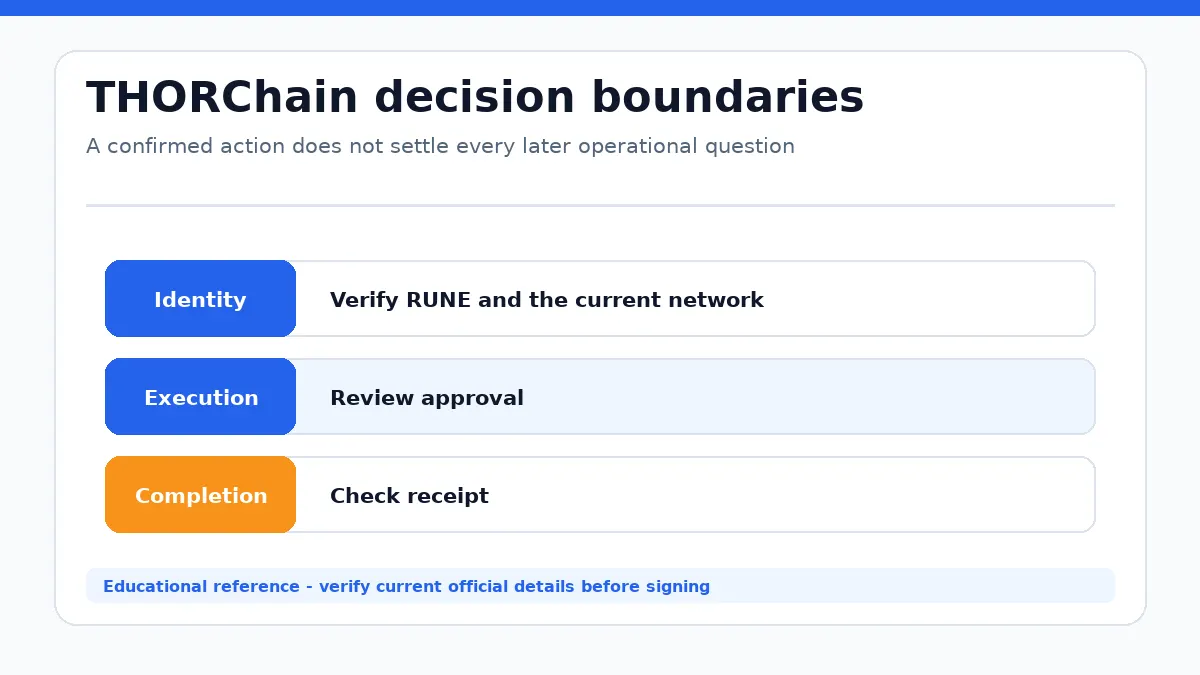
THORChain decision diagram separating identity, execution and completion checks
THORChain confirmation does not settle every later operational question.

Observation, bonding and churn

No single active signer holds the full vault key.

Users still face protocol, pool, connected-chain, vault and software risks. Verify current inbound addresses from live network data because vaults rotate. Never reuse an old deposit address from transaction history, and never infer that a large RUNE bond eliminates contract bugs, chain halts or incorrect memos.

Choose the Next THORChain Check

Treat address and memo validation as part of the swap.

Before sending native assets

Fetch a fresh quote and inbound address, confirm the source and destination chains, validate the memo, compare expected output with minimum output, and use a destination address controlled on the correct chain. Preserve the source transaction ID and quote details until the outbound is complete.

Do not send from an exchange when refunds cannot return to the original sender, omit a required memo or choose a synthetic representation by ticker alone. For liquidity or node participation, review the separate pool, bond and withdrawal rules rather than extrapolating from a simple swap.

Browse converter tools

THORChain Swaps and liquidity FAQ

Can a THORChain swap succeed at a worse price than the preview?

Yes. Pool state, routing, price impact, slippage settings, fees and transaction ordering can change execution.

Known Limitations

Market Data Methodology

The page uses a CoinGecko aggregated RUNE/USD snapshot. No exchange chart is rendered for this entity.

Market Snapshot Source
CoinGecko aggregated market data (RUNE/USD)
Cache
Snapshot cache is approximately 60 seconds.
Failure Handling
Verified cached data is labeled Cached or Delayed. Missing values remain unavailable.
Snapshot Status
Delayed
Report Issue
Report a market-data problem →

Technical Sources

Selected primary sources support the operational explanations. Market-provider attribution remains separate.

Editorial Information

Verified technical content, reviewed sources and update history.

Published
Last Review
Data Verification
Sources
Official documentation