Skip to content
BitcoinToolkit

Starknet (STRK): STRK Fees Price Multiple Network Resources

Starknet is an Ethereum Layer 2 validity rollup that executes Cairo programs and proves state transitions with STARK proofs. STRK is used for fees, staking and governance. This page focuses on sTRK Fees Price Multiple Network Resources and the checks users need before bridging assets, paying fees or waiting for finality.

Use Starknet with correct account, fee, proof, settlement and staking assumptions.

Subject:
Starknet
Market mode:
Snapshot Only
Fee asset:
STRK
Timezone:
UTC

This page does not estimate a live fee, deploy a Cairo contract, select a validator, bridge an asset or prove transaction privacy.

Content ownership: BitcoinToolkit Editorial Team Technical references: Official protocol and developer documentation. Review approach: Technical explanations are checked against primary sources and updated when the network or asset changes. Last content review: Data integration last tested:

STRK Fees Price Multiple Network Resources

A Starknet fee covers execution and data-related resources rather than one simple opcode total.

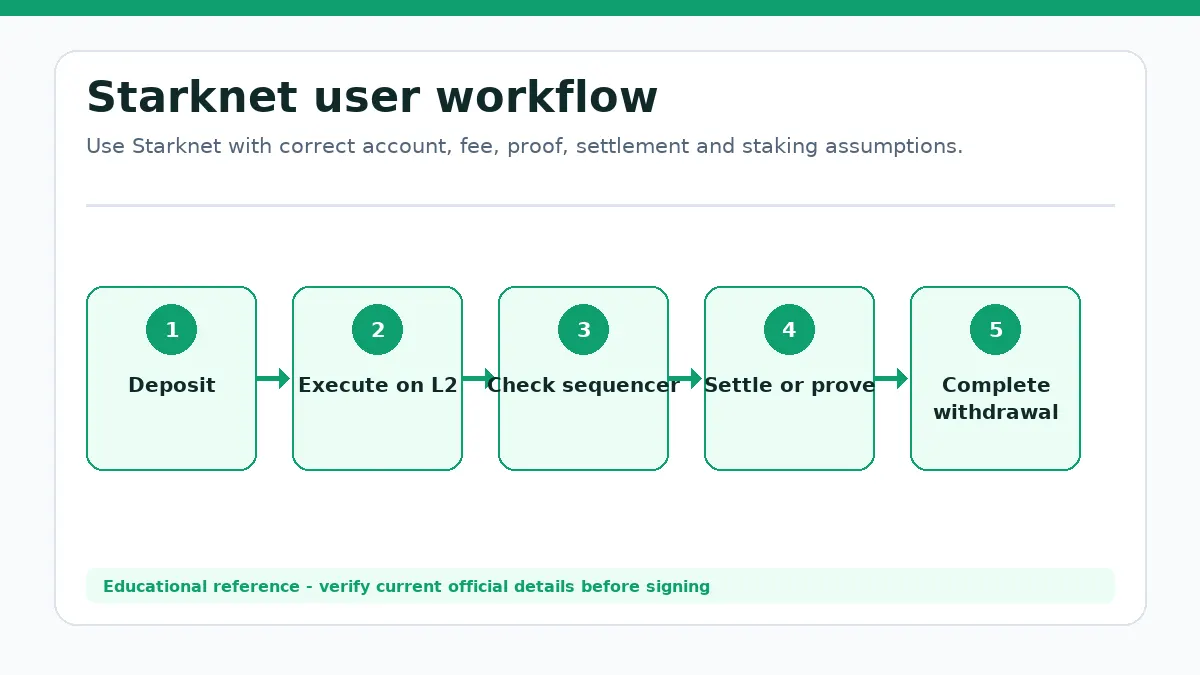
Starknet workflow showing Deposit, Execute on L2, Check sequencer state, Settle or prove, Complete withdrawal
Starknet workflow from the first user decision to a verified outcome.

Resource bounds and atomic charging

Current Starknet transactions specify STRK-denominated maximum amounts and prices for relevant resource units. The sequencer estimates and charges the actual fee atomically with transaction execution, subject to the authorized bounds. L2 computation, state changes and data availability can contribute to the result.

Use a current wallet estimate and review the maximum authorization. Keep STRK in the submitting account, including when the contract action concerns another token. Historical guidance that described ETH fee payment can be stale after protocol upgrades, so integrations should follow the active transaction version and official fee specification.
Starknet Operating Context

Transaction status should be read at both the execution and finality layers.

Sequencer, OS and proof

A Starknet account submits an invoke, declare or deploy-account transaction. The sequencer validates it, orders it and executes it through Starknet OS. Reverted transactions can still be included and charged because the network performed work. Blocks are proved, and the resulting state update is verified by a contract on Ethereum.

Check the execution status and finality status rather than relying on one success badge. An accepted-on-L2 state gives faster application feedback, while the later Ethereum-accepted state provides the stronger rollup settlement milestone. A receiving service can choose which status it requires before crediting an operation.

Starknet Staking Is Being Introduced in Stages

Current validator responsibilities should not be overstated as a fully completed decentralization design.

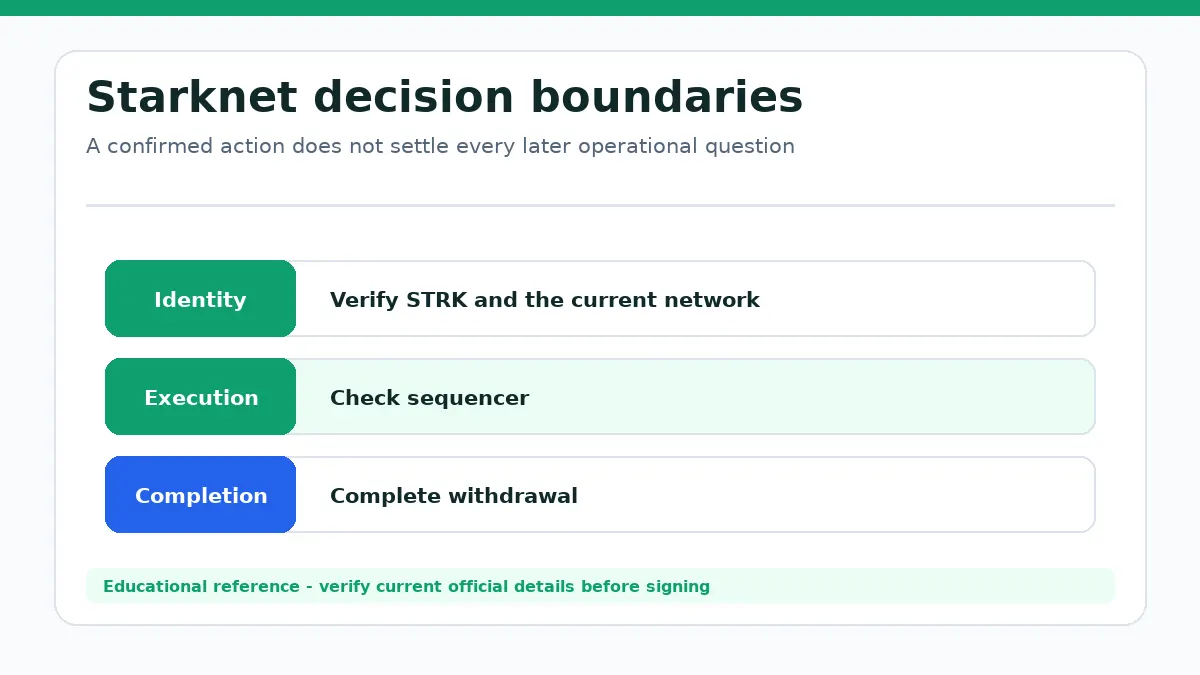
Starknet decision diagram separating identity, execution and completion checks
Starknet confirmation does not settle every later operational question.

Validators, delegators and epochs

STRK holders can stake directly or delegate under the current protocol, while validators operate full nodes and perform the responsibilities enabled for the active stage. Rewards and attestations are epoch-based. Starknet documentation explicitly describes a gradual transition of sequencing, attesting and proving duties rather than a single finished changeover.

Check the active phase, minimums, commission, exit latency and operational address funding before staking. Delegation does not make the delegator a sequencer, and a displayed reward rate is not fixed. Keep enough STRK outside the position for fees and avoid services that imply immediate withdrawal or guaranteed returns.

Choose the Next Starknet Check

Start from the account, transaction version and required settlement state.

User and developer checklist

For a transfer, confirm the Starknet account, nonce, STRK balance and fee bounds. For a contract, decode Cairo calldata and review token approvals. For staking, verify the current phase and validator. For a bridge, preserve the L2 transaction and Ethereum message or claim state.

Do not assume an Ethereum 0x workflow applies unchanged, confuse privacy with proof validity, or call an L2 receipt Ethereum-finalized. Use Starknet-native explorers and current SDKs, then continue to wallet or developer tools for address and contract checks.

Browse developer tools

Where Starknet Differs for Users

The STRK result needs context

Smart accounts submit transactions to a sequencer, the Starknet OS executes blocks, a prover creates a STARK proof, and an Ethereum verifier accepts the proved state update.

A Starknet transaction can be accepted on the execution layer before settlement or a parent-chain withdrawal is complete. STRK is the market asset shown in the snapshot. Current Starknet transactions specify and pay fees in STRK.

What Starknet users should verify and why this design differs

Staking and decentralization stages can change. Transaction versions and fee units can be upgraded.

For Starknet, the practical sequence is Deposit, Execute on L2, Check sequencer state, Settle or prove, Complete withdrawal. Confirm the official destination and current network, then inspect the final balance, position, receipt or documented exit state that actually completes the task: Use Starknet with correct account, fee, proof, settlement and staking assumptions.

STRK is used for fees, staking and governance.

Starknet Layer 2 use FAQ

What pays current Starknet fees?

Current transactions specify and pay fees in STRK.

Is Starknet a privacy network because it uses zero-knowledge proofs?

No. Validity proofs establish correct execution and do not automatically hide user activity.

Is an accepted-on-L2 transaction already accepted on Ethereum?

No. Ethereum acceptance follows proof verification and state update settlement.

Known Limitations

Market Data Methodology

The page uses a CoinGecko aggregated STRK/USD snapshot. No exchange chart is rendered for this entity.

Market Snapshot Source
CoinGecko aggregated market data (STRK/USD)
Cache
Snapshot cache is approximately 60 seconds.
Failure Handling
Verified cached data is labeled Cached or Delayed. Missing values remain unavailable.
Snapshot Status
Delayed
Report Issue
Report a market-data problem →

Technical Sources

Selected primary sources support the operational explanations. Market-provider attribution remains separate.

Editorial Information

Verified technical content, reviewed sources and update history.

Published
Last Review
Data Verification
Sources
Official documentation