Shiba Inu (SHIB): What SHIB Does in the Shiba Inu Ecosystem
SHIB is a meme and community ecosystem token launched on Ethereum and represented on supported networks. It is not a standalone SHIB blockchain and is not the universal gas asset for Shibarium. This page focuses on what SHIB Does in the Shiba Inu Ecosystem and the checks users need before holding, transferring or verifying the token.
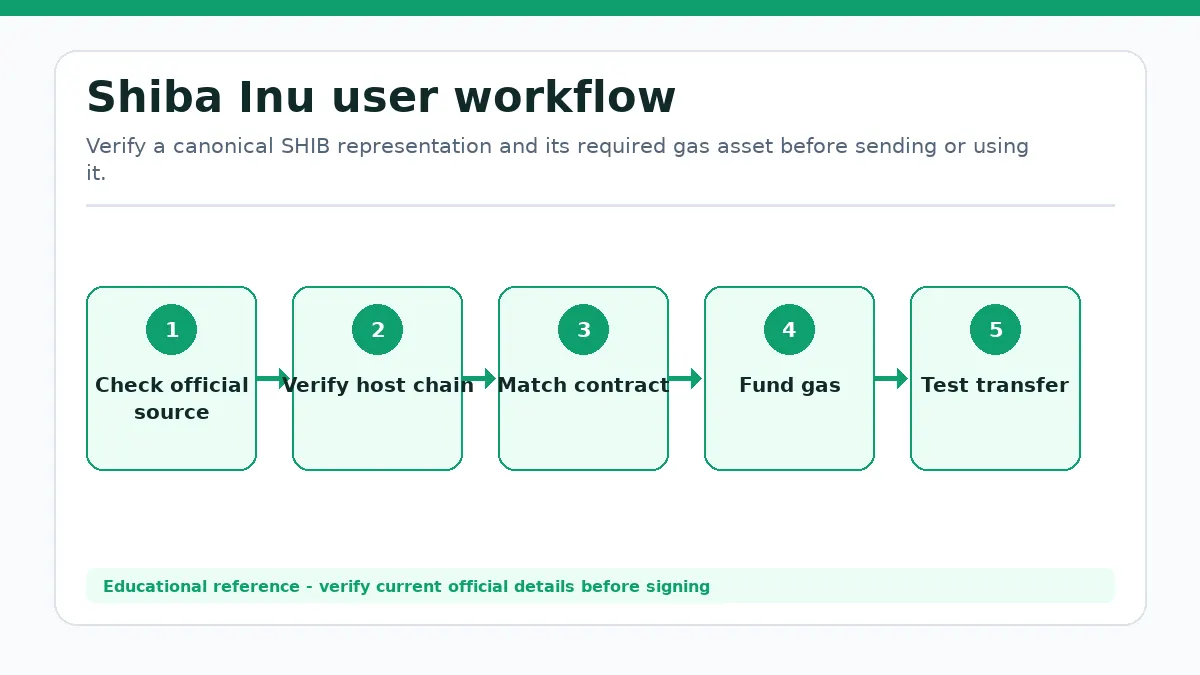
Verify a canonical SHIB representation and its required gas asset before sending or using it.
Subject:
Shiba Inu
Market mode:
Chart and Snapshot
Fee asset:
ETH/BONE/Varies
Timezone:
UTC
This page does not endorse a token, promise burn-driven price effects, validate an unofficial contract or treat ecosystem branding as technical security.
Content ownership: BitcoinToolkit Editorial TeamTechnical references: Official protocol and developer documentation.Review approach: Technical explanations are checked against primary sources and updated when the network or asset changes.Last content review: Data integration last tested:
What SHIB Does in the Shiba Inu Ecosystem
The most common irreversible mistake is selecting the wrong contract or deposit network.
Shiba Inu workflow from the first user decision to a verified outcome.
Before sending
Confirm the full contract address from an official source, the sending network, receiving network, deposit support and gas asset. Send a small test when the destination is new. If a bridge is used, verify the official route and the destination representation it creates.
Custodial services can pause or restrict deposits independently of the blockchain. Liquidity can vary sharply between networks and venues. Impersonation tokens, fake support accounts and approval phishing are especially important risks for a widely recognized community brand.
What SHIB does not provide
Holding SHIB does not guarantee yield, governance rights, Shibarium gas, bridge protection or access to every branded product. Verify each product separately.
SHIB Candlestick Chart
SHIB/USDT · Binance Spot · UTC
Historical Only
Pair
SHIB/USDT
Venue
Binance Spot
Market Type
Spot
Interval
1H
Timezone
UTC
Last Update
Aug 25, 2026 11:42:55 UTC
Interval
Range
Long ranges automatically use a compatible candle interval.
Historical Binance Spot candles are available. JavaScript is required for current-candle updates.
Historical Binance Spot candles are available. JavaScript is required for current-candle updates.
Recent OHLC and volume data
Time (UTC)
Open (USDT)
High (USDT)
Low (USDT)
Close (USDT)
Volume (SHIB)
Aug 25, 2026 11:00:00 UTC
0.00 USDT
0.00 USDT
0.00 USDT
0.00 USDT
22,661,114,454.00 SHIB
Aug 25, 2026 10:00:00 UTC
0.00 USDT
0.00 USDT
0.00 USDT
0.00 USDT
27,503,716,562.00 SHIB
Aug 25, 2026 09:00:00 UTC
0.00 USDT
0.00 USDT
0.00 USDT
0.00 USDT
82,605,335,903.00 SHIB
Aug 25, 2026 08:00:00 UTC
0.00 USDT
0.00 USDT
0.00 USDT
0.00 USDT
34,124,373,466.00 SHIB
Aug 25, 2026 07:00:00 UTC
0.00 USDT
0.00 USDT
0.00 USDT
0.00 USDT
101,209,170,583.00 SHIB
Market data: Binance Spot SHIB/USDT
Charting library: TradingView Lightweight Charts
Shiba Inu Transaction and Fee Checks
The ticker alone is not enough because copies and network-specific representations can share a name.
Canonical origin and contracts
SHIB launched as an ERC-20 token on Ethereum. Its canonical Ethereum contract is 0x95aD61b0a150d79219dCF64E1E6Cc01f0B64C4cE. A wallet or exchange listing should be matched to the official network and contract, not only the Shiba Inu name, logo or ticker.
Official ecosystem materials list supported multi-chain contracts. Each representation lives under the selected host chain's rules and can use a different contract address. A random token named SHIB is not made authentic by matching decimals, artwork or a trading pair.
Supply and burns
Supply changes should be checked through current contract and official ecosystem information. A burn removes tokens sent through the defined mechanism, but a burn headline does not by itself establish demand, liquidity or future value.
SHIB, Shibarium and BONE Have Different Roles
Brand relationships do not turn several assets and networks into one balance.
Token versus network
Shibarium is an EVM-compatible ecosystem network with its own chain settings and contracts. Official network details identify BONE as the gas currency. SHIB can exist as a token on Shibarium, but a SHIB balance cannot automatically pay the transaction fee.
On Ethereum, ETH pays gas for SHIB transfers. On Shibarium, BONE pays gas. On another supported network, that host chain's fee asset applies. The user must keep both the intended SHIB balance and the correct fee asset for the selected network.
No invented consensus
SHIB itself has no validators, block production or finality. Those properties belong to the host network. Shibarium validators and BONE staking should not be described as SHIB consensus.
A Practical SHIB Verification Checklist
Contract verification should happen before wallet approval or deposit.
Checklist
Match the official contract, host chain and destination support; keep the host fee asset; review token approvals; and test the route with a small amount.
Do not buy by logo or ticker alone.
Do not assume SHIB pays Shibarium gas.
Do not send an Ethereum token to an unsupported Shibarium deposit.
Do not grant unlimited approvals to an unverified application.
Next action
Compare the contract shown by the wallet or exchange with the official SHIB token list before signing.
SHIB transfers follow the smart-contract and finality rules of the selected host chain. Ethereum SHIB uses the canonical ERC-20 contract; Shibarium uses BONE for gas, and other representations require their own verified contract addresses.
A token can display the SHIB ticker and Shiba Inu branding without being the canonical contract or mint. SHIB is the profiled market token. ETH pays Ethereum gas, BONE pays Shibarium gas, and other supported chains use their own fee assets.
What Shiba Inu users should verify and why this design differs
Supported representations and ecosystem products can change. The page does not validate a user-supplied contract.
For Shiba Inu, the practical sequence is Check official source, Verify host chain, Match contract or mint, Fund gas, Test transfer. Confirm the official destination and current network, then inspect the final balance, position, receipt or documented exit state that actually completes the task: Verify a canonical SHIB representation and its required gas asset before sending or using it.
Shiba Inu Token verification FAQ
Is SHIB a blockchain?
No. SHIB is a token whose transfers use a host blockchain.
What pays SHIB transfer fees?
The host-chain asset, such as ETH on Ethereum or BONE on Shibarium.
Is SHIB the gas token of Shibarium?
No. Official Shibarium network details use BONE as the gas currency.
Known Limitations
Supported representations and ecosystem products can change.
The page does not validate a user-supplied contract.
Market activity is not evidence of technical utility.
Market Data Methodology
The snapshot is CoinGecko aggregated SHIB/USD data. The chart is Binance Spot SHIB/USDT data. USD and USDT are separate quote units and values may differ.
Market Snapshot Source
CoinGecko aggregated market data (SHIB/USD)
Candlestick Source
Binance Spot market data (SHIB/USDT)
Pair
SHIB/USDT
Venue
Binance Spot
Market Type
Spot
Timezone
UTC
Cache
Snapshot cache is approximately 60 seconds.
Failure Handling
Verified cached data is labeled Cached or Delayed. Missing values remain unavailable.