Skip to content
BitcoinToolkit

Ronin (RON): RON Funds Ronin Transactions and Contract Calls

Ronin is an EVM-compatible network designed around games and digital assets. RON is its native currency for transaction gas, staking and network governance. This page focuses on rON Funds Ronin Transactions and Contract Calls and the checks users need before using the protocol or evaluating the token role.

Use Ronin games and assets with correct gas, validator, bridge and wallet assumptions.

Subject:
Ronin
Market mode:
Snapshot Only
Fee asset:
RON
Timezone:
UTC

This page does not select a validator, bridge an asset, recover a wallet, verify an NFT or promise a game asset will remain supported.

Content ownership: BitcoinToolkit Editorial Team Technical references: Official protocol and developer documentation. Review approach: Technical explanations are checked against primary sources and updated when the network or asset changes. Last content review: Data integration last tested:

RON Funds Ronin Transactions and Contract Calls

Game tokens and NFTs still depend on a network transaction.

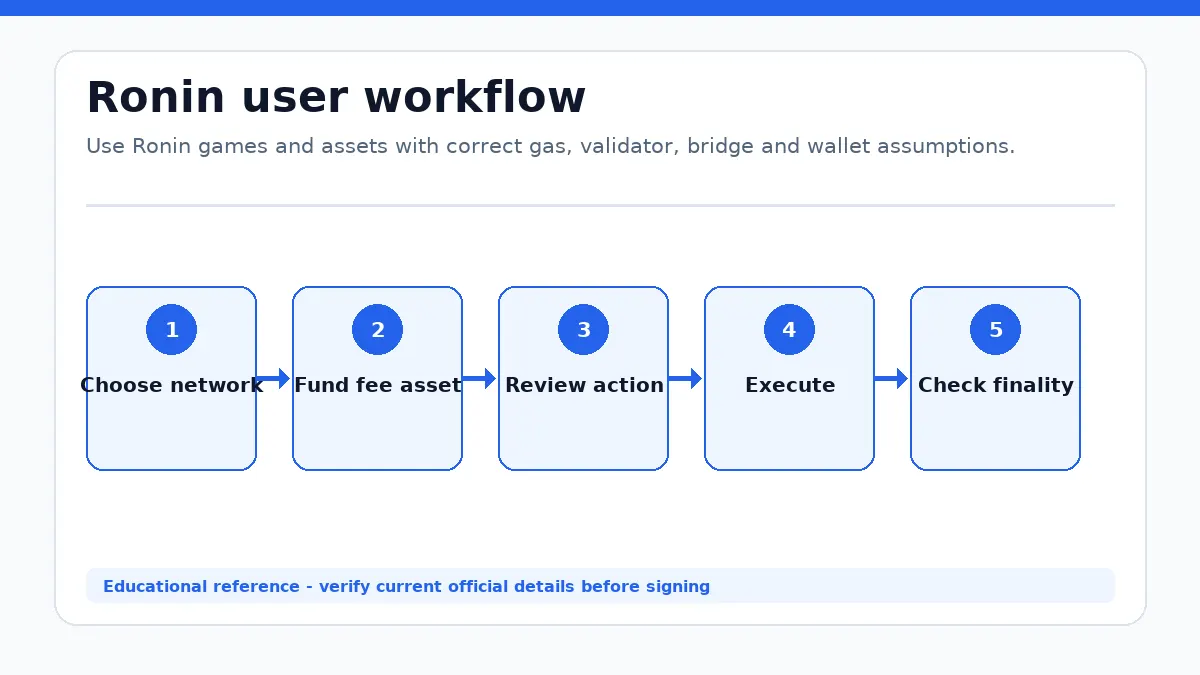
Ronin workflow showing Choose network, Fund fee asset, Review action, Execute, Check finality
Ronin workflow from the first user decision to a verified outcome.

Account, nonce and gas

A Ronin transaction uses an EVM-style account, nonce, recipient or contract, calldata and gas limit. RON pays the network fee even when the action transfers another token or NFT. A custodial game balance, an Ethereum token and a Ronin onchain balance are separate states that may use the same brand or asset name.

Why Ronin's Design Matters

RON holders and validator operators have different responsibilities.

Delegated proof of stake

Ronin uses delegated proof of stake. Validator candidates operate infrastructure and commit stake, while RON holders can delegate to eligible validators. Governing validators participate in additional network governance and bridge-related decisions. Delegation does not transfer ordinary wallet ownership, but the stake remains subject to current protocol rules and validator performance.

Review validator status, commission, uptime, reward rules and withdrawal timing rather than selecting only by headline yield. Keep liquid RON for fees. A delegator should distinguish protocol staking from exchange earn products, which add custody and provider terms that the base network does not control.

Ronin Bridge Spans Two Network Transactions

Moving an asset between Ethereum and Ronin changes where it is represented.

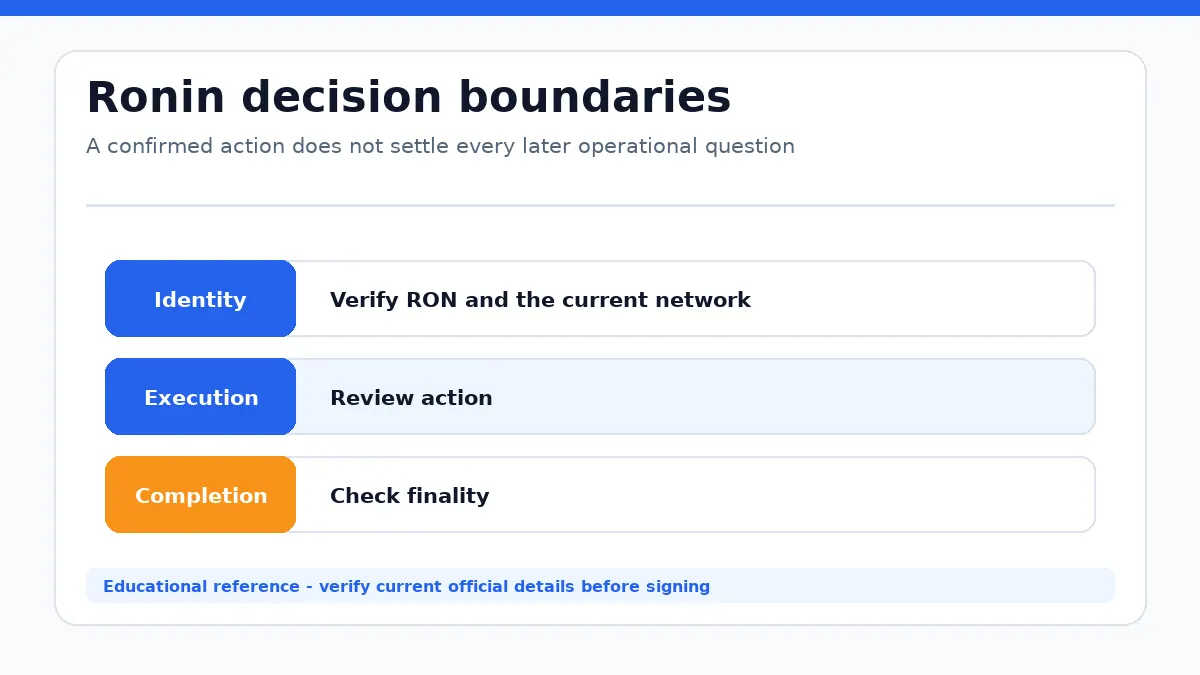
Ronin decision diagram separating identity, execution and completion checks
Ronin confirmation does not settle every later operational question.

Deposit, withdrawal and support

The official bridge coordinates contracts on Ethereum and Ronin. A deposit begins with an Ethereum transaction and results in a supported Ronin representation. A withdrawal begins on Ronin and can require a separate Ethereum-side completion. ETH and RON fees, confirmation times and token contracts therefore belong to different parts of the route.

Use only the current official route, verify both destination and token support, and inspect the transaction identifiers on the correct explorers. Never send directly to a bridge contract from an exchange unless the documented path permits it. Bridge status, limits and supported assets can change independently of the game application.

Choose the Next Ronin Check

Match the check to the game, staking or bridge task.

A practical sequence

For a game, confirm its official contract and wallet permissions. For staking, verify the validator and current unbonding process. For a bridge transfer, confirm the source chain, destination chain, token representation and fees before signing. Test a small amount when the destination has not already been proven.

Do not assume a Ronin address proves the recipient supports every token, that an NFT image proves ownership, or that a fast block confirmation removes application risk. Use Ronin documentation for current network parameters and wallet tools for address and transaction review.

Browse wallet tools

Where Ronin Differs for Users

The RON result needs context

Validators operate Ronin through delegated proof of stake, while governing validators add a separate governance and bridge-security role. Smart contracts manage game assets and bridge representations.

A Ronin transaction can execute successfully while the application state, contract permission or later exit remains wrong for the user's goal. RON is the market asset shown in the snapshot. RON pays gas for Ronin transfers and contract calls.

What Ronin users should verify and why this design differs

Validator, bridge and game support can change. Bridge steps depend on both networks and the selected asset.

For Ronin, the practical sequence is Choose network, Fund fee asset, Review action, Execute, Check finality. Confirm the official destination and current network, then inspect the final balance, position, receipt or documented exit state that actually completes the task: Use Ronin games and assets with correct gas, validator, bridge and wallet assumptions.
Ronin Network use FAQ

What pays gas on Ronin?

RON pays transaction and contract-execution fees.

Does staking RON make someone a validator?

No. Delegators back eligible validators; operating a validator has separate requirements.

Is a bridge transfer an ordinary token transfer?

No. It coordinates contracts and settlement on two networks.

Known Limitations

Market Data Methodology

The page uses a CoinGecko aggregated RON/USD snapshot. No exchange chart is rendered for this entity.

Market Snapshot Source
CoinGecko aggregated market data (RON/USD)
Cache
Snapshot cache is approximately 60 seconds.
Failure Handling
Verified cached data is labeled Cached or Delayed. Missing values remain unavailable.
Snapshot Status
Delayed
Report Issue
Report a market-data problem →

Technical Sources

Selected primary sources support the operational explanations. Market-provider attribution remains separate.

Editorial Information

Verified technical content, reviewed sources and update history.

Published
Last Review
Data Verification
Sources
Official documentation