Skip to content
BitcoinToolkit

Pyth Network (PYTH): How Pyth Price Feeds Are Produced

Pyth Network provides price data and related services for applications across many blockchains. PYTH is its governance and staking token; it is not a universal payment token for every data update and does not replace the native gas currency of supported chains. This page focuses on how Pyth Price Feeds Are Produced and the checks users need before integrating the service or using the token.

Understand Pyth price-feed delivery, PYTH token roles and Oracle Integrity Staking risk.

Subject:
Pyth Network
Market mode:
Snapshot Only
Fee asset:
Varies
Timezone:
UTC

This page does not certify a price feed, select a publisher, calculate staking rewards or validate a token representation.

Content ownership: BitcoinToolkit Editorial Team Technical references: Official protocol and developer documentation. Review approach: Technical explanations are checked against primary sources and updated when the network or asset changes. Last content review: Data integration last tested:

How Pyth Price Feeds Are Produced

A feed is an aggregation of publisher observations rather than one exchange quote.

Price, confidence and publication time

Pyth publishers include market participants and data providers that submit observations for supported symbols. The protocol aggregates those inputs into a price and confidence interval. Applications should read both values and the publication time because a narrow-looking price without freshness checks can still be unsafe.

The feed describes a market reference under Pyth's methodology; it does not guarantee an executable trade at that value. Downstream protocols decide acceptable confidence, staleness and fallback behavior. A correct Pyth update can still be used incorrectly by an application with weak validation or unsuitable liquidation settings.
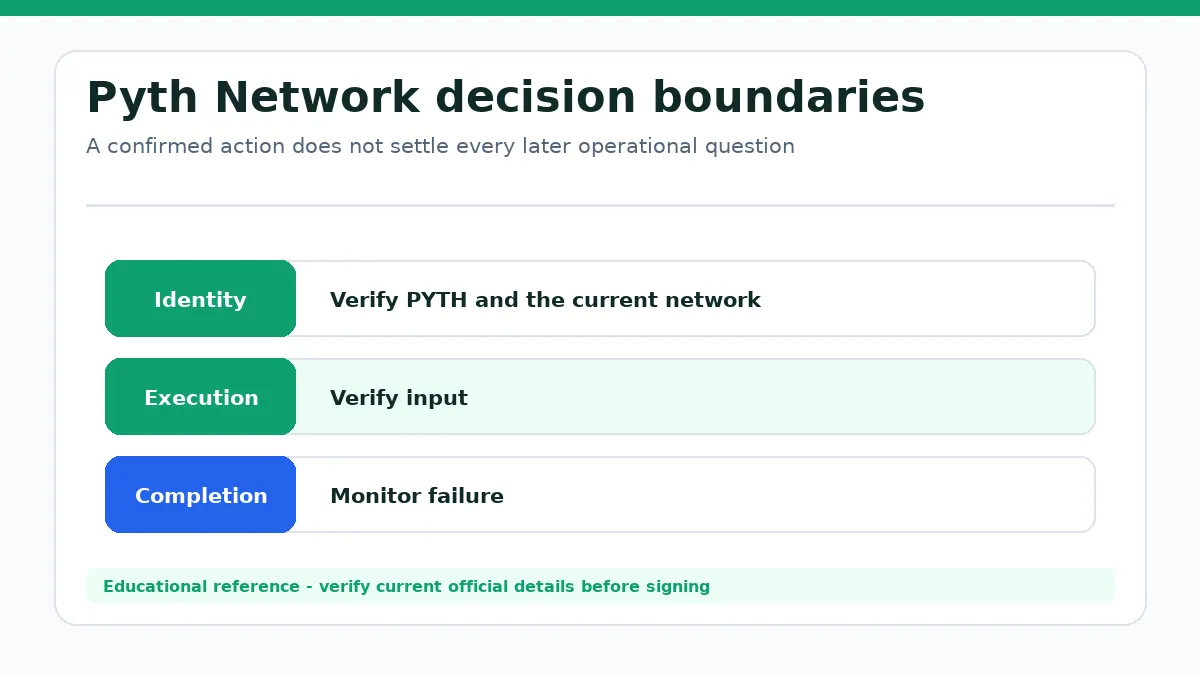
How Applications Receive Pyth Updates

Data delivery and blockchain execution are separate cost layers.

Pyth Network decision diagram separating identity, execution and completion checks
Pyth Network confirmation does not settle every later operational question.

Pull, push and host-chain transactions

Pyth Core supports delivery patterns where applications submit verified updates when needed and environments where updates are pushed through supported infrastructure. The exact contract, update fee and transaction format depend on the destination chain and product. Developers should use current deployment addresses and SDK documentation.

A user or application submitting an update pays the destination network's transaction cost and any applicable update fee. PYTH is not automatically the gas asset. For example, Solana activity needs SOL, while an EVM deployment uses that chain's native fee currency.

PYTH Governance and Oracle Integrity Staking

Governance voting and publisher accountability use related but distinct staking paths.

Voting power and slashing exposure

Staked PYTH can vote on Pyth DAO proposals under the current constitution and parameters. Oracle Integrity Staking lets publishers self-stake and delegators assign stake to publisher pools, creating economic exposure to data quality. The program uses epochs, caps and documented slashing conditions.

Delegation does not make a publisher risk-free. Stake assigned to a responsible pool can be reduced under the slashing rulebook, and rewards depend on current parameters and participation. Users should distinguish governance staking, OIS allocation and merely holding a liquid PYTH token.

Pyth Network Infrastructure use FAQ

What happens if a Pyth Network data or message path is delayed?

The consuming application can receive stale, incomplete or unavailable information even when its host chain continues producing blocks.

Known Limitations

Market Data Methodology

The page uses a CoinGecko aggregated PYTH/USD snapshot. No exchange chart is rendered for this entity.

Market Snapshot Source
CoinGecko aggregated market data (PYTH/USD)
Cache
Snapshot cache is approximately 60 seconds.
Failure Handling
Verified cached data is labeled Cached or Delayed. Missing values remain unavailable.
Snapshot Status
Delayed
Report Issue
Report a market-data problem →

Technical Sources

Selected primary sources support the operational explanations. Market-provider attribution remains separate.

Editorial Information

Verified technical content, reviewed sources and update history.

Published
Last Review
Data Verification
Sources
Official documentation