Pudgy Penguins (PENGU): How PENGU Claims and Wallet Linking Worked
PENGU is a Solana token associated with the Pudgy Penguins brand and community. It is separate from the original Pudgy Penguins NFT collections on Ethereum, does not turn an NFT into a fungible token and does not provide its own blockchain or validators. This page focuses on how PENGU Claims and Wallet Linking Worked and the checks users need before holding, transferring or verifying the token.
Verify PENGU identity and understand its relationship to the Pudgy Penguins NFT and brand ecosystem.
Subject:
Pudgy Penguins
Market mode:
Snapshot Only
Fee asset:
SOL
Timezone:
UTC
This page does not check claim eligibility, value an NFT, endorse a marketplace or promise token benefits.
Content ownership: BitcoinToolkit Editorial TeamTechnical references: Official protocol and developer documentation.Review approach: Technical explanations are checked against primary sources and updated when the network or asset changes.Last content review: Data integration last tested:
How PENGU Claims and Wallet Linking Worked
Eligibility checks and token delivery were distinct steps.
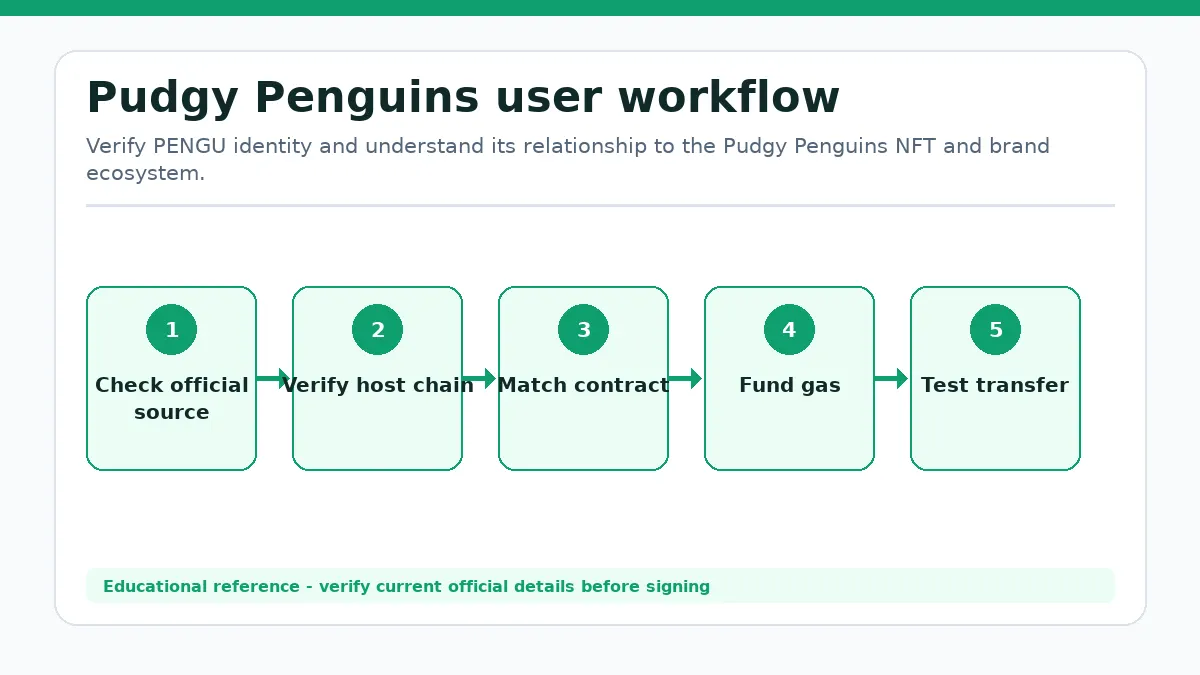
Pudgy Penguins workflow from the first user decision to a verified outcome.
Cross-wallet proof with Solana receipt
Official claim interfaces allowed users to connect supported Solana or Ethereum wallets to prove eligibility and receive PENGU into a selected Solana wallet. Linking an Ethereum wallet could demonstrate NFT ownership, while the fungible token itself arrived on Solana. This did not move the Ethereum NFT.
Claim periods, domains and eligibility rules can expire. A page that copies an old interface may be malicious even if the original campaign was real. Users should never enter a seed phrase and should verify a current announcement before signing a wallet-linking or token-claim message.
Pudgy Penguins Operating Context
The fungible token and collectible assets live in different technical contexts.
Solana token versus Ethereum collection
PENGU is held in Solana token accounts and can be transferred in fungible units. The original Pudgy Penguins and related NFT collections use Ethereum contracts with individually identified tokens. Owning PENGU does not automatically grant an NFT, and transferring an NFT does not transfer a PENGU balance.
Brand announcements can connect the communities through eligibility, products or campaigns, but those links are program specific. Users should confirm which wallet, chain and snapshot a campaign references. A familiar penguin image or ticker is not proof that a token or collection is official.
PENGU Transfers and Brand Programs
Token movement follows Solana even when a program references broader brand activity.
SOL fees and independent terms
Sending PENGU requires SOL for transaction fees and may require a destination token account. Exchanges can support only selected networks and can impose minimum deposits. Users should verify the Solana mint and destination instructions, then send a small test when using a new service.
Pudgy Penguins brand programs, physical products, NFTs, soulbound tokens and PENGU can have separate rules. Token ownership should not be interpreted as a license, revenue claim or permanent access right unless the current program terms explicitly state it. Commercial value and benefits are not guaranteed.
PENGU Safety Checks
Claim impersonation and token copies are the main avoidable risks.
Verify domain, mint and requested permission
Confirm the official Solana mint through a current Pudgy Penguins source or trusted token registry. Keep SOL for fees, inspect the recipient and distinguish a simple signature from a transaction that transfers assets or grants authority. Disconnect unfamiliar applications after use.
Do not trust direct messages offering a renewed claim, NFT conversion or guaranteed reward. Verify dates and terms independently, and never share a seed phrase. Treat PENGU market exposure, NFT ownership and brand participation as three separate decisions with different custody and liquidity risks.
PENGU transfers through Solana token accounts and needs SOL for fees. Historical claim workflows linked eligibility from supported wallets or NFT ownership to distribution into a Solana wallet, while current token use and brand programs depend on their own published terms.
A token can display the PENGU ticker and Pudgy Penguins branding without being the canonical contract or mint. PENGU is the market-profiled brand ecosystem token. SOL pays PENGU transfer and token-account fees.
What Pudgy Penguins users should verify and why this design differs
Brand programs and claims change. The page does not verify eligibility.
For Pudgy Penguins, the practical sequence is Check official source, Verify host chain, Match contract or mint, Fund gas, Test transfer. Confirm the official destination and current network, then inspect the final balance, position, receipt or documented exit state that actually completes the task: Verify PENGU identity and understand its relationship to the Pudgy Penguins NFT and brand ecosystem.
Pudgy Penguins Token verification FAQ
Is PENGU a Pudgy Penguins NFT?
No. PENGU is a fungible Solana token; the collectible NFTs are separate assets.
What pays PENGU transfer fees?
SOL pays Solana transaction and token-account fees.
Can I still use any old PENGU claim link?
No. Verify the current official domain and campaign status before connecting a wallet.
Known Limitations
Brand programs and claims change.
The page does not verify eligibility.
The page does not validate a pasted mint.
Market Data Methodology
The page uses a CoinGecko aggregated PENGU/USD snapshot. No exchange chart is rendered for this entity.
Market Snapshot Source
CoinGecko aggregated market data (PENGU/USD)
Cache
Snapshot cache is approximately 60 seconds.
Failure Handling
Verified cached data is labeled Cached or Delayed. Missing values remain unavailable.