What the Polygon PoS user is confirming
Bor produces Polygon PoS blocks, Heimdall-v2 coordinates validator consensus and milestones, and checkpoints periodically anchor accepted Polygon state to Ethereum.
Polygon PoS is an EVM-compatible proof-of-stake sidechain for Ethereum, and POL is its protocol-native asset used for transaction fees and validator staking. This page focuses on how Polygon PoS Transactions and Checkpoints Work and the checks users need before bridging assets, paying fees or waiting for finality.
Help users understand how Polygon PoS transactions work and make safer bridge and transaction decisions for Polygon PoS.
Use this page to inspect sourced market references and understand Polygon PoS architecture. It is not an executable quote, price forecast or bridge transaction interface.
BitcoinToolkit separates CoinGecko USD data from the Binance Spot POL/USDT market and explains Polygon PoS execution, checkpoints, bridge withdrawals, fees and local finality.
Bor produces Polygon PoS blocks, Heimdall-v2 coordinates validator consensus and milestones, and checkpoints periodically anchor accepted Polygon state to Ethereum.
Polygon Ecosystem Token (POL) is the asset profiled on this page. POL is the market asset displayed on this page.
Polygon Ecosystem Token (POL) pays the applicable transaction cost. POL pays EVM transaction execution fees on Polygon PoS.
POL/USDT · Binance Spot · UTC
Long ranges automatically use a compatible candle interval.
Historical Binance Spot candles are available. JavaScript is required for current-candle updates.
| Time (UTC) | Open (USDT) | High (USDT) | Low (USDT) | Close (USDT) | Volume (POL) |
|---|---|---|---|---|---|
| Oct 11, 2026 00:00:00 UTC | 0.10 USDT | 0.10 USDT | 0.10 USDT | 0.10 USDT | 1,763,576.80 POL |
| Oct 10, 2026 23:00:00 UTC | 0.10 USDT | 0.10 USDT | 0.10 USDT | 0.10 USDT | 1,503,065.20 POL |
| Oct 10, 2026 22:00:00 UTC | 0.10 USDT | 0.10 USDT | 0.10 USDT | 0.10 USDT | 1,917,414.30 POL |
| Oct 10, 2026 21:00:00 UTC | 0.10 USDT | 0.10 USDT | 0.10 USDT | 0.10 USDT | 588,849.20 POL |
| Oct 10, 2026 20:00:00 UTC | 0.10 USDT | 0.10 USDT | 0.10 USDT | 0.10 USDT | 1,049,817.60 POL |
Market data: Binance Spot POL/USDT
Charting library: TradingView Lightweight Charts
Polygon PoS is an EVM-compatible sidechain network, while POL is the protocol-native asset used for fees and validator staking.
Polygon PoS executes EVM transactions with its own validator and consensus systems while maintaining an anchoring relationship with Ethereum.
POL is the native asset used for Polygon PoS transaction fees and validator staking.
Polygon PoS is the transaction-processing network; POL is an asset with fee, staking and market roles.
Polygon PoS executes EVM transactions independently while checkpoints connect accepted sidechain history to Ethereum.
Ethereum
Ethereum receives checkpoint commitments and hosts bridge contracts, but it does not directly order or execute each Polygon PoS transaction.
Bor provides EVM-compatible block production and execution for account state and smart contracts.
Polygon PoS validators provide the immediate network security model, so Ethereum consensus does not automatically secure every sidechain block.
Polygon PoS uses EVM account state with balances, nonces, contract code and storage.
Private keys control externally owned accounts and authorize transactions.
Deployed bytecode controls contract accounts and executes when called.
A sender nonce orders transactions and prevents replay from the same account.
The page entity, transaction fee asset, and primary displayed asset are configured independently.
POL is the protocol-native asset on Polygon PoS.
POL pays EVM transaction execution fees on Polygon PoS.
POL is the market asset displayed on this page.
Polygon PoS represents native POL with 18 decimal places; raw RPC values use wei and gas prices are commonly quoted in gwei.
POL
POL
wei
gwei
wei
1 POL = 10^18 wei; 1 gwei = 10^9 wei
Wallets display POL, fee interfaces commonly quote gwei, and JSON-RPC values use integer wei.
Polygon PoS meters EVM work in gas and pays execution fees in native POL.
POL
Gas measures EVM computation and storage work.
The gas limit caps the work a transaction can consume.
Gas used records the work consumed during execution.
An EIP-1559-style base fee adjusts according to Polygon PoS block utilization.
A priority fee can influence transaction inclusion and ordering.
Execution cost depends on gas used and the effective gas price in POL-denominated wei.
A signed EVM transaction is checked, executed by Bor, included in a sidechain block and finalized under Polygon PoS consensus.
Polygon PoS executes EVM-compatible smart contracts through its Bor execution layer.
Common EVM bytecode, account, Solidity and JSON-RPC concepts apply.
Contract accounts execute deployed bytecode and have no private key.
Token contracts maintain balances and allowances independently of native POL.
Polygon PoS checkpoints commit accepted sidechain state to Ethereum without turning each Polygon block into an Ethereum block.
Checkpoint contracts on Ethereum receive commitments produced through the Polygon PoS checkpoint process.
Heimdall-v2 aggregates an accepted range of Bor blocks and submits a checkpoint commitment to Ethereum according to protocol rules.
Local finality is established by Polygon PoS consensus and milestones; Ethereum checkpoint acceptance is a separate anchoring event.
The official bridge coordinates contracts and proofs across the Ethereum and Polygon PoS boundary.
Bridge contracts lock or release assets and coordinate mapped representations across Ethereum and Polygon PoS.
A deposit locks or transfers an asset on Ethereum before the mapped asset becomes available on Polygon PoS.
A withdrawal burns or exits the Polygon representation and follows the protocol path back to Ethereum.
Withdrawal completion depends on checkpoint availability, bridge proof processing and Ethereum confirmation requirements, so it is not immediate.
Polygon PoS validators coordinate Bor block production and Heimdall-v2 consensus, with milestones providing fast deterministic finality.
Polygon PoS uses a proof-of-stake validator system spanning Bor execution and Heimdall-v2 consensus rather than Ethereum consensus ordering each block.
Validators produce or validate Bor blocks and participate in Heimdall-v2 consensus, checkpoints and milestone commitments.
The Polygon PoS validator and staking system is the immediate security model even though checkpoints are later committed to Ethereum.
Heimdall-v2 milestones provide deterministic finality for confirmed Polygon PoS blocks, normally within a short network-dependent interval.
Bridges and applications may require a later checkpoint or Ethereum confirmation beyond local milestone finality.
A Polygon PoS transaction can execute successfully while the application state, contract permission or later exit remains wrong for the user's goal. POL is the market asset displayed on this page. POL pays EVM transaction execution fees on Polygon PoS.
CoinGecko USD and Binance Spot POL/USDT are separate datasets and can differ. Bridge completion depends on checkpoints, proofs and Ethereum confirmation requirements.
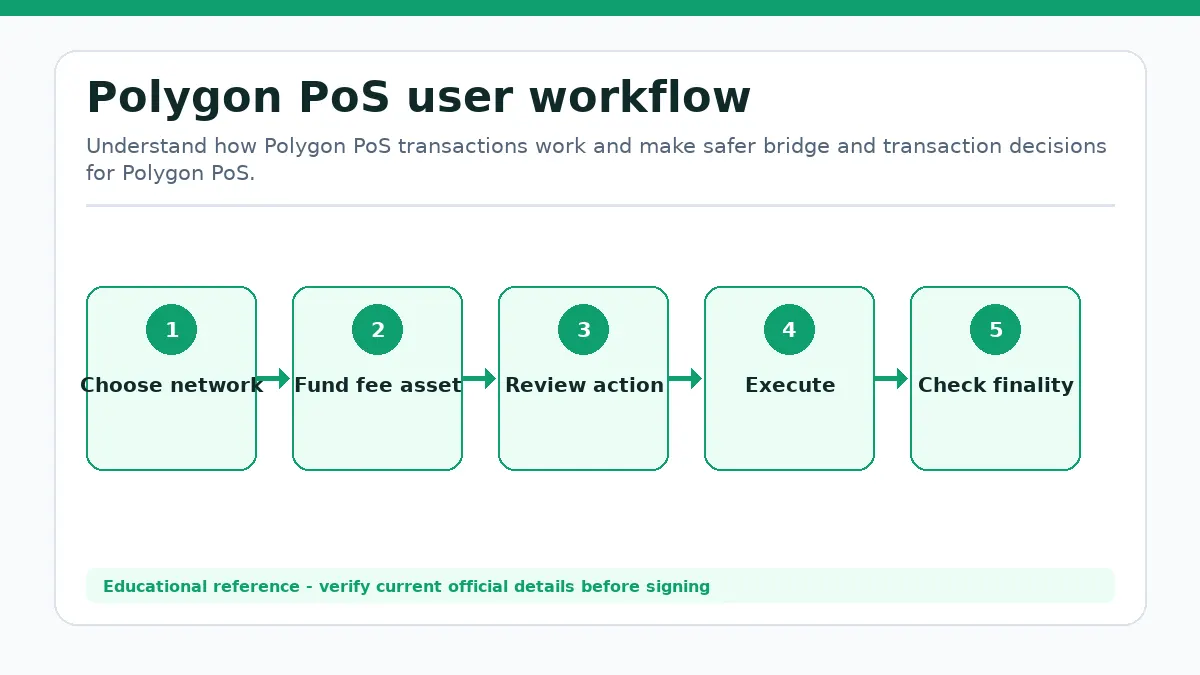
For Polygon PoS, the practical sequence is Choose network, Fund fee asset, Review action, Execute, Check finality. Confirm the official destination and current network, then inspect the final balance, position, receipt or documented exit state that actually completes the task: Understand how Polygon PoS transactions work and make safer bridge and transaction decisions for Polygon PoS.
Polygon PoS is an EVM-compatible proof-of-stake sidechain for Ethereum.
Native POL pays transaction execution fees.
Heimdall-v2 summarizes accepted Polygon block ranges and submits checkpoint commitments to Ethereum.
No. Withdrawal completion depends on checkpoints, proof processing and Ethereum confirmations.
The snapshot is CoinGecko aggregated USD data. The chart is Binance Spot POL/USDT data. Providers, venue coverage and quote currencies differ.
Selected primary sources support the operational explanations. Market-provider attribution remains separate.
Verified technical content, reviewed sources and update history.