Plasma (XPL): Zero-Fee USDT Depends on the Supported Payment Route
Plasma is a payments-focused Layer 1 blockchain designed around stablecoins and EVM applications. XPL is its native network asset; USDT is a separately issued stablecoin used by payment applications and supported transfer routes. This page focuses on zero-Fee USDT Depends on the Supported Payment Route and the checks users need before sending funds, paying fees or using the network.
Use Plasma for stablecoin payments while understanding XPL gas, route-specific fee abstraction, finality and custody boundaries.
Subject:
Plasma
Market mode:
Snapshot Only
Fee asset:
XPL
Timezone:
UTC
This page does not send stablecoins, promise a zero-fee route, operate a validator, bridge assets, assess issuer reserves, provide a bank account or guarantee payment-product eligibility.
Content ownership: BitcoinToolkit Editorial TeamTechnical references: Official protocol and developer documentation.Review approach: Technical explanations are checked against primary sources and updated when the network or asset changes.Last content review: Data integration last tested:
Zero-Fee USDT Depends on the Supported Payment Route
A product can sponsor or abstract network fees without eliminating every cost around the transfer.
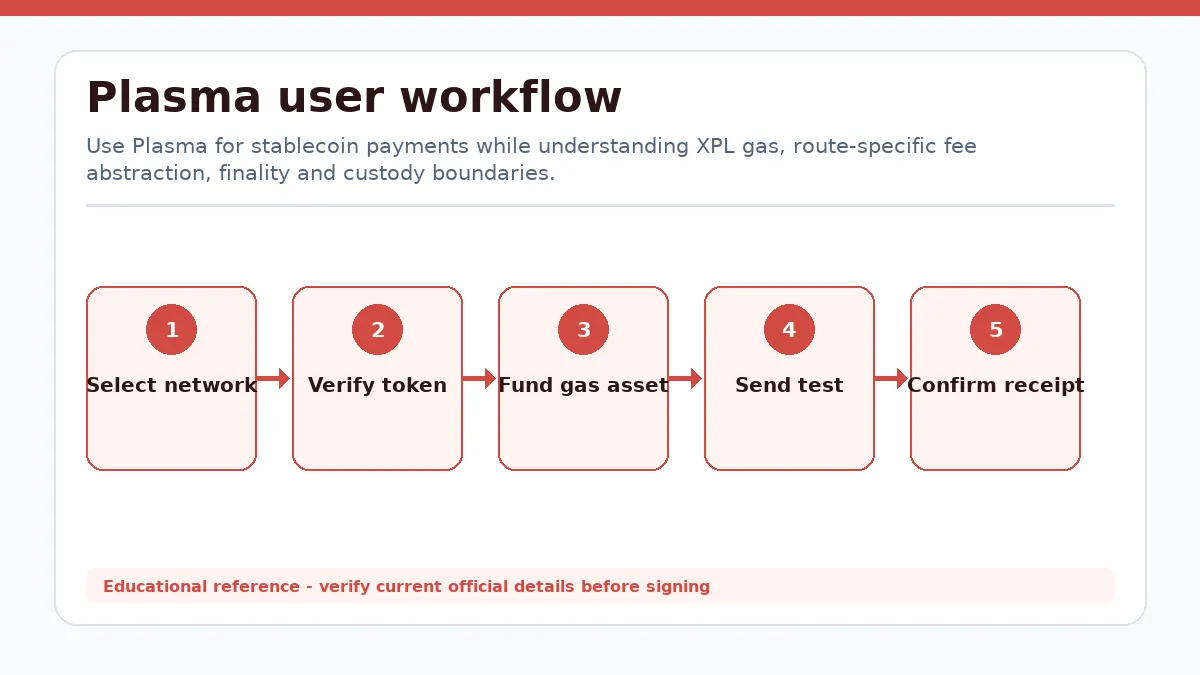
Plasma workflow from the first user decision to a verified outcome.
Base gas, sponsorship and third-party fees
Standard Plasma execution uses the network fee mechanism associated with XPL. Plasma is developing and operating payment-specific gas abstraction so eligible USDT routes can avoid requiring the end user to hold XPL. A paymaster, account system or product can sponsor the network cost or recover it under its own rules rather than changing the USDT token into the native gas asset.
Confirm the exact wallet, application and route before expecting a sponsored transfer. Bridge, exchange, card, fiat-rail, spread and third-party service charges can still apply. Keep a small XPL balance when using ordinary EVM applications or when sponsorship is unavailable. Read the final confirmation amount instead of assuming every transaction containing USDT is free.
Why Plasma's Design Matters
The network and the stablecoins moving through it remain separate systems.
Payments focus with EVM execution
Plasma provides its own consensus, block history and native XPL balance while exposing an EVM-compatible execution environment built on Reth. Developers can use familiar Solidity contracts, wallets and tooling. The network prioritizes stablecoin payment flows, liquidity and account infrastructure, but it can still execute general smart-contract activity subject to the deployed application.
USDT on Plasma remains a token whose issuance and redemption depend on its issuer and supported representation. XPL is the network-native asset used by the chain. Holding XPL does not create a dollar claim, and holding USDT does not make the user a Plasma validator. Verify chain ID, token contract, issuer support and application before treating a displayed balance as transferable value.
PlasmaBFT Finality Is Separate From Application Settlement
Fast chain finality does not complete every bridge, exchange or payment-provider process.
Consensus, execution and service credit
PlasmaBFT is documented as a pipelined Fast HotStuff implementation that overlaps proposal, voting and commit work. It provides deterministic blockchain finality, typically within seconds, while the Reth-based EVM layer executes account and contract state changes. XPL is documented as the asset for validator incentives and the future delegated-stake system.
A finalized Plasma transaction proves the network state transition, not an offchain merchant delivery, exchange account credit or bridge destination settlement. Confirm contract status, token event and service record independently. Current tokenomics state that inflation begins only when external validators and stake delegation are activated, so do not calculate rewards from a future schedule before the relevant system is live.
Payment users, developers and prospective network participants require different evidence.
Payment, contract and validator checklist
Payment users should verify the USDT contract, recipient, sponsor status and any product fee. Developers should confirm chain ID, RPC, XPL funding, paymaster behavior and failure handling. Bridge users should track source, message and destination records. Prospective validators or delegators should verify that the external program is active and read the current stake, reward and penalty rules.
Send a small test through a new custody route and preserve both the transaction hash and provider reference. Avoid unsolicited XPL or USDT copies, fake zero-fee interfaces and direct transfers to bridge contracts. Use wallet tools for address and approval checks, developer tools for EVM integration and the Tether page for issuer and redemption boundaries.
Plasma combines PlasmaBFT consensus with a Reth-based EVM execution layer. Standard transactions use the network fee system, while supported payment infrastructure can sponsor or abstract fees for eligible stablecoin transfers.
A XPL ticker match can still point to the wrong network, contract or bridged representation. XPL is the network asset shown in the market snapshot. XPL pays standard Plasma execution fees; eligible payment routes can sponsor or abstract fees under separate rules.
What Plasma users should verify and why this design differs
Fee sponsorship and validator rollout can change. Stablecoin issuer and payment-provider risks remain.
For Plasma, the practical sequence is Select network, Verify token, Fund gas asset, Send test, Confirm receipt. Confirm the official destination and current network, then inspect the final balance, position, receipt or documented exit state that actually completes the task: Use Plasma for stablecoin payments while understanding XPL gas, route-specific fee abstraction, finality and custody boundaries.
Plasma Transfers FAQ
Does every Plasma USDT transfer cost zero?
No. Zero-fee behavior depends on the supported route and third-party charges can remain.
What pays ordinary Plasma gas?
XPL is the native asset for standard network execution.
Does fast network finality guarantee an exchange credit?
No. Custody services have separate processing states.
Known Limitations
Fee sponsorship and validator rollout can change.
Stablecoin issuer and payment-provider risks remain.
The page does not inspect a transfer, paymaster or bridge message.
Market Data Methodology
The page uses a CoinGecko aggregated XPL/USD snapshot. No exchange chart is rendered for this entity.
Market Snapshot Source
CoinGecko aggregated market data (XPL/USD)
Cache
Snapshot cache is approximately 60 seconds.
Failure Handling
Verified cached data is labeled Cached or Delayed. Missing values remain unavailable.