Skip to content
BitcoinToolkit

Morpho (MORPHO): What MORPHO Governance Can Change

Morpho is permissionless lending infrastructure with isolated markets and curated vault products on supported EVM networks. MORPHO is its governance token, not the asset supplied to every market and not the gas currency of the host chain. This page focuses on what MORPHO Governance Can Change and the checks users need before using the protocol or evaluating the token role.

Understand Morpho markets, Vault roles and MORPHO governance before supplying or borrowing.

Subject:
Morpho
Market mode:
Snapshot Only
Fee asset:
ETH
Timezone:
UTC

This page does not rank vaults, forecast APY, validate an oracle or recommend collateral.

Content ownership: BitcoinToolkit Editorial Team Technical references: Official protocol and developer documentation. Review approach: Technical explanations are checked against primary sources and updated when the network or asset changes. Last content review: Data integration last tested:

What MORPHO Governance Can Change

MORPHO is linked to protocol governance and ecosystem decisions; it is not the asset that every lending position supplies or borrows.

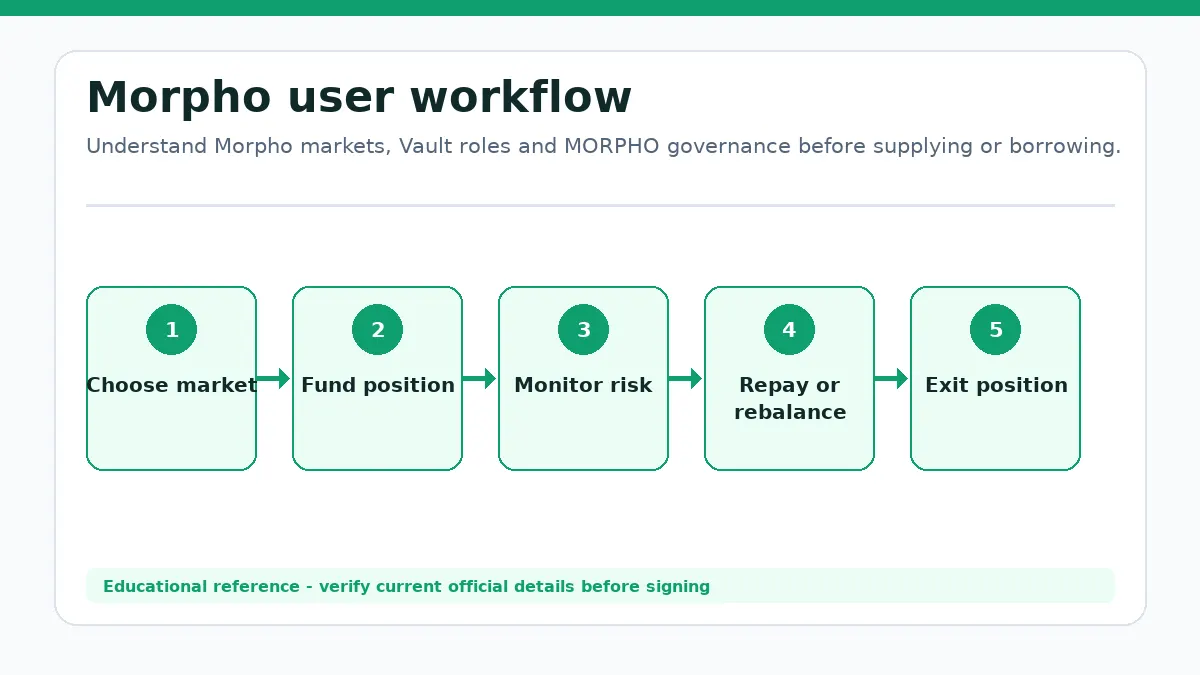
Morpho workflow showing Choose market, Fund position, Monitor risk, Repay or rebalance, Exit position
Morpho workflow from the first user decision to a verified outcome.

Token role boundaries

Holding MORPHO does not create a lending claim, pay every host-chain transaction fee, collateralize a loan automatically or guarantee vault performance. Users interact with the actual loan and collateral tokens selected by each market, while the network's native asset is generally needed for gas.

Governance influence should be evaluated separately from the economics of a specific lending position.

Risks that vary market by market

Material risks include oracle failure, collateral volatility, thin liquidity, bad debt, smart-contract defects, liquidation execution and unsuitable LLTV settings. Vault users add curator and allocation risk. A common mistake is comparing headline rates without checking whether the underlying markets or withdrawal conditions changed.

Morpho Transaction and Fee Checks

Morpho is a lending infrastructure protocol built around permissionless, isolated markets and curated vaults. The correct decision depends on the exact market configuration, not the Morpho name by itself.

Where Isolated Markets Fit

Morpho can suit users who want transparent market parameters, isolated collateral risk or vault-based lending allocation and who can evaluate the selected loan asset, collateral, oracle, interest-rate model and liquidation threshold. Developers and curators can use the infrastructure to construct markets or allocate deposits under explicit rules.

It may be a poor fit for users expecting protocol-wide risk management, a guaranteed lender of last resort or a single safety rating that applies to every market. Permissionless creation increases choice, but it also means two Morpho markets can have materially different risk.

The first decision is market selection

Never infer safety from the interface alone. Verify the market identifier, collateral and loan contracts, oracle, LLTV and available liquidity before supplying or borrowing.

Why Morpho Uses Isolated Lending Markets

Morpho separates lending decisions into immutable market configurations so risk can be evaluated and contained at a smaller boundary.

A different place for risk decisions

Traditional pooled lending protocols commonly rely on governance to list assets and set many shared parameters. Morpho markets are defined by a specific loan asset, collateral asset, oracle, interest-rate model and liquidation loan-to-value ratio. Once created, that configuration forms the market's operating boundary.

This design reduces dependence on continuous protocol governance for individual market settings, but it does not remove judgment. Market creators choose components, lenders choose exposure, borrowers choose collateral, and vault curators choose allocations.

Why vaults exist beside direct markets

Vaults can allocate supplied assets across selected markets according to a curator's mandate. They simplify the lender workflow while introducing curator, allocation and withdrawal-liquidity considerations that direct market users evaluate themselves.
How Lenders and Borrowers Use Morpho

The protocol offers two related workflows: direct interaction with an isolated market and deposit through a curated vault.

Direct market workflow

A borrower identifies the loan and collateral assets, checks the oracle and LLTV, supplies collateral, borrows within the limit and monitors the position as prices and interest change. A lender supplies the loan asset and depends on borrower demand, market liquidity and correct component behavior.

Repayment reduces debt before collateral is withdrawn. If collateral value breaches the liquidation boundary, a liquidator can close eligible debt according to the market rules.

Vault workflow

A vault depositor reviews the curator, allocation policy, fee structure, caps and withdrawal liquidity before depositing. The vault abstracts market selection, but the underlying markets remain the source of credit and oracle risk.

Morpho Operating Context

Both protocols support onchain lending, but their market structure changes what users must verify.

What Morpho users should verify and why this design differs

Morpho emphasizes isolated, immutable market configurations and optional vault curation. Aave organizes assets within governed deployments and uses protocol-level risk parameters and features. Morpho can expose a narrower market boundary; Aave can offer deeper shared liquidity and a more standardized interface, depending on network and asset.

The useful comparison covers oracle design, collateral isolation, liquidity, governance, liquidation settings and who is responsible for allocation. Rates alone do not describe those differences.

Morpho Position management FAQ

What pays transaction fees when using Morpho?

Host-network gas asset (ETH) pays the applicable network fee. ETH pays gas on Ethereum and Base deployments. Verify the selected network before signing because a later approval, bridge, claim or exit can require another transaction.

What should I verify before a Morpho transaction?

Check the official destination, current network, asset representation, amount, recipient and requested permissions. A Morpho market fixes one collateral asset, one loan asset, an LLTV, oracle and interest-rate model at creation. Vaults pool one loan asset and allocate it across selected markets under curator, allocator, guardian and cap rules. After confirmation, inspect the resulting balance or protocol state instead of relying only on a wallet success message.

Can a successful Morpho transaction still leave a position unsafe?

Yes. Execution success does not measure collateral, debt, utilization, liquidity or liquidation exposure after the state change.

Known Limitations

Market Data Methodology

The page uses a CoinGecko aggregated MORPHO/USD snapshot. No exchange chart is rendered for this entity.

Market Snapshot Source
CoinGecko aggregated market data (MORPHO/USD)
Cache
Snapshot cache is approximately 60 seconds.
Failure Handling
Verified cached data is labeled Cached or Delayed. Missing values remain unavailable.
Snapshot Status
Fresh
Report Issue
Report a market-data problem →

Technical Sources

Selected primary sources support the operational explanations. Market-provider attribution remains separate.

Editorial Information

Verified technical content, reviewed sources and update history.

Published
Last Review
Data Verification
Sources
Official documentation