Skip to content
BitcoinToolkit

MANTRA (MANTRA): OM Became MANTRA in a Completed 2026 Transition

MANTRA Chain is a Layer 1 for real-world-asset applications, built with Cosmos SDK modules and EVM compatibility. MANTRA is the current native asset; it replaced the OM ticker after a 2026 non-dilutive split. This page focuses on oM Became MANTRA in a Completed 2026 Transition and the checks users need before using the protocol or evaluating the token role.

Use current MANTRA Chain after the OM transition without sending funds to a deprecated representation.

Subject:
MANTRA
Market mode:
Snapshot Only
Fee asset:
MANTRA
Timezone:
UTC

This page does not migrate deprecated ERC-20 OM, verify an RWA claim, perform identity checks, select a validator or promise application access.

Content ownership: BitcoinToolkit Editorial Team Technical references: Official protocol and developer documentation. Review approach: Technical explanations are checked against primary sources and updated when the network or asset changes. Last content review: Data integration last tested:

OM Became MANTRA in a Completed 2026 Transition

The current ticker and denomination changed after legacy representations were deprecated.

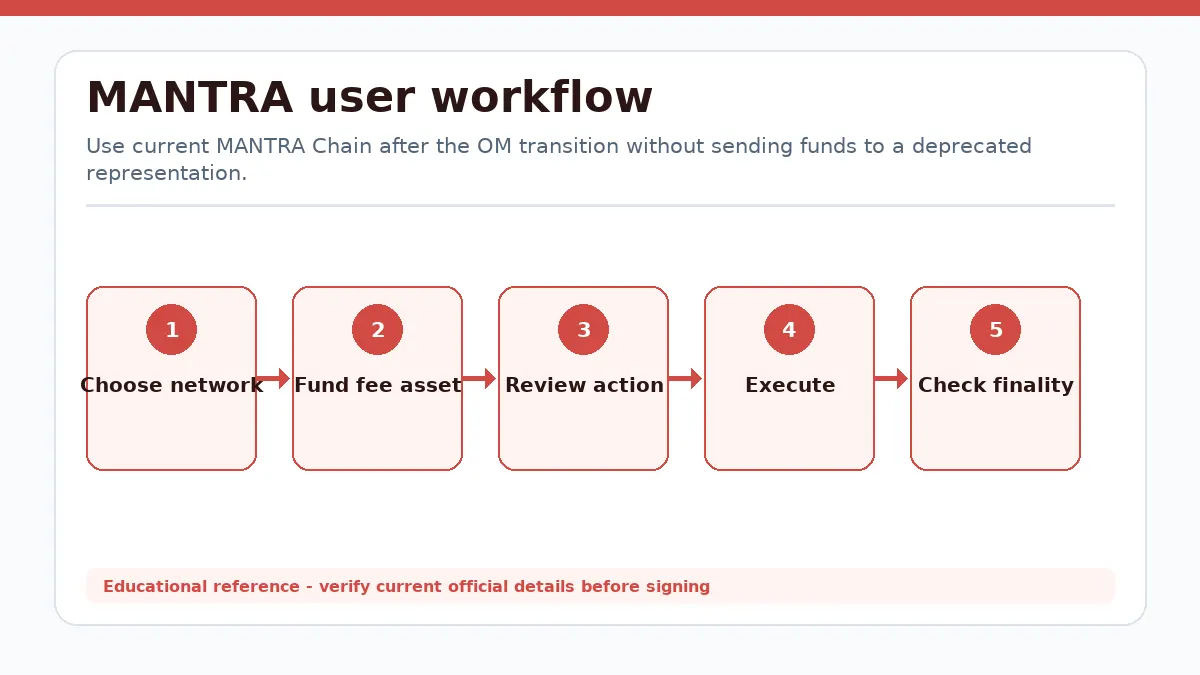
MANTRA workflow showing Choose network, Fund fee asset, Review action, Execute, Check finality
MANTRA workflow from the first user decision to a verified outcome.

Migration cutoff, split and ticker

MANTRA Chain launched with OM as its native staking coin. The migration window for legacy ERC-20 OM ended on January 15, 2026. At block 13,000,000 on March 2, 2026, native OM underwent a non-dilutive one-to-four split and the ticker changed to MANTRA. Existing native balances were adjusted automatically at the chain upgrade.

Current users should verify a MANTRA Chain balance and current denomination. An old ERC-20 OM balance, an archived bridge page or a pre-split amount is not interchangeable with current native MANTRA. Do not use unofficial recovery offers: the documented EVM migration window is closed, and exchange support must be confirmed with that exchange.
MANTRA Chain Supports Cosmos and EVM Workflows

Address format and transaction method depend on the module and interface in use.

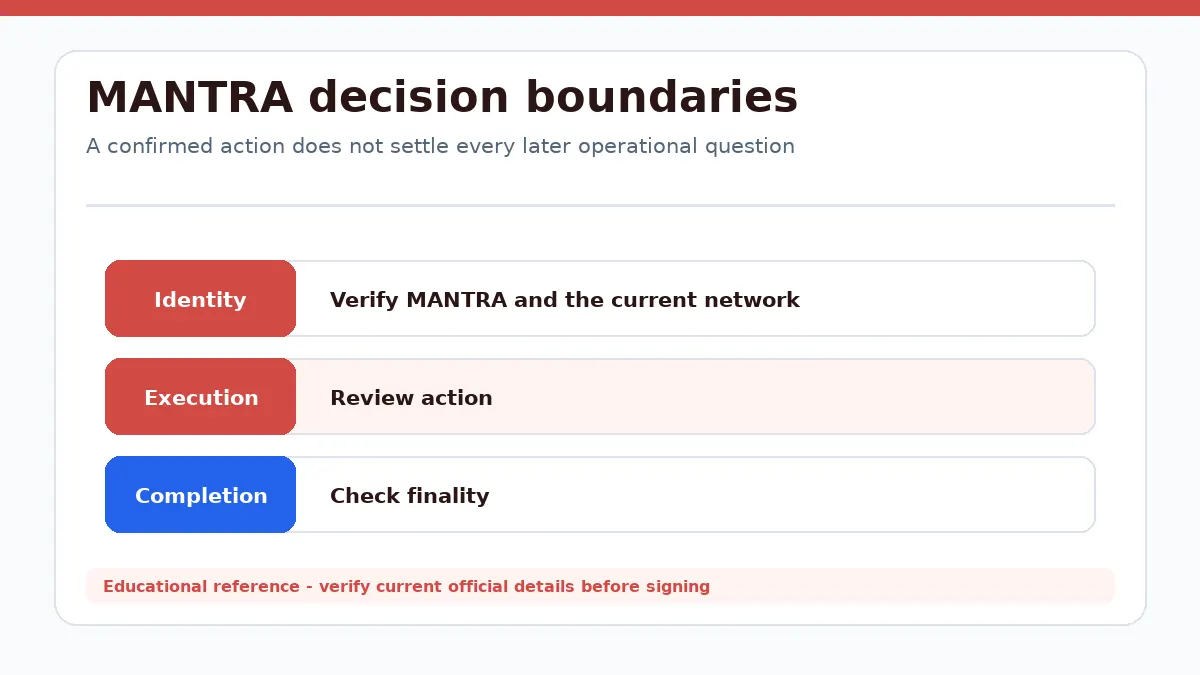
MANTRA decision diagram separating identity, execution and completion checks
MANTRA confirmation does not settle every later operational question.

Native modules and Solidity contracts

MANTRA Chain combines Cosmos SDK modules, IBC interoperability and an EVM module for Solidity contracts. Wallets can expose a Cosmos-style account, an EVM address or both through an interface mapping. Native staking, governance and IBC operations can use different messages from an EVM contract call even though they settle on one validator network.

Confirm the chain ID, address format, receiving service and transaction type before sending. An exchange may support only one deposit format. MANTRA pays fees, but a contract can also require token approvals or application permissions. Preserve both transaction hash and the address representation shown by the receiving service.

Network Permissionlessness and RWA Access Are Separate

A public chain can host applications with regulated participation rules.

Validators, contracts and application controls

Delegated proof-of-stake validators order and finalize MANTRA Chain blocks. Applications that issue or trade real-world assets can add identity, jurisdiction, transfer or issuer controls in their contracts and operating agreements. EVM compatibility does not remove those product rules, and a token record alone does not prove a legal claim to an offchain asset.

For staking, review validator commission, uptime, unbonding and slashing conditions. For an RWA application, separately verify issuer, asset rights, custody, redemption, transfer restrictions and documentation. A network explorer can confirm a transaction and contract state but cannot independently confirm the legal enforceability or current valuation of an offchain asset.

MANTRA Risks Before Completion

Start from current asset identity and the intended module.

What MANTRA users should verify and why this design differs

For a transfer, verify current MANTRA denomination, address format and exchange support. For staking, inspect validator and exit rules. For EVM use, verify chain ID, contract and allowance. For an RWA product, read issuer and redemption terms in addition to checking the onchain token.

Do not copy an OM contract from a pre-2026 guide, assume every EVM wallet displays native staking or confuse an application permission with validator consensus. Keep MANTRA for fees, preserve migration-era statements for accounting and use current official documentation when converting old balances or labels in portfolio records.

MANTRA Network use FAQ

What pays transaction fees when using MANTRA?

MANTRA (MANTRA) pays the applicable network fee. MANTRA pays native and EVM transaction fees on MANTRA Chain. Verify the selected network before signing because a later approval, bridge, claim or exit can require another transaction.

Does holding MANTRA make every MANTRA application transaction-ready?

No. MANTRA is the current market asset shown in the snapshot. The wallet still needs the correct network, fee asset, contract or program, and any application-specific token or permission.

Known Limitations

Market Data Methodology

The page uses a CoinGecko aggregated MANTRA/USD snapshot. No exchange chart is rendered for this entity.

Market Snapshot Source
CoinGecko aggregated market data (MANTRA/USD)
Cache
Snapshot cache is approximately 60 seconds.
Failure Handling
Verified cached data is labeled Cached or Delayed. Missing values remain unavailable.
Snapshot Status
Delayed
Report Issue
Report a market-data problem →

Technical Sources

Selected primary sources support the operational explanations. Market-provider attribution remains separate.

Editorial Information

Verified technical content, reviewed sources and update history.

Published
Last Review
Data Verification
Sources
Official documentation