Kaia is an EVM-compatible Layer 1 blockchain formed from the Klaytn and Finschia integration. KAIA is its protocol-native asset and pays transaction fees on Kaia. This page focuses on kaia Gas and Fees and the checks users need before using the current asset or handling a legacy representation.
Help users understand Kaia token migration and make safer usage and transaction decisions for Kaia.
Snapshot:
CoinGecko - USD
Chart:
Binance Spot - KAIA/USDT
Timezone:
UTC
Use this page as an educational network and market reference. It is not an executable exchange quote, bridge interface, price forecast or trading recommendation.
Content ownership: BitcoinToolkit Editorial TeamTechnical references: Official Kaia protocol, transition and developer documentation.Review approach: Technical explanations are checked against primary Kaia sources.Last content review: Data integration last tested:
Kaia Fee Checks Before You Sign
BitcoinToolkit separates CoinGecko aggregated KAIA/USD data from the Binance Spot KAIA/USDT market and explains KAIA units, gas, fee delegation, transaction execution, contracts and BFT finality.
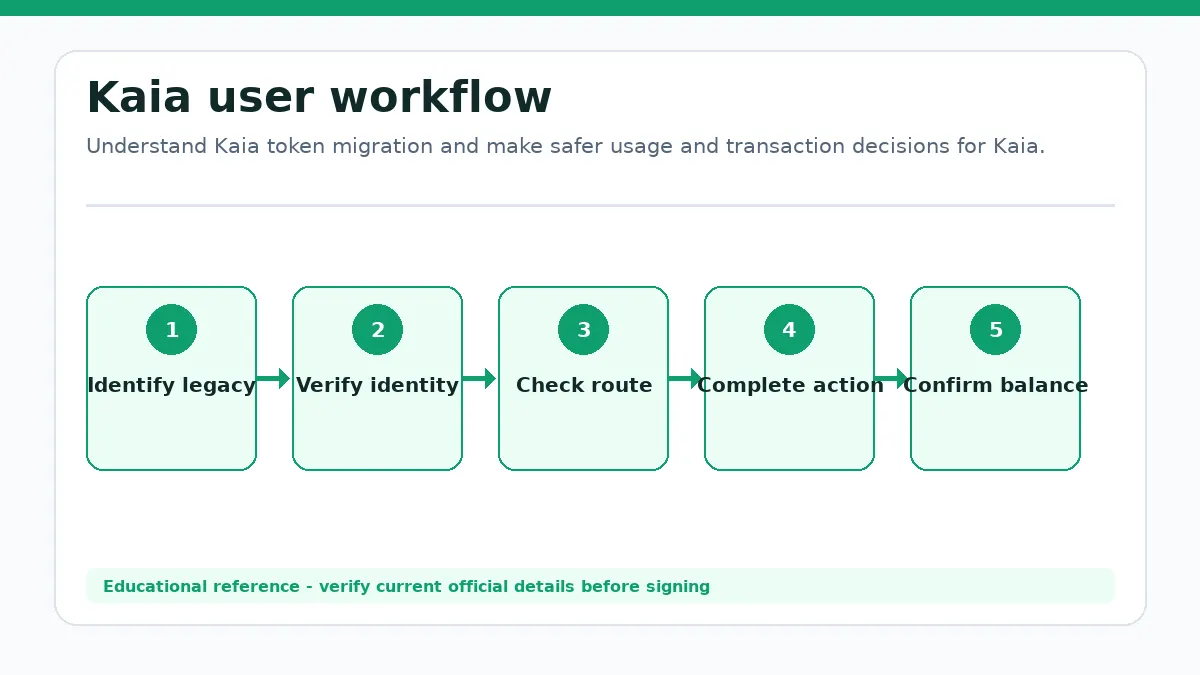
Kaia workflow from the first user decision to a verified outcome.
What the Kaia user is confirming
KAIA is its protocol-native asset and pays transaction fees on Kaia.
Kaia uses account-based execution and an optimized Istanbul BFT consensus process in which selected consensus nodes validate each block and provide immediate finality after agreement.
KAIA and transaction costs
Kaia (KAIA) is the asset profiled on this page. KAIA is the market asset displayed in the page snapshot and exchange chart.
Kaia (KAIA) pays the applicable transaction cost. KAIA pays transaction execution fees on Kaia, including fees for EVM-compatible transactions.
Kaia Candlestick Chart
KAIA/USDT · Binance Spot · UTC
Historical Only
Pair
KAIA/USDT
Venue
Binance Spot
Market Type
Spot
Interval
1H
Timezone
UTC
Last Update
Aug 25, 2026 11:40:35 UTC
Interval
Range
Long ranges automatically use a compatible candle interval.
Wallets display KAIA, gas prices are commonly expressed in Gkei, and raw transaction values use integer kei.
Kaia Gas and Fees
Kaia meters computation in gas and charges the resulting execution fee in native KAIA, with support for network-defined base and priority fee fields.
Fee asset
KAIA
Gas
Gas measures computation and storage work requested by a transaction.
Gas limit
The gas limit caps the work a transaction may consume.
Gas used
Gas used records the work consumed by execution.
Base fee
The network sets a base fee per gas that adjusts with block usage.
Priority fee
A priority fee can be supplied by compatible transaction types.
Execution cost
The transaction fee equals gas used multiplied by the effective gas price and is paid in KAIA.
Kaia Transactions
A Kaia transaction is created, authorized, validated, propagated, executed, included in a block and finalized by BFT consensus.
Transaction creationThe sender selects a Kaia or Ethereum-compatible transaction type and sets value, data, nonce and gas fields.
SigningThe sender signs with the account key; fee-delegated types can also require a fee-payer signature.
Nonce validationNodes validate the account key, nonce, balance and transaction rules.
BroadcastThe signed transaction is submitted to a Kaia RPC endpoint.
Node propagationValid transactions propagate to consensus nodes and enter transaction pools.
ExecutionA consensus node executes the transaction against account state and meters gas.
Receipt generationExecution produces a receipt containing status, gas usage and logs.
Block inclusionA selected proposer includes the transaction in a candidate block.
Finality stateCommittee agreement under optimized Istanbul BFT commits the block with immediate finality.
Kaia Smart Contracts
Kaia executes EVM-compatible smart contracts while also supporting Kaia-specific transaction and account features.
Contract accounts
Contract accounts contain deployed bytecode and have no private signing key.
Bytecode execution
Compiled EVM-compatible bytecode executes in the Kaia Virtual Machine.
Storage
Contracts read and update persistent storage after successful execution.
Contract calls
Calls can transfer native KAIA and pass encoded input to contract functions.
Token contracts
Token contracts maintain balances and allowances independently from native KAIA.
Native asset and token roles
Native KAIA pays protocol gas; contract-token balances cannot automatically replace KAIA as the fee asset.
Kaia Consensus and Finality
Kaia uses an optimized Istanbul BFT process to validate each proposed block and provide immediate finality after committee agreement.
Consensus model
Kaia uses an optimized Istanbul BFT mechanism with a governance-selected council and a committee selected for each block.
Validator model
Consensus nodes operated by council members propose, validate and vote on blocks according to the active committee rules.
Block proposal
A selected consensus node proposes a block for the committee to validate and vote on.
Finality model
When the required committee agreement is reached, the block is committed with immediate BFT finality rather than probabilistic confirmation depth.
Application limitation
Applications should verify the node-reported block and receipt state and handle RPC delays instead of treating a broadcast transaction as finalized.
Where Kaia Differs for Users
Use this page as an educational network and market reference.
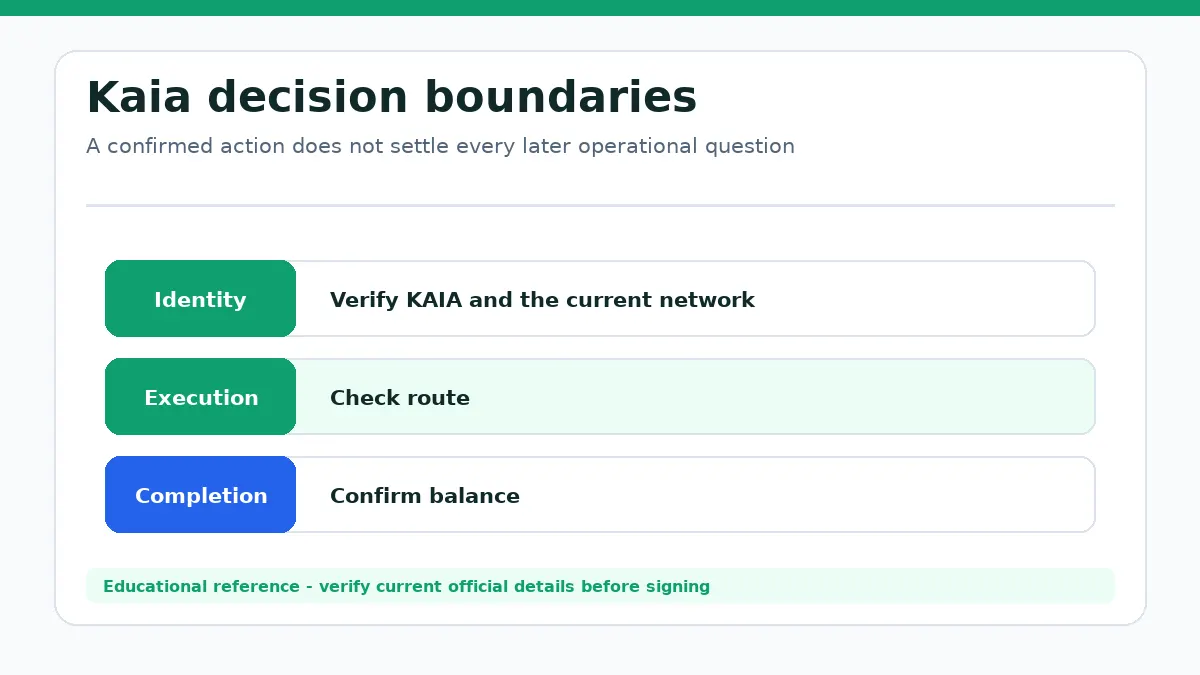
Kaia confirmation does not settle every later operational question.
Before the next transaction
Identify legacy asset for the current Kaia route.
Verify current identity for the current Kaia route.
Check route for the current Kaia route.
Complete action for the current Kaia route.
Confirm balance for the current Kaia route.
The Next Kaia Step
A familiar KAIA ticker can refer to a legacy representation, a current asset or an unsupported migration route.
What Kaia users should verify and why this design differs
CoinGecko USD and Binance Spot KAIA/USDT are separate datasets. Wallet and application support for Kaia-specific transaction types can vary.
For Kaia, the practical sequence is Identify legacy asset, Verify current identity, Check route, Complete action, Confirm balance. Confirm the official destination and current network, then inspect the final balance, position, receipt or documented exit state that actually completes the task: Understand Kaia token migration and make safer usage and transaction decisions for Kaia.
Kaia Migration checks FAQ
Is KAIA the same asset as KLAY?
Official transition documentation describes KAIA as the renamed successor of KLAY after the Kaia integration.
How are Kaia gas fees paid?
Gas fees are calculated from gas used and the effective gas price, then paid in native KAIA.
What are kei and Gkei?
Kei is the smallest KAIA unit and Gkei equals one billion kei.
How does Kaia finality work?
A selected committee of consensus nodes validates and agrees on each block through optimized Istanbul BFT, providing immediate finality after consensus.
What pays transaction fees when using Kaia?
Kaia (KAIA) pays the applicable network fee. Verify the selected network before signing because a later approval, bridge, claim or exit can require another transaction.
Known Limitations
CoinGecko USD and Binance Spot KAIA/USDT are separate datasets.
Applications should use current Kaia node documentation for fee and RPC policies.
Market Data Methodology
The snapshot is CoinGecko aggregated USD data. The chart is Binance Spot KAIA/USDT data. Provider coverage and quote currencies differ, so displayed values can differ.
Market Snapshot Source
CoinGecko aggregated market data (USD)
Candlestick Source
Binance Spot market data
Pair
KAIA/USDT
Venue
Binance Spot
Market Type
Spot
Timezone
UTC
Cache
Snapshot cache is approximately 60 seconds; historical candle cache varies by interval.
Failure Handling
Verified cache is labeled Cached or Delayed. Missing values remain unavailable.