Skip to content
BitcoinToolkit

Jito (JTO): JTO and JitoSOL Represent Different Rights

Jito coordinates Solana liquid staking and MEV infrastructure. JTO is the governance token, while JitoSOL is the liquid token representing a share of staked SOL. This page focuses on jTO and JitoSOL Represent Different Rights and the checks users need before using the protocol or evaluating the token role.

Use JitoSOL or JTO while understanding staking rewards, MEV, liquidity and governance as separate roles.

Subject:
Jito
Market mode:
Snapshot Only
Fee asset:
SOL
Timezone:
UTC

This page does not calculate a live yield, unstake JitoSOL, select a validator, value a DeFi position or guarantee an MEV reward.

Content ownership: BitcoinToolkit Editorial Team Technical references: Official protocol and developer documentation. Review approach: Technical explanations are checked against primary sources and updated when the network or asset changes. Last content review: Data integration last tested:

JTO and JitoSOL Represent Different Rights

One asset governs the protocol and the other tracks a stake-pool share.

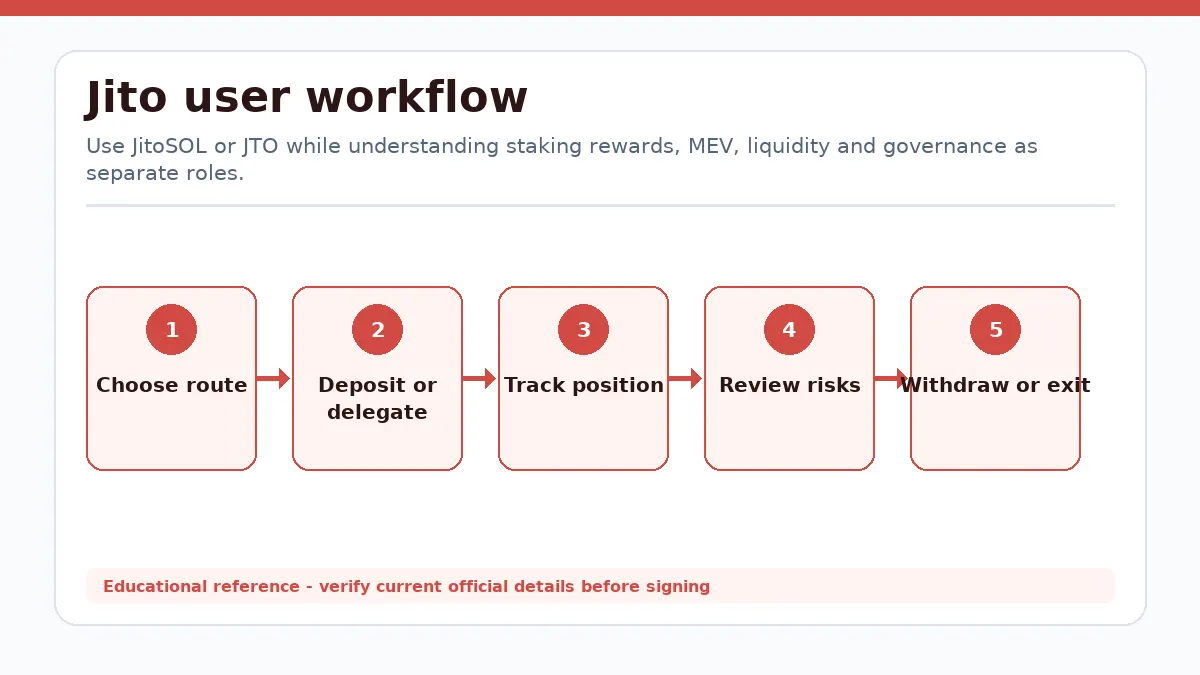
Jito workflow showing Choose route, Deposit or delegate, Track position, Review risks, Withdraw or exit
Jito workflow from the first user decision to a verified outcome.

Governance token and staking receipt

JTO is used in Jito governance for proposals, treasury and protocol parameters. JitoSOL is an SPL liquid-staking token minted when supported SOL or stake accounts enter the Jito stake pool. Its balance represents a proportional claim on pool assets rather than one SOL held separately for each token.

SOL pays transaction and priority fees for both assets. Holding JTO does not create staking rewards from the JitoSOL pool, and holding JitoSOL does not automatically grant JTO voting power. Verify the mint address before receiving either token because copied names and symbols are not reliable identifiers on Solana.
JitoSOL Rewards Accumulate Through Its Exchange Rate

The wallet token count can stay constant while its SOL value changes.

Staking and MEV components

The stake pool delegates SOL to selected validators. Solana staking rewards and distributed MEV or priority-fee rewards increase total pool lamports after applicable commissions. Because JitoSOL supply represents shares, the amount of SOL redeemable per JitoSOL can rise instead of rewards arriving as a separate token transfer.

Compare the current exchange rate, pool fees and validator allocation rather than reading wallet balance growth. Reward dashboards can be estimates and may not track JitoSOL deposited into DeFi. MEV varies by network activity, validator participation and auction outcomes, so historical annualized rates are not promised future returns.

Direct Unstaking and Selling JitoSOL Have Different Costs

One path uses stake-pool redemption and another uses market liquidity.

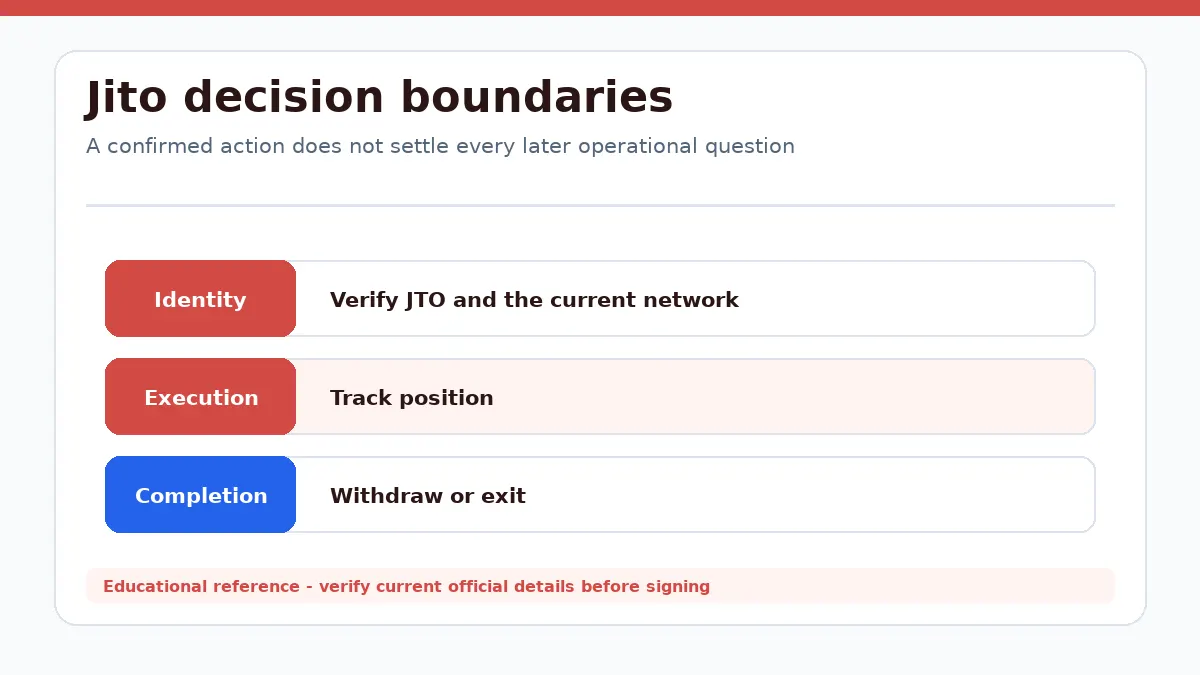
Jito decision diagram separating identity, execution and completion checks
Jito confirmation does not settle every later operational question.

Protocol exit versus DEX trade

Check which path the interface proposes, minimum received, Solana fees and whether a stake account is created. JitoSOL used as collateral or liquidity adds liquidation, smart-contract and impermanent-loss risk; those positions must be unwound before the underlying token can be redeemed normally.

Choose the Next Jito Check

Start from governance, staking or DeFi use.

A role-specific checklist

For staking, verify the JitoSOL mint, current exchange rate and pool terms. For an exit, compare direct redemption with DEX output. For DeFi, review the protocol that holds JitoSOL. For JTO governance, inspect the proposal and voting account rather than assuming token ownership alone casts a vote.

Do not harvest stake-account MEV through an unrelated site, confuse JTO with JitoSOL or expect an unstaking queue to match a market swap. Keep SOL available and use official Jito and Solana records for every transaction.

Browse staking tools

Jito Staking and yield FAQ

What pays transaction fees when using Jito?

Solana (SOL) pays the applicable network fee. SOL pays Solana network and priority fees. Verify the selected network before signing because a later approval, bridge, claim or exit can require another transaction.

Can Jito rewards or withdrawal timing change after staking?

Yes. Reward rates, validator performance, slashing exposure, liquidity and exit queues can change while the position remains open.

Known Limitations

Market Data Methodology

The page uses a CoinGecko aggregated JTO/USD snapshot. No exchange chart is rendered for this entity.

Market Snapshot Source
CoinGecko aggregated market data (JTO/USD)
Cache
Snapshot cache is approximately 60 seconds.
Failure Handling
Verified cached data is labeled Cached or Delayed. Missing values remain unavailable.
Snapshot Status
Delayed
Report Issue
Report a market-data problem →

Technical Sources

Selected primary sources support the operational explanations. Market-provider attribution remains separate.

Editorial Information

Verified technical content, reviewed sources and update history.

Published
Last Review
Data Verification
Sources
Official documentation