io.net (IO): Compute Revenue, Rewards, IO Stake and SOL Gas Are Separate
io.net is a distributed compute marketplace that connects customers needing GPU or CPU capacity with independently operated workers. IO is a network asset; SOL remains the blockchain fee asset. This page focuses on compute Revenue, Rewards, IO Stake and SOL Gas Are Separate and the checks users need before integrating the service or using the token.
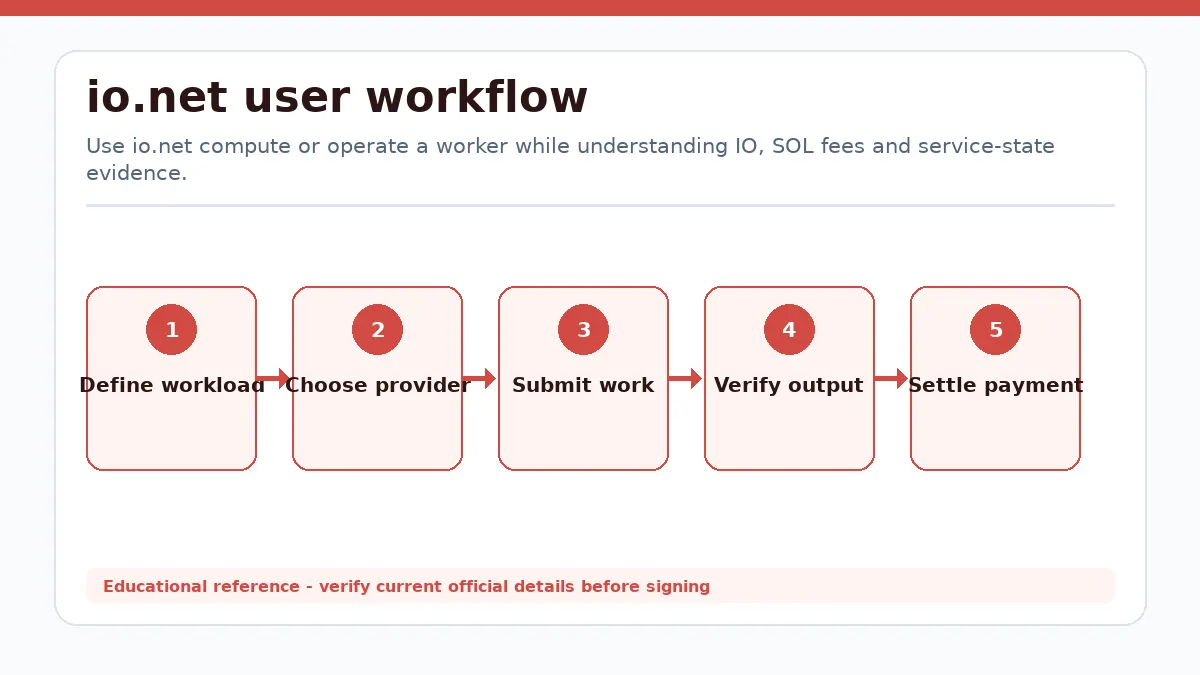
Use io.net compute or operate a worker while understanding IO, SOL fees and service-state evidence.
Subject:
io.net
Market mode:
Snapshot Only
Fee asset:
SOL
Timezone:
UTC
This page does not rent a GPU, validate hardware, estimate earnings, guarantee a job, install worker software or certify workload privacy.
Content ownership: BitcoinToolkit Editorial TeamTechnical references: Official protocol and developer documentation.Review approach: Technical explanations are checked against primary sources and updated when the network or asset changes.Last content review: Data integration last tested:
Compute Revenue, Rewards, IO Stake and SOL Gas Are Separate
Several balances can change during worker operation.
io.net workflow from the first user decision to a verified outcome.
Service and onchain roles
Customers pay for compute under current platform billing terms. Worker earnings depend on actual hires and service performance, while protocol reward programs can use eligibility scores, proofs and IO staking. IO is a Solana token used by the ecosystem; SOL is still required for Solana transactions and token-account operations.
Do not estimate revenue from a headline GPU rate without uptime, utilization, electricity, bandwidth, hardware wear, platform rules and payout timing. Do not send IO to a ticker-matched address on another chain or stake through an unverified interface. Reward formulas and requirements can change, so use current worker documentation at the time of action.
IO Cloud Assembles Distributed Compute Into Clusters
A customer reserves service capacity; buying IO is not the same action.
Select, deploy and monitor
A customer chooses processor type, quantity, location and deployment settings, then IO Cloud matches available workers and creates a managed cluster. The workload runs through platform networking and monitoring layers while the underlying devices remain independently supplied. Cluster state, service hours and billing belong to the compute platform rather than a token transfer alone.
Benchmark the exact framework, model, dataset and communication pattern before production. Verify image, storage, ports, credentials, egress, region and fault tolerance. Save cluster and worker identifiers so a support incident can be separated from a Solana payment, wallet or token-balance issue.
Worker Readiness Depends on Hardware and Continuous Checks
A connected device is not automatically hireable or reward-eligible.
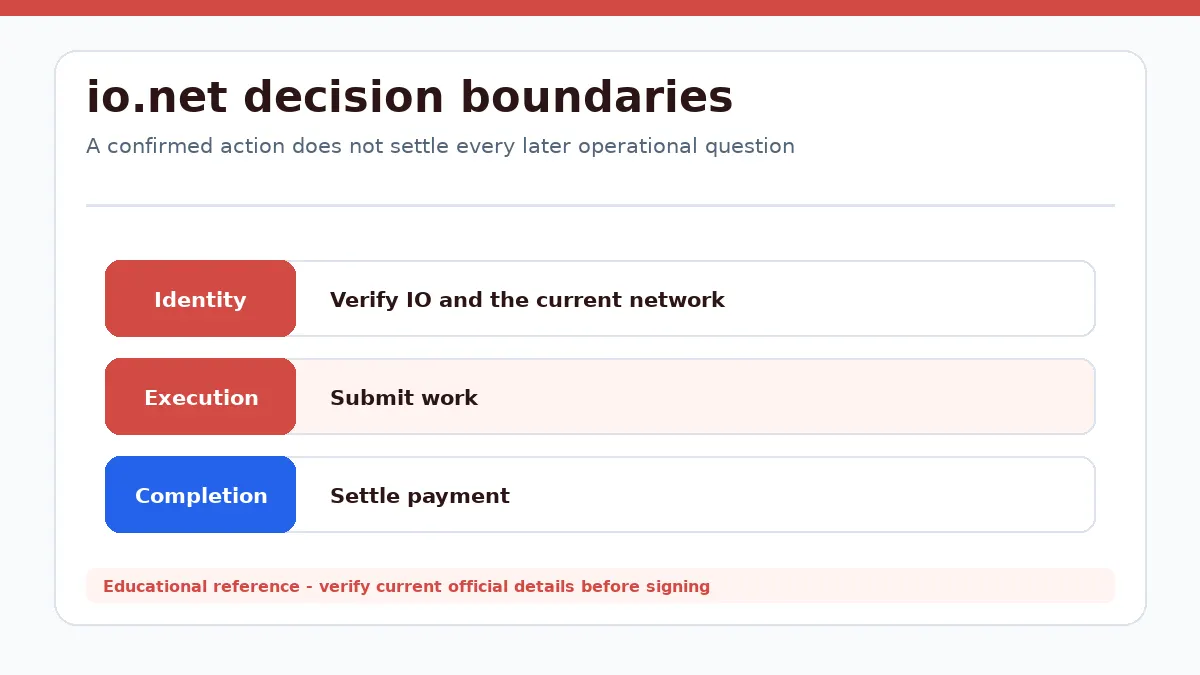
io.net confirmation does not settle every later operational question.
Onboard, verify and stay available
Use dedicated hardware and follow current driver and container requirements. A worker can be blocked when unauthorized utilization, mining, hardware switching or failed verification is detected. Monitor connectivity, IO software and Ray services instead of assuming an online dashboard tile proves every job will run correctly.
Start with the operational role you actually intend to take.
Customer or supplier
Customers should test workload compatibility, price, data movement, checkpointing and replacement behavior. Suppliers should verify hardware support, utilization thresholds, device identity, staking requirements and payout status. Token holders should verify the Solana mint and distinguish IO market exposure from compute service demand.
Keep logs and job identifiers outside the worker machine, secure API tokens and isolate customer workloads. Confirm the state shown by IO Explorer before troubleshooting rewards. Use Solana tools for token transfers and network fees, and developer tools for workload or API checks.
Solana (SOL) pays the applicable network fee. SOL pays Solana transaction fees. Verify the selected network before signing because a later approval, bridge, claim or exit can require another transaction.
How is work or data verified before io.net settlement?
Verification depends on the network's documented provider, proof, availability or result-checking process; a token transfer alone does not prove useful work.
Known Limitations
Hardware and reward requirements can change.
Platform status is not a service guarantee.
The page does not inspect a worker, cluster or payout.
Market Data Methodology
The page uses a CoinGecko aggregated IO/USD snapshot. No exchange chart is rendered for this entity.
Market Snapshot Source
CoinGecko aggregated market data (IO/USD)
Cache
Snapshot cache is approximately 60 seconds.
Failure Handling
Verified cached data is labeled Cached or Delayed. Missing values remain unavailable.