Skip to content
BitcoinToolkit

Immutable (IMX): Games Can Sponsor Gas Without Removing Network Fees

Immutable Chain is an Ethereum-linked, EVM-compatible network designed for games and digital ownership. IMX is its native gas asset and also exists as an ERC-20 token on Ethereum. This page focuses on games Can Sponsor Gas Without Removing Network Fees and the checks users need before using the protocol or evaluating the token role.

Use IMX and game assets on Immutable Chain without confusing native, wrapped and Ethereum token balances.

Subject:
Immutable
Market mode:
Snapshot Only
Fee asset:
IMX
Timezone:
UTC

This page does not bridge IMX, inspect an NFT, recover a Passport wallet, audit a game contract or guarantee a withdrawal time.

Content ownership: BitcoinToolkit Editorial Team Technical references: Official protocol and developer documentation. Review approach: Technical explanations are checked against primary sources and updated when the network or asset changes. Last content review: Data integration last tested:

Games Can Sponsor Gas Without Removing Network Fees

A player may see a zero-fee experience because an application pays on the player's behalf.

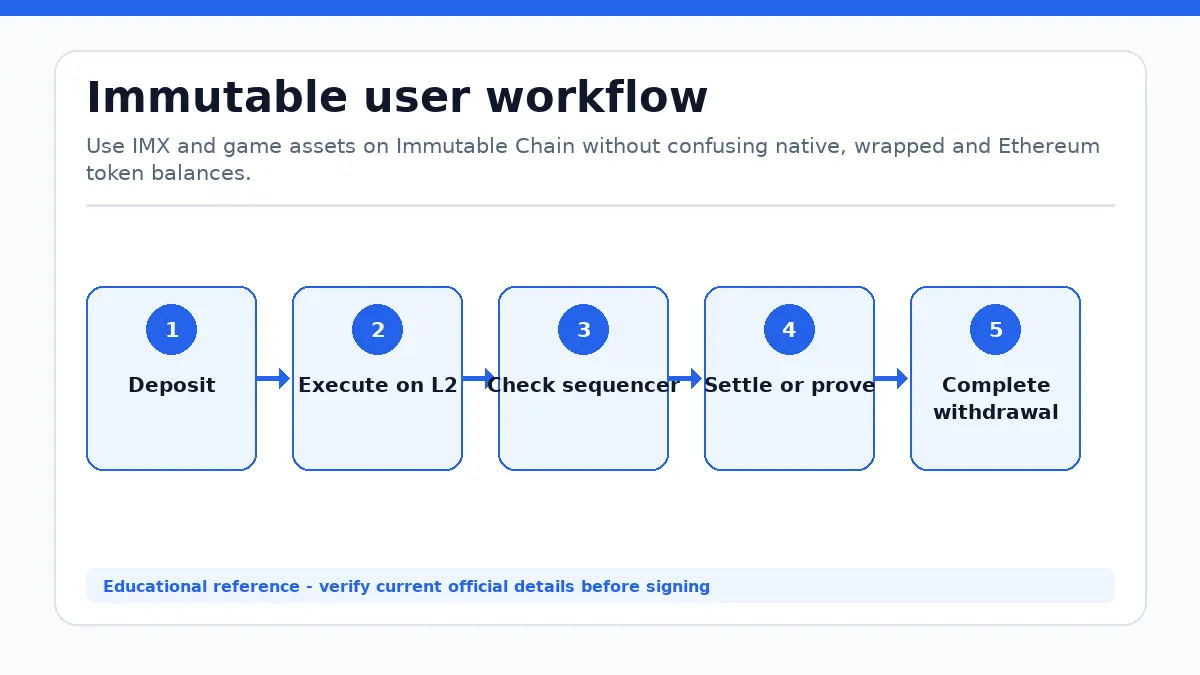
Immutable workflow showing Deposit, Execute on L2, Check sequencer state, Settle or prove, Complete withdrawal
Immutable workflow from the first user decision to a verified outcome.

Sponsored and user-paid transactions

Immutable Chain uses EVM transaction execution and EIP-1559-style fee fields. Native IMX is the fee currency. An application can sponsor eligible actions through its wallet and policy integration, so the player does not supply IMX for that transaction. Sponsorship is a product rule, not a protocol promise that every transaction is free.

Check the wallet preview for the signer, target contract and sponsor state. A direct transfer, unsupported game action or third-party contract may still require IMX. Failed contract execution can also consume gas. Gas sponsorship does not verify an NFT collection, guarantee game support or remove contract approval risk.

Immutable Transaction and Fee Checks

The ticker alone does not identify the network or token form.

Three balances to distinguish

On Immutable Chain, IMX is the native currency used for ordinary transaction gas and staking. On Ethereum, IMX is an ERC-20 contract token and ETH pays the transfer fee. Wrapped IMX, or wIMX, is an ERC-20 representation created from native IMX on Immutable Chain for applications that expect token-contract behavior.

Before transferring, confirm the selected network and whether the receiving application expects native IMX, wIMX or Ethereum IMX. A shared ticker and a familiar 0x address do not make the balances interchangeable. Keep the correct gas asset on the chain where the next transaction will occur.

The Canonical Bridge Changes the Asset Representation

A bridge movement is more than a same-chain transfer.

Deposit and withdrawal checks

Depositing ERC-20 IMX from Ethereum through the canonical bridge credits native IMX on Immutable Chain. Withdrawing native IMX or wIMX can deliver ERC-20 IMX on Ethereum after the required message and claim process. Other supported assets may retain token representations rather than becoming the native gas currency.

Confirm the direction, token contract, recipient and current bridge status before signing. Large or rate-limited withdrawals can take longer under documented safeguards. Budget for transactions on both sides and never send assets directly to a bridge contract unless the official workflow explicitly instructs it.

Choose the Next Immutable Check

Start with the network and wallet that will receive the asset.

Game, wallet or bridge task

For a game action, verify the official game contract and whether gas is sponsored. For a wallet transfer, select Immutable Chain and preserve native IMX for later fees. For an Ethereum withdrawal, review the canonical bridge steps, claim requirements and destination token contract before committing.

Do not treat Passport recovery, marketplace custody and bridge recovery as the same process. Use the game publisher for asset support, Immutable documentation for chain and bridge rules, and wallet tools for destination checks. Test a small amount when a destination has not already confirmed support.

Browse wallet tools

Where Immutable Differs for Users

The IMX result needs context

Transactions execute on Immutable Chain, while the canonical bridge connects assets with Ethereum. Games can sponsor gas, and Passport-based smart wallets can apply application-specific signing policies.

A Immutable transaction can be accepted on the execution layer before settlement or a parent-chain withdrawal is complete. IMX is the market asset shown in the snapshot. Native IMX pays Immutable Chain gas unless an application sponsors the fee.

What Immutable users should verify and why this design differs

Bridge limits and supported assets can change. Gas sponsorship depends on each application policy.

For Immutable, the practical sequence is Deposit, Execute on L2, Check sequencer state, Settle or prove, Complete withdrawal. Confirm the official destination and current network, then inspect the final balance, position, receipt or documented exit state that actually completes the task: Use IMX and game assets on Immutable Chain without confusing native, wrapped and Ethereum token balances.

Immutable Layer 2 use FAQ

What pays gas on Immutable Chain?

Native IMX pays gas unless an application sponsors the transaction.

Is Ethereum IMX the same balance as Immutable Chain IMX?

No. The canonical bridge converts between the Ethereum ERC-20 and native chain representations.

What is wIMX?

wIMX is an ERC-20 wrapper for native IMX on Immutable Chain.

Known Limitations

Market Data Methodology

The page uses a CoinGecko aggregated IMX/USD snapshot. No exchange chart is rendered for this entity.

Market Snapshot Source
CoinGecko aggregated market data (IMX/USD)
Cache
Snapshot cache is approximately 60 seconds.
Failure Handling
Verified cached data is labeled Cached or Delayed. Missing values remain unavailable.
Snapshot Status
Fresh
Report Issue
Report a market-data problem →

Technical Sources

Selected primary sources support the operational explanations. Market-provider attribution remains separate.

Editorial Information

Verified technical content, reviewed sources and update history.

Published
Last Review
Data Verification
Sources
Official documentation