HTX is the transferable governance and ecosystem token of HTX DAO. It is deployed on several host networks and is different from sHTX, the non-transferable accounting unit created by the current staking system. This page focuses on common HTX DAO Mistakes and the checks users need before using the protocol or evaluating the token role.
Use or stake HTX while understanding multichain fees, sHTX governance and DAO dependencies.
Subject:
HTX DAO
Market mode:
Snapshot Only
Fee asset:
Varies
Timezone:
UTC
This page does not estimate staking returns, verify a proposal, execute an HTX swap or determine exchange eligibility.
Content ownership: BitcoinToolkit Editorial TeamTechnical references: Official protocol and developer documentation.Review approach: Technical explanations are checked against primary sources and updated when the network or asset changes.Last content review: Data integration last tested:
Common HTX DAO Mistakes
Multichain identity and staking receipts create the main failure paths.
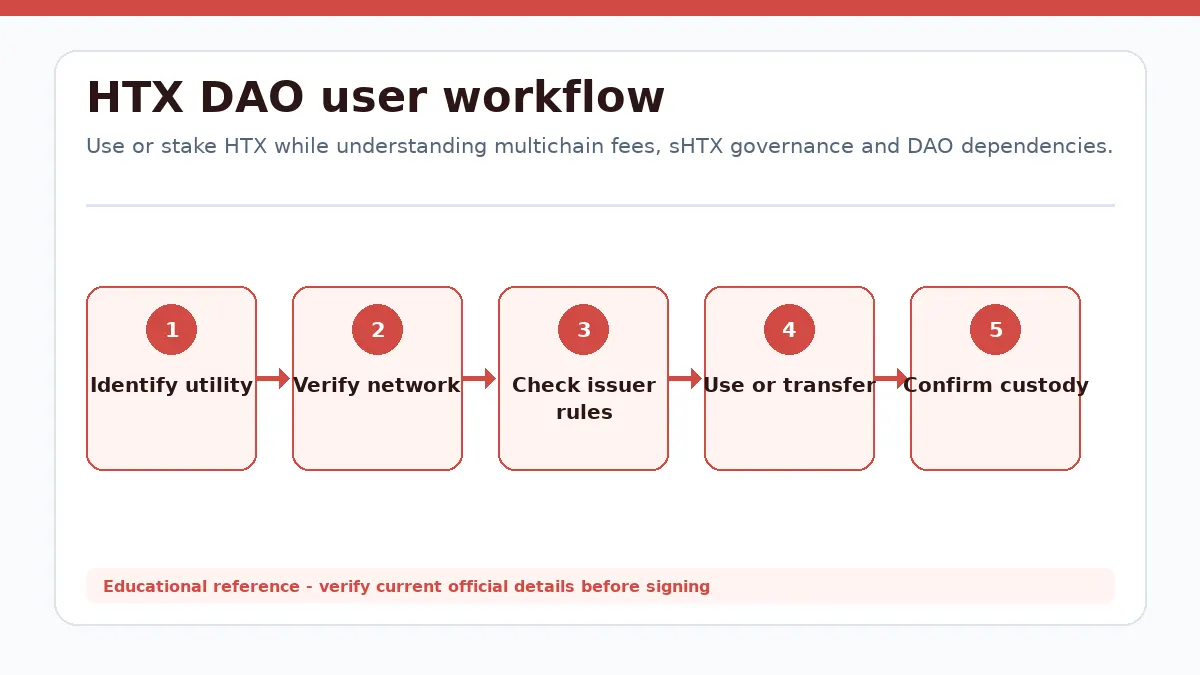
HTX DAO workflow from the first user decision to a verified outcome.
Before transferring or staking
Confirm the network and official contract, keep the host-chain fee asset, and distinguish HTX from sHTX. Do not send to another network as an ordinary transfer, buy a similarly named token, or approve a staking contract discovered through an unsolicited message.
Review unstaking conditions and proposal details. Do not assume HTX pays gas, that sHTX can be sold, or that an HTX exchange account automatically participates in DAO governance.
HTX DAO Guidance for Holders
Staking changes how the balance participates in governance.
Transferable token and accounting receipt
HTX is transferable and market traded. The current HTX DAO staking interface locks HTX and issues sHTX as a non-transferable accounting unit for voting weight and reward attribution. sHTX cannot be treated as an ordinary token for trading or transfer, and it is burned or adjusted through the unstaking process.
Staking terms, reward rates and withdrawal timing can change. A displayed APY is not guaranteed, and the reward reserve or program rules can be modified through operations or governance. Verify the official contract and current product screen before committing tokens.
Voting is defined by the governance system
HTX DAO uses token-weighted participation for published proposals, while committee and implementation processes can define how accepted proposals are carried out. Holding HTX outside the required staking or voting flow may not create active voting weight.
A vote is not ownership of HTX exchange, a guarantee of proposal execution or a claim on protocol revenue. Users should read the proposal, voting window, quorum and implementation authority separately.
Contract and fee checks must match the selected deployment.
TRON and EVM representations
HTX DAO publishes HTX contracts for TRON, Ethereum, BNB Smart Chain and BitTorrent Chain. TRON is central to current staking instructions, but the other representations remain distinct tokens on their host chains. A shared ticker and compatible address format do not make balances interchangeable.
TRX and the TRON energy or bandwidth model apply on TRON; ETH pays Ethereum gas; BNB pays BNB Smart Chain gas; and BTT is used for BitTorrent Chain execution. Keep the correct fee asset and verify the exact official contract before approving a transfer or staking call.
The public history records completed operations, not guaranteed future market effects.
Liquidity and burn mechanisms
HTX DAO reports liquidity pledge activity and later direct buyback-and-burn events. The public history includes dates, quantities and transaction identifiers. Users should distinguish HTX paired in liquidity, LP tokens made inaccessible and HTX directly burned because they change supply and liquidity through different operations.
Past events do not guarantee future frequency, price stability or returns. Verify each event against the current history and chain explorer, and treat future schedules as subject to program and market conditions.
Choose the Next HTX Check
Continue with governance, staking or host-chain context.
DAO, TRON or tools
Use HTX DAO primary pages for staking, proposals and burn history. Review TRON before the primary onchain workflow, and use wallet tools for contract and address checks without sharing private keys.
sHTX is a non-transferable accounting unit for staked HTX voting and reward weight.
Does HTX pay network gas?
Not universally. The selected host chain fee asset pays transfer and contract costs.
Is an HTX exchange balance automatically a DAO vote?
No. Voting depends on the current staking and governance process.
What should I verify before a HTX DAO transaction?
Check the official destination, current network, asset representation, amount, recipient and requested permissions. Users can stake HTX through the official system to receive sHTX voting and reward weight. HTX transfers and staking transactions still use the selected host chain, with TRX, ETH, BNB or BTT-related fees rather than HTX as a universal gas asset. After confirmation, inspect the resulting balance or protocol state instead of relying only on a wallet success message.
Known Limitations
Staking and governance rules can change.
Host-chain contracts and supported transfer routes must be checked at use time.
The page does not verify an HTX contract or proposal payload.
Market Data Methodology
The page uses a CoinGecko aggregated HTX/USD snapshot. No exchange chart is rendered for this entity.
Market Snapshot Source
CoinGecko aggregated market data (HTX/USD)
Cache
Snapshot cache is approximately 60 seconds.
Failure Handling
Verified cached data is labeled Cached or Delayed. Missing values remain unavailable.