GMX (GMX): Oracle Price, Price Impact and Funding Affect Position Health
GMX is a decentralized spot and perpetual trading protocol deployed on supported networks including Arbitrum and Avalanche. GMX is its governance asset; host-chain currencies pay gas. This page focuses on oracle Price, Price Impact and Funding Affect Position Health and the checks users need before using the protocol or evaluating the token role.
Trade or provide liquidity on GMX while understanding request execution, oracle prices and pool-specific risk.
Subject:
GMX
Market mode:
Snapshot Only
Fee asset:
ETH / AVAX / varies
Timezone:
UTC
This page does not place an order, calculate a live liquidation price, verify an oracle signature, quote funding or recommend a GM or GLV market.
Content ownership: BitcoinToolkit Editorial TeamTechnical references: Official protocol and developer documentation.Review approach: Technical explanations are checked against primary sources and updated when the network or asset changes.Last content review: Data integration last tested:
Oracle Price, Price Impact and Funding Affect Position Health
GMX was built to provide onchain leveraged trading without a traditional centralized order-book custodian.
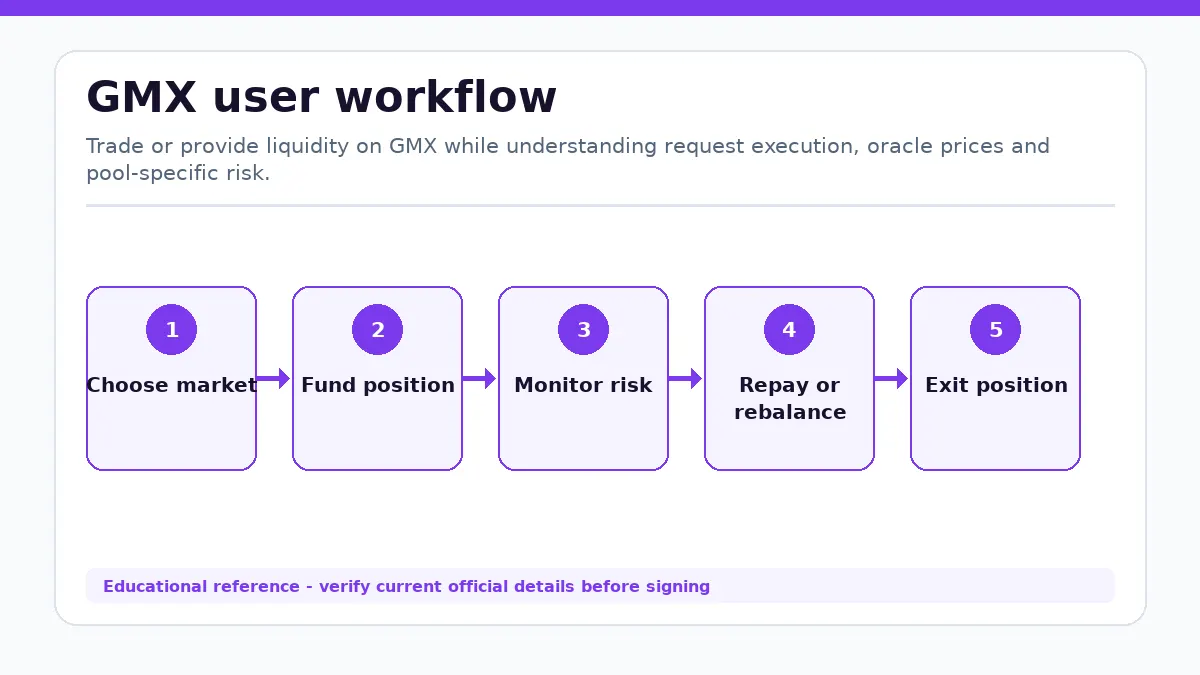
GMX workflow from the first user decision to a verified outcome.
Execution without a centralized account
Users trade from wallets while protocol contracts, keepers and oracle inputs coordinate order execution and position accounting. This reduces reliance on an exchange holding the user's full account balance, but it introduces smart-contract, oracle, keeper and network dependencies.
Liquidity pools support trading and can act as economic counterparties to trader outcomes. Fees paid by traders can benefit liquidity, while profitable trader positions, asset price changes and imbalanced exposure can work against pool returns.
What the design does not promise
Decentralized settlement does not guarantee the best market price, uninterrupted execution or immunity from liquidation. Orders still depend on configured markets, liquidity, acceptable price limits and functioning infrastructure.
GMX Transaction and Fee Checks
GMX is a decentralized spot and perpetual trading protocol. Traders and liquidity providers use different parts of the system and accept different sources of risk.
Two distinct user decisions
A trader uses collateral to open leveraged long or short positions and must manage margin, execution fees, borrowing costs, funding effects and liquidation. A liquidity provider supplies assets through GM market structures and is exposed to pool composition, trader performance, pricing and protocol mechanics.
GMX can suit users who understand perpetual contracts and self-custody execution. It is a poor fit for beginners seeking principal protection, guaranteed fills, fixed yield or a position that cannot be liquidated.
Choose the role before the asset
Buying GMX, trading a perpetual and providing liquidity are not substitutes. Each creates a different claim, workflow and risk profile.
How a GMX Perpetual Position Moves From Order to Close
A disciplined workflow treats collateral, leverage, execution and exit as separate checks.
Open and monitor
The trader selects a supported network and market, deposits an accepted collateral asset, chooses direction and size, sets acceptable execution conditions and submits the order. The eventual execution price can differ from the displayed reference because of price impact, fees and oracle or keeper timing.
After execution, the trader monitors collateral value, liquidation price, borrowing fees, funding effects and network conditions. Increasing leverage can improve capital efficiency but leaves less room for adverse movement.
Reduce or close
Closing realizes profit or loss after fees. Partial reductions change leverage and liquidation distance. Users should keep enough native gas asset to manage a position during volatile periods rather than committing every wallet balance as collateral.
What GMX Does and Which Trading Risks It Cannot Remove
GMX is associated with protocol governance and staking mechanics; it is not the collateral or settlement asset for every trade.
Token role boundaries
Holding or staking GMX does not open a perpetual position, guarantee fee income, pay all gas costs or protect against protocol losses. Trading positions use the collateral and market rules shown in the interface, while liquidity providers hold pool-specific exposure rather than a risk-free claim on the protocol.
Token incentives can change through governance and should not be treated as a fixed contract with users.
Failure modes that matter
Material risks include liquidation, oracle deviation, smart-contract defects, chain congestion, keeper delays, price impact, pool imbalance and adverse deleveraging where applicable. Common mistakes include using maximum leverage, overlooking cumulative fees, confusing a trigger price with guaranteed execution and supplying liquidity without modeling trader profit exposure.
Why GMX's Design Matters
Both products serve active derivatives users, but their execution, liquidity and chain assumptions differ.
What GMX users should verify and why this design differs
GMX uses its deployed smart-contract and oracle-based market architecture on supported chains. Hyperliquid uses a purpose-built trading environment with an order-book experience and its own network design. This affects order behavior, custody boundaries, market depth, latency, liquidation and infrastructure risk.
A trader should compare the exact market, collateral support, leverage rules, execution model, withdrawal path and outage assumptions before moving a position or committing significant collateral.
GMX Position management FAQ
Can a successful GMX transaction still leave a position unsafe?
Yes. Execution success does not measure collateral, debt, utilization, liquidity or liquidation exposure after the state change.
Known Limitations
Markets, oracle feeds and risk parameters can change.
Keeper execution is separate from request submission.
The page does not calculate a live position or liquidity return.
Market Data Methodology
The page uses a CoinGecko aggregated GMX/USD snapshot. No exchange chart is rendered for this entity.
Market Snapshot Source
CoinGecko aggregated market data (GMX/USD)
Cache
Snapshot cache is approximately 60 seconds.
Failure Handling
Verified cached data is labeled Cached or Delayed. Missing values remain unavailable.