Skip to content
BitcoinToolkit

Gala (GALA): GalaChain Gas Is Paid in GALA

Gala is a gaming and entertainment ecosystem with its own GalaChain network. GALA is used for network fees and ecosystem activity, while individual games and media products can issue separate tokens and NFTs. This page focuses on galaChain Gas Is Paid in GALA and the checks users need before using the protocol or evaluating the token role.

Use GALA across GalaChain and Ethereum without confusing gas, bridge, game-token and account states.

Subject:
Gala
Market mode:
Snapshot Only
Fee asset:
GALA / ETH
Timezone:
UTC

This page does not operate a Gala account or node, bridge assets, calculate rewards, verify a game economy, restore custody or guarantee product availability.

Content ownership: BitcoinToolkit Editorial Team Technical references: Official protocol and developer documentation. Review approach: Technical explanations are checked against primary sources and updated when the network or asset changes. Last content review: Data integration last tested:

GalaChain Gas Is Paid in GALA

The network charges for supported operations independently of a game purchase price.

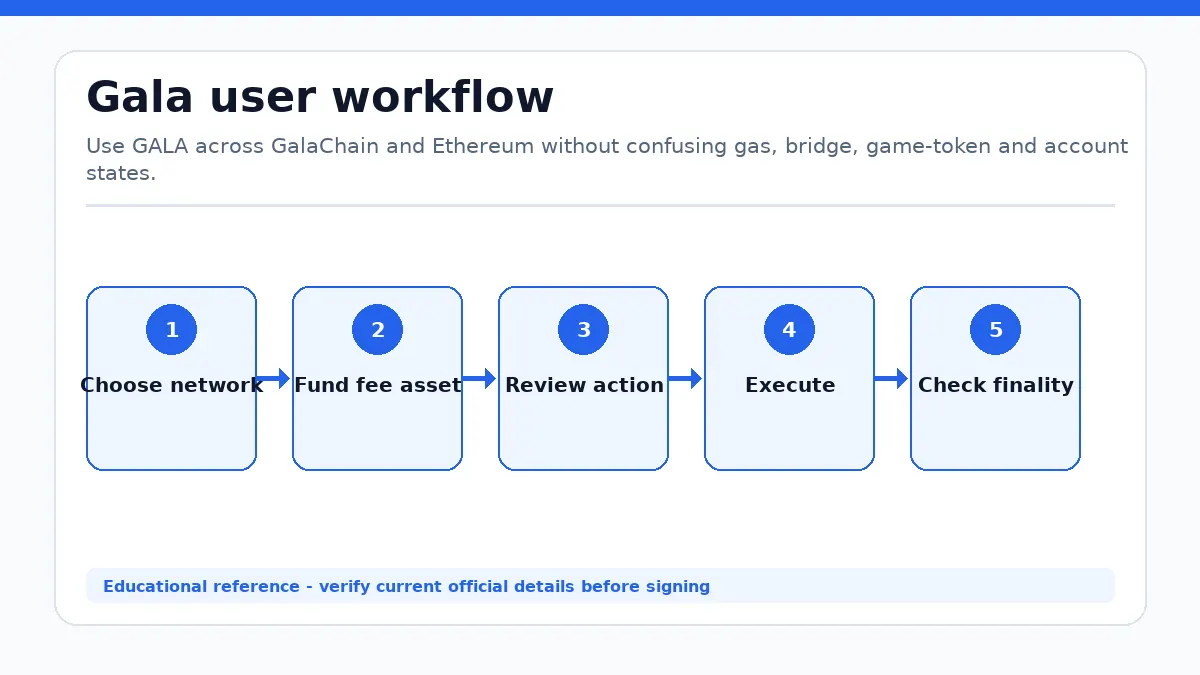
Gala workflow showing Choose network, Fund fee asset, Review action, Execute, Check finality
Gala workflow from the first user decision to a verified outcome.

Operation, channel and fee

GalaChain applies GALA gas to supported actions such as token transfers, mints, burns, swaps and bridge-out requests. Fees can vary by operation and channel, and published policy describes gas as part of resource allocation, spam control and network incentives. On Ethereum, the same GALA ticker does not replace ETH gas.

Keep GALA available for GalaChain actions and ETH for Ethereum actions. Read the confirmation screen because a marketplace price, bridge fee and network gas can be separate charges. A failed application response should be checked against the GalaChain transaction state before retrying, especially when a previous request may already have settled.

The Next Gala Step

A GALA amount is incomplete information until the network and custody location are known.

GalaChain, Ethereum and application inventory

GALA can be held and used on GalaChain and can also exist as the supported Ethereum ERC-20 representation. Gala platform applications may show an inventory or allowance state associated with a Gala account. Those contexts can share a symbol while requiring different addresses, explorers, fee assets and support procedures.

Identify network, contract or GalaChain token identity, account and destination support before moving funds. Do not send an Ethereum representation to a GalaChain-only route or assume a platform inventory is ordinary self-custody. Game currencies, NFTs, music items and film rewards can use different assets and product rules.

A Bridge Request Has Source, Processing and Destination States

Submitting a bridge action is not the same as receiving a spendable destination balance.

Track the complete movement

A supported bridge operation locks, burns or otherwise accounts for an asset on the source side and credits the approved representation on the destination side after service processing. The wallet signature, GalaChain transaction, bridge request and destination transaction can therefore have different identifiers and completion times.

Use only the current official bridge, confirm both networks and record every identifier. Do not repeat a pending request or transfer directly to a bridge contract. Maintenance, minimums, item support and network fees can change. A market listing on two chains is not proof that a direct canonical bridge route exists for every token or NFT.

Choose the Next Gala Check

Match the evidence to a player, asset holder, developer or node operator.

Practical checklist

Players should verify the game, account and inventory state. Asset holders should identify the network and contract. Developers should confirm the correct GalaChain channel, API environment and gas behavior. Founder Node operators should use current licensing, uptime and distribution rules rather than extrapolating from historical emissions.

Preserve account, order, bridge and transaction records separately. Protect recovery credentials and revoke unused Ethereum approvals. Treat GALA market exposure, network gas use, product purchases and node rewards as distinct decisions. Use developer tools for API work and wallet tools for transfer or approval checks.

Browse developer tools

Gala Operating Context

The GALA result needs context

GalaChain channels execute supported asset and application operations, GALA covers applicable network fees, and bridge services move supported representations between GalaChain and external networks under separate transaction states.

A Gala transaction can execute successfully while the application state, contract permission or later exit remains wrong for the user's goal. GALA is the market asset shown in the snapshot. GALA pays GalaChain gas; ETH pays Ethereum gas for the ERC-20 representation.

What Gala users should verify and why this design differs

Fees, bridge support and product rules can change. Game assets are not interchangeable with GALA.

For Gala, the practical sequence is Choose network, Fund fee asset, Review action, Execute, Check finality. Confirm the official destination and current network, then inspect the final balance, position, receipt or documented exit state that actually completes the task: Use GALA across GalaChain and Ethereum without confusing gas, bridge, game-token and account states.

Gala Network use FAQ

What pays GalaChain gas?

GALA pays applicable GalaChain gas.

Is every Gala game asset GALA?

No. Products can use separate tokens and NFTs.

Known Limitations

Market Data Methodology

The page uses a CoinGecko aggregated GALA/USD snapshot. No exchange chart is rendered for this entity.

Market Snapshot Source
CoinGecko aggregated market data (GALA/USD)
Cache
Snapshot cache is approximately 60 seconds.
Failure Handling
Verified cached data is labeled Cached or Delayed. Missing values remain unavailable.
Snapshot Status
Delayed
Report Issue
Report a market-data problem →

Technical Sources

Selected primary sources support the operational explanations. Market-provider attribution remains separate.

Editorial Information

Verified technical content, reviewed sources and update history.

Published
Last Review
Data Verification
Sources
Official documentation