Skip to content
BitcoinToolkit

Ether.fi (ETHFI): Ether.fi Adds EigenLayer Restaking to Ethereum Staking

Ether.fi is an Ethereum liquid-staking protocol that issues eETH and weETH and restakes supported stake through EigenLayer. ETHFI is its governance token. This page focuses on ether.fi Adds EigenLayer Restaking to Ethereum Staking and the checks users need before using the protocol or evaluating the token role.

Use Ether.fi liquid staking while understanding token forms, restaking, withdrawals and added DeFi risk.

Subject:
Ether.fi
Market mode:
Snapshot Only
Fee asset:
ETH
Timezone:
UTC

This page does not calculate yield, mint or redeem eETH, inspect an operator, value a DeFi position or guarantee a withdrawal time.

Content ownership: BitcoinToolkit Editorial Team Technical references: Official protocol and developer documentation. Review approach: Technical explanations are checked against primary sources and updated when the network or asset changes. Last content review: Data integration last tested:

Ether.fi Adds EigenLayer Restaking to Ethereum Staking

Additional rewards come with additional operators, services and conditions.

Validator and AVS exposure

The Ether.fi liquidity pool creates and funds Ethereum validators through its operator system. Supported stake is restaked through EigenLayer, where operators can participate in Actively Validated Services. The pool can distribute applicable restaking rewards while socializing protocol-level outcomes across depositors under its current design.

Users should separate Ethereum consensus rewards, restaking rewards, points or external incentives and DeFi yield. Each has different sources and risks. Once Ether.fi opts into slashable services, operator failure or AVS conditions can add loss exposure beyond ordinary Ethereum penalties and smart-contract risk.
ETHFI, eETH and weETH Are Three Different Assets

Governance, rebasing stake and wrapped stake should not be combined into one balance.

Governance and staking representations

ETHFI supports protocol governance. eETH is a rebasing liquid-staking token whose wallet balance can adjust as pooled rewards accrue. weETH wraps eETH into a non-rebasing ERC-20 balance whose exchange rate changes instead, making it easier for many DeFi contracts to integrate. ETH pays gas for all Ethereum transactions.

Verify the exact contract before transferring. Unwrapping weETH produces eETH at the current rate, not a fixed one-to-one token count. Neither ETHFI nor weETH is raw validator ETH, and a bridged representation can add another issuer or messaging dependency beyond the native Ethereum contracts.

Withdrawals Depend on Pool Liquidity and Validator Exits

A requested redemption is not always an immediately available ETH balance.

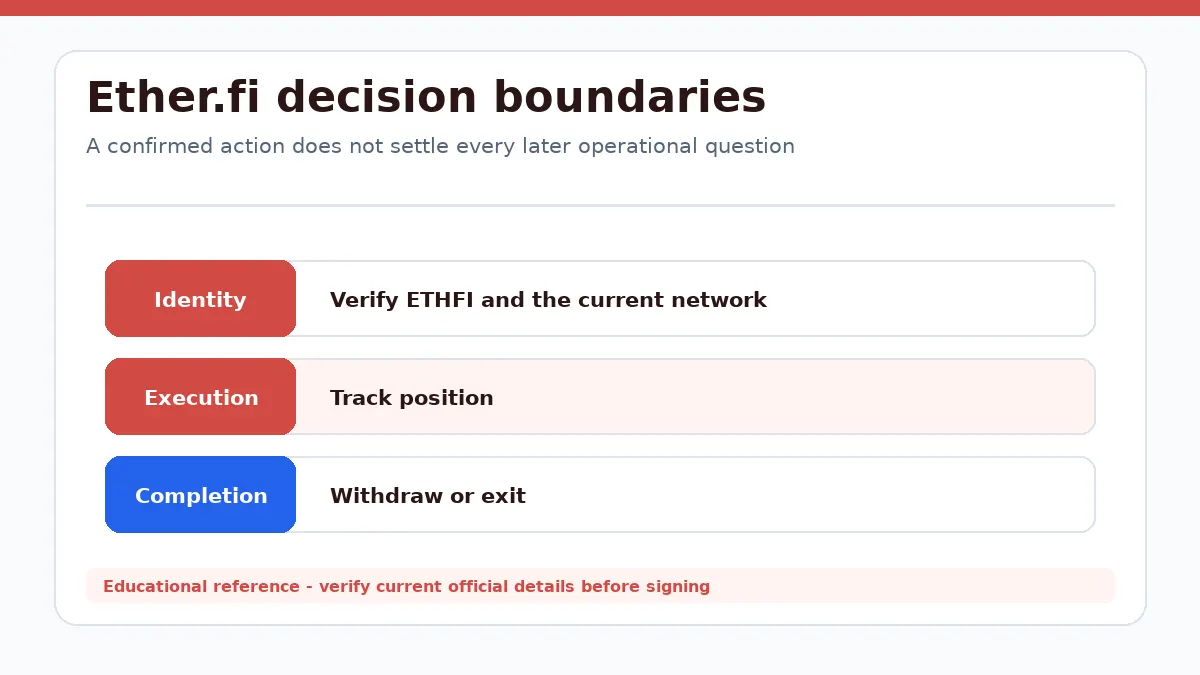
Ether.fi decision diagram separating identity, execution and completion checks
Ether.fi confirmation does not settle every later operational question.

Liquidity queue and market exit

A user can request protocol redemption of eETH or weETH for ETH. If the pool has enough unbonded ETH, it can satisfy the request more quickly. When liquidity is insufficient, validators may need to exit and complete Ethereum withdrawal processing before queued redemptions can settle.

A secondary-market sale can be faster but includes trading fees, price impact and possible discount to the protocol rate. Tokens deposited in DeFi must first be withdrawn, and collateral positions can be liquidated if weETH pricing moves. Compare route, output, gas and timing before choosing an exit.

Choose the Next Ether.fi Check

Trace the current token and every protocol holding it.

Stake, wrap, use or exit

For staking, verify the pool contract and current exchange rate. For wrapping, record the eETH-to-weETH rate. For DeFi, review allowance, collateral and liquidation terms. For withdrawal, compare protocol queue with market liquidity. Keep ETH available for all transactions.

Do not call ETHFI a staking receipt, assume weETH rebases in wallet units or count the same rewards twice across dashboards. Use current Ether.fi, EigenLayer and Ethereum records for each layer of the position. Recheck allowances after leaving an integration, and preserve withdrawal request identifiers until settlement.

Browse staking tools

Ether.fi Staking and yield FAQ

What pays transaction fees when using Ether.fi?

Ether (ETH) pays the applicable network fee. ETH pays Ethereum transaction fees. Verify the selected network before signing because a later approval, bridge, claim or exit can require another transaction.

Can Ether.fi rewards or withdrawal timing change after staking?

Yes. Reward rates, validator performance, slashing exposure, liquidity and exit queues can change while the position remains open.

Known Limitations

Market Data Methodology

The page uses a CoinGecko aggregated ETHFI/USD snapshot. No exchange chart is rendered for this entity.

Market Snapshot Source
CoinGecko aggregated market data (ETHFI/USD)
Cache
Snapshot cache is approximately 60 seconds.
Failure Handling
Verified cached data is labeled Cached or Delayed. Missing values remain unavailable.
Snapshot Status
Delayed
Report Issue
Report a market-data problem →

Technical Sources

Selected primary sources support the operational explanations. Market-provider attribution remains separate.

Editorial Information

Verified technical content, reviewed sources and update history.

Published
Last Review
Data Verification
Sources
Official documentation