Skip to content
BitcoinToolkit

Ethena (ENA): ENA Governance and Committee Delegation

Ethena is the protocol behind USDe and related products. ENA is its governance token, while USDe is a separate synthetic dollar and sENA a receipt for locked ENA; none of these roles should be inferred from the shared brand alone. This page focuses on eNA Governance and Committee Delegation and the checks users need before using the protocol or evaluating the token role.

Understand ENA governance and its relationship to sENA and USDe before holding or locking the token.

Subject:
Ethena
Market mode:
Snapshot Only
Fee asset:
ETH
Timezone:
UTC

This page does not forecast sENA rewards, evaluate USDe backing, recommend a vote or validate a contract.

Content ownership: BitcoinToolkit Editorial Team Technical references: Official protocol and developer documentation. Review approach: Technical explanations are checked against primary sources and updated when the network or asset changes. Last content review: Data integration last tested:

ENA Governance and Committee Delegation

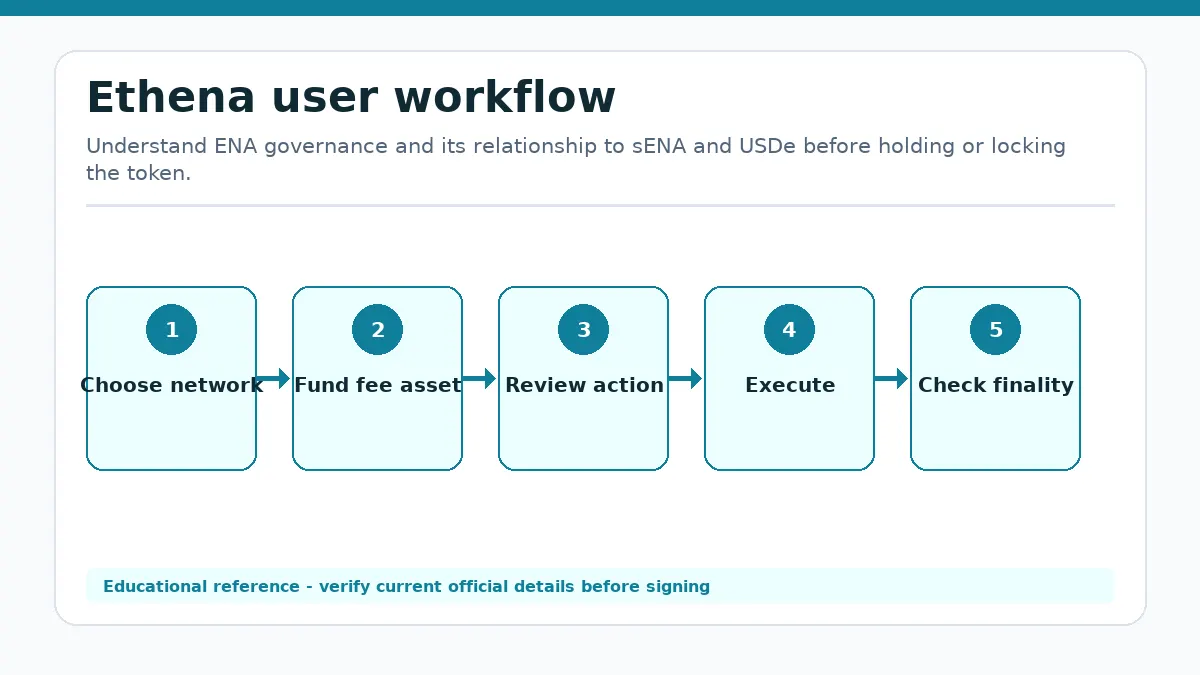
Ethena workflow showing Choose network, Fund fee asset, Review action, Execute, Check finality
Ethena workflow from the first user decision to a verified outcome.

Stable-value use and governance exposure are separate

A user considering USDe should evaluate its minting and redemption access, backing strategy, market liquidity and integrations. A user considering a savings representation must also understand how rewards accrue and what exit route exists. An ENA holder is evaluating governance and ecosystem exposure rather than a direct dollar claim.

Ethena may fit experienced users who understand synthetic-dollar and derivatives dependencies. It is a poor fit for anyone assuming USDe is a bank deposit, government-insured cash or a token backed only by unencumbered dollars in a traditional account.

Access matters

Direct creation and redemption can be subject to eligibility and operational requirements. Secondary-market access is not identical to direct protocol redemption.

Why Ethena's Design Matters

Ethena seeks to create a crypto-native dollar-denominated asset without relying exclusively on the reserve model used by conventional fiat-backed stablecoins.

Collateral plus hedging

The protocol combines crypto collateral with derivatives positions intended to reduce directional price exposure. Custody arrangements and off-exchange settlement structures are used to manage assets while hedges are maintained on trading venues. The resulting system depends on collateral, hedge execution and counterparties working together.

This design can generate economics from staking and derivatives markets, but those sources can vary or become negative. Delta neutrality is a managed target, not a guarantee that every market movement or operational failure is fully offset.

Why USDe differs from fiat-backed stablecoins

The backing and risk path includes crypto collateral, derivatives, custodians and exchanges rather than only cash-equivalent reserves and an issuer redemption promise.

How Users Acquire, Hold and Exit USDe

The workflow changes depending on whether the user has direct protocol access or obtains USDe through a secondary market.

Acquire and verify

Eligible users may interact with official minting or redemption processes under current terms, while other users trade USDe through supported onchain markets. In either case, verify the network and contract, compare the execution price with the intended dollar value and keep enough native gas asset for transactions.

Users choosing a savings representation should understand its conversion, reward accounting, cooldown or withdrawal conditions where applicable, and how its market price can differ from the underlying balance.

Plan the exit before entering

Check whether the expected exit is direct redemption, an onchain swap or a centralized venue. Each route has different eligibility, liquidity, fee and counterparty dependencies.

ENA Governance Does Not Make USDe Risk-Free

ENA supports governance and ecosystem incentives. It is not USDe, does not represent a fixed-dollar redemption claim and does not pay every host-chain fee.

Keep the claims separate

Holding ENA does not automatically entitle a user to USDe backing assets, protocol yield or loss protection. USDe holders do not automatically receive the governance rights associated with ENA. Any staking or incentive mechanism should be reviewed under its current terms rather than assumed from token ownership.

Market performance of ENA cannot prove that the synthetic dollar mechanism is healthy, and USDe stability does not guarantee ENA value.

Ethena-specific risks

Material risks include adverse funding, imperfect hedges, exchange or custodian failure, collateral impairment, smart-contract defects, liquidity stress and regulatory or access constraints. Common mistakes include treating a variable protocol reward as fixed interest, confusing secondary liquidity with guaranteed redemption and ignoring the multiple institutions involved in the hedge chain.

The Next Ethena Step

The meaningful comparison is not only whether two tokens trade near one dollar, but why they are expected to do so and how a holder exits.

What Ethena users should verify and why this design differs

USDe relies on crypto collateral and derivatives hedging. A reserve-backed stablecoin relies more directly on issuer assets, banking partners and redemption rules. Both can face liquidity, counterparty, smart-contract and regulatory risks, but the transmission paths differ.

Review the dedicated USDe reference next for its token role and market context before comparing it with fiat-backed or onchain credit-based stable assets.

Ethena Network use FAQ

What pays transaction fees when using Ethena?

Host-network gas asset (ETH) pays the applicable network fee. ETH pays Ethereum gas for ENA and core Ethena contracts. Verify the selected network before signing because a later approval, bridge, claim or exit can require another transaction.

What should I verify before a Ethena transaction?

Check the official destination, current network, asset representation, amount, recipient and requested permissions. ENA holders participate in protocol governance and committee selection under current rules. Locking ENA can mint sENA for governance and ecosystem reward programs, while USDe backing, hedging and redemption operate through separate contracts and risk systems. After confirmation, inspect the resulting balance or protocol state instead of relying only on a wallet success message.

Does holding ENA make every Ethena application transaction-ready?

No. ENA is the market-profiled governance token. The wallet still needs the correct network, fee asset, contract or program, and any application-specific token or permission.

Known Limitations

Market Data Methodology

The page uses a CoinGecko aggregated ENA/USD snapshot. No exchange chart is rendered for this entity.

Market Snapshot Source
CoinGecko aggregated market data (ENA/USD)
Cache
Snapshot cache is approximately 60 seconds.
Failure Handling
Verified cached data is labeled Cached or Delayed. Missing values remain unavailable.
Snapshot Status
Delayed
Report Issue
Report a market-data problem →

Technical Sources

Selected primary sources support the operational explanations. Market-provider attribution remains separate.

Editorial Information

Verified technical content, reviewed sources and update history.

Published
Last Review
Data Verification
Sources
Official documentation