Skip to content
BitcoinToolkit

EigenLayer (EIGEN): Slashing and Withdrawal States Limit Liquidity

EigenLayer is an Ethereum protocol that lets supported stake be allocated to additional services. EIGEN is a protocol asset; ETH remains the host-chain gas currency. This page focuses on slashing and Withdrawal States Limit Liquidity and the checks users need before using the protocol or evaluating the token role.

Understand what an EigenLayer restaking position secures and which additional risks it accepts.

Subject:
EigenLayer
Market mode:
Snapshot Only
Fee asset:
ETH
Timezone:
UTC

This page does not recommend an operator, estimate rewards, verify an AVS, restake assets, calculate slashing loss or provide investment advice.

Content ownership: BitcoinToolkit Editorial Team Technical references: Official protocol and developer documentation. Review approach: Technical explanations are checked against primary sources and updated when the network or asset changes. Last content review: Data integration last tested:

Slashing and Withdrawal States Limit Liquidity

Exiting a position is a process, not an instant token swap.

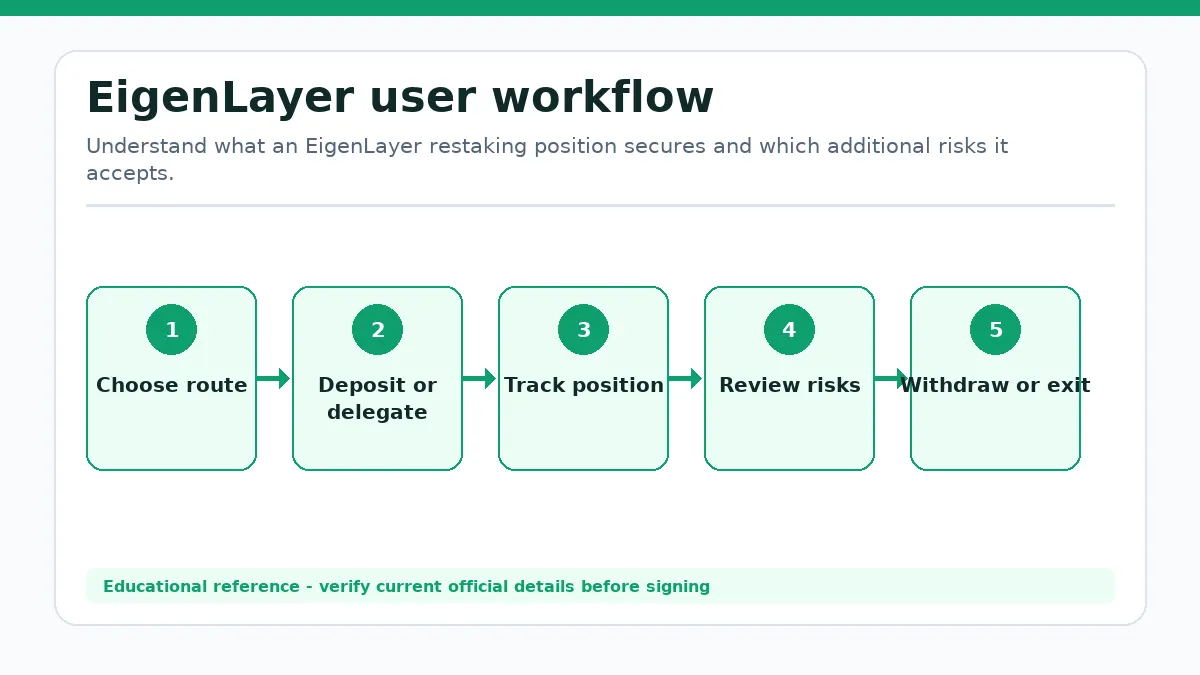
EigenLayer workflow showing Choose route, Deposit or delegate, Track position, Review risks, Withdraw or exit
EigenLayer workflow from the first user decision to a verified outcome.

Allocation, deallocation and delay

Allocated stake can be exposed to the slashing conditions of services supported by the operator. Deallocation and undelegation can introduce delays so pending obligations remain enforceable. Strategy withdrawals also depend on contract state and the underlying token; native restaking adds the Ethereum validator exit and withdrawal lifecycle.

Do not estimate risk from headline total value alone or assume all operators secure the same AVSs. Check active allocations, slashable commitments, withdrawal status and smart-contract upgrades. Liquid restaking tokens add another issuer and liquidity layer and should not be represented as identical to a direct EigenLayer position.

Restaking Adds an Allocation Layer Above Ethereum Stake

A position is defined by more than the deposited token.

Asset, strategy, operator and service

Liquid staking tokens can enter approved strategy contracts, while native restaking connects Ethereum validator withdrawal credentials through EigenPods. The restaker delegates eligible shares to an EigenLayer operator. That operator registers for one or more Actively Validated Services and allocates stake according to protocol and service rules.

Before depositing, identify the exact token, strategy contract, withdrawal owner, operator and services that may receive allocation. An operator is not the custodian of an ordinary wallet balance, but delegation gives the operator an important role in how the position participates. Token, smart-contract and operator risks remain distinct.

Each AVS Defines Its Own Work and Failure Conditions

Restaked security does not turn every service into Ethereum consensus.

Opt-in service duties

An Actively Validated Service can use operators for data availability, verification, or other work outside the base Ethereum validator duties. Operators opt in and run service-specific software. The AVS and EigenLayer contracts define allocations, rewards and enforceable conditions rather than inheriting one identical rule set for every service.

Review each service independently. Ethereum finality can secure the contracts that record commitments, but it does not prove that every offchain output is correct without the AVS design. A larger pooled stake can improve economic deterrence while leaving software bugs, correlated operators and faulty task definitions as separate risks.

Choose the Next EigenLayer Check

Follow the exact position rather than the general restaking category.

Before depositing or exiting

For a deposit, verify the strategy and token contract. For delegation, review the operator, active AVSs and allocation limits. For an exit, check queued withdrawals, deallocation delays and any Ethereum validator state. Preserve ETH for every host-chain transaction, because EIGEN does not replace Ethereum gas.

Use official contract addresses and dashboards, then read the documentation of each selected AVS. Avoid copied reward pages, unsigned operator claims and approvals with unlimited unrelated scope. Continue to validator and security tools for address, allowance and operational checks.

Browse validator tools

EigenLayer Staking and yield FAQ

What pays transaction fees when using EigenLayer?

Ether (ETH) pays the applicable network fee. ETH pays gas for EigenLayer contract transactions. Verify the selected network before signing because a later approval, bridge, claim or exit can require another transaction.

Can EigenLayer rewards or withdrawal timing change after staking?

Yes. Reward rates, validator performance, slashing exposure, liquidity and exit queues can change while the position remains open.

Known Limitations

Market Data Methodology

The page uses a CoinGecko aggregated EIGEN/USD snapshot. No exchange chart is rendered for this entity.

Market Snapshot Source
CoinGecko aggregated market data (EIGEN/USD)
Cache
Snapshot cache is approximately 60 seconds.
Failure Handling
Verified cached data is labeled Cached or Delayed. Missing values remain unavailable.
Snapshot Status
Fresh
Report Issue
Report a market-data problem →

Technical Sources

Selected primary sources support the operational explanations. Market-provider attribution remains separate.

Editorial Information

Verified technical content, reviewed sources and update history.

Published
Last Review
Data Verification
Sources
Official documentation