Skip to content
BitcoinToolkit

Brett (BRETT): Canonical BRETT Is Identified by Its Base Contract

Brett is a community meme token on Base inspired by a comic character. BRETT is an ERC-20 token, not the Base gas currency, a share in Base or an official network-governance asset. This page focuses on canonical BRETT Is Identified by Its Base Contract and the checks users need before holding, transferring or verifying the token.

Verify and transfer canonical BRETT on Base while understanding gas, contract and meme-token risk.

Subject:
Brett
Market mode:
Snapshot Only
Fee asset:
ETH
Timezone:
UTC

This page does not quote BRETT, predict returns, grant comic rights, represent Base, guarantee liquidity or endorse community and partnership claims.

Content ownership: BitcoinToolkit Editorial Team Technical references: Official protocol and developer documentation. Review approach: Technical explanations are checked against primary sources and updated when the network or asset changes. Last content review: Data integration last tested:

Canonical BRETT Is Identified by Its Base Contract

The ticker also appears on unrelated tokens on other networks.

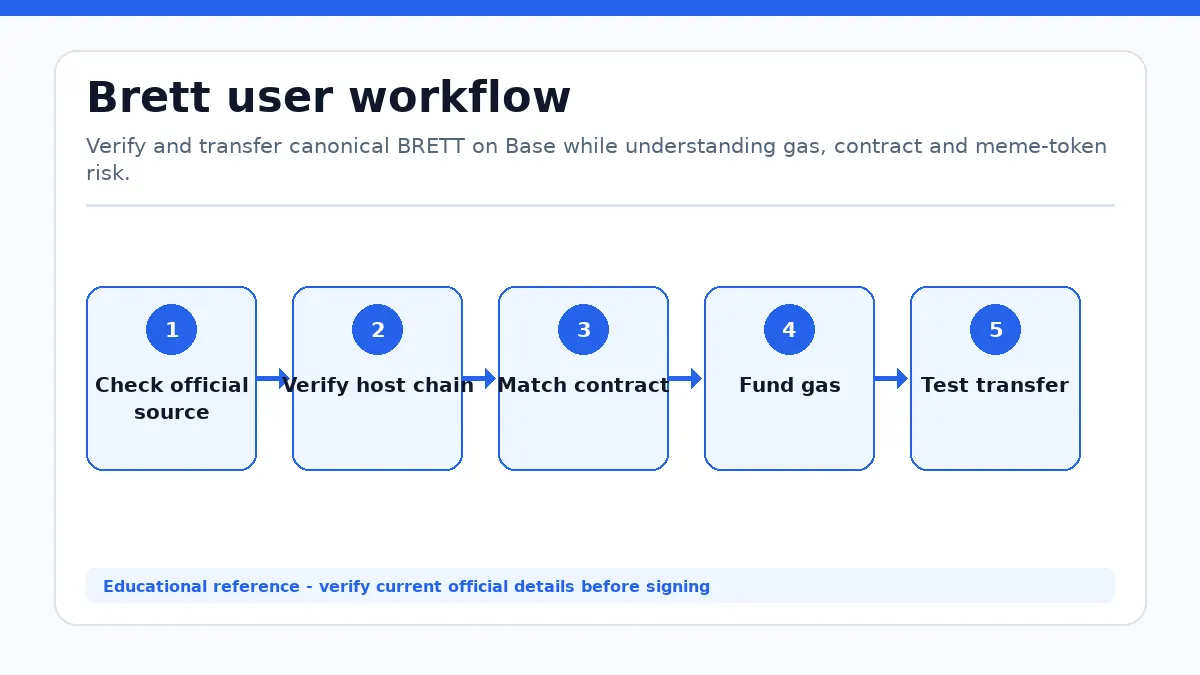
Brett workflow showing Check official source, Verify host chain, Match contract or mint, Fund gas, Test transfer
Brett workflow from the first user decision to a verified outcome.

Base contract and host network

The official Brett site publishes Base contract 0x532f27101965dd16442e59d40670FaF5eBB142E4. Base uses Ethereum-compatible addresses and ETH for gas. BRETT is transferred by its token contract and does not replace ETH or secure Base.

Check chain ID and the complete contract before importing, swapping or withdrawing. An Ethereum token with the same ticker is not canonical Base BRETT. A wallet can display a copied logo or symbol, so contract verification must precede any approval or transfer.
Where Brett Differs for Users

The token balance cannot pay its own contract execution fee.

Approve, swap and receive

A direct transfer calls the BRETT contract; a swap can first require an allowance to a router. Base batches and settles execution through its rollup infrastructure while the wallet pays ETH. Centralized exchanges can support only selected networks even when the destination address uses an EVM format.

Keep Base ETH, verify the spender and set an appropriate allowance. Match the exchange deposit network and send a test to a new route. Do not bridge through a site merely because it uses the Brett name or approve an unlimited amount without understanding the router.

Meme Status Is Not Base Ownership or Governance

Community descriptions of Brett as a mascot do not create protocol authority.

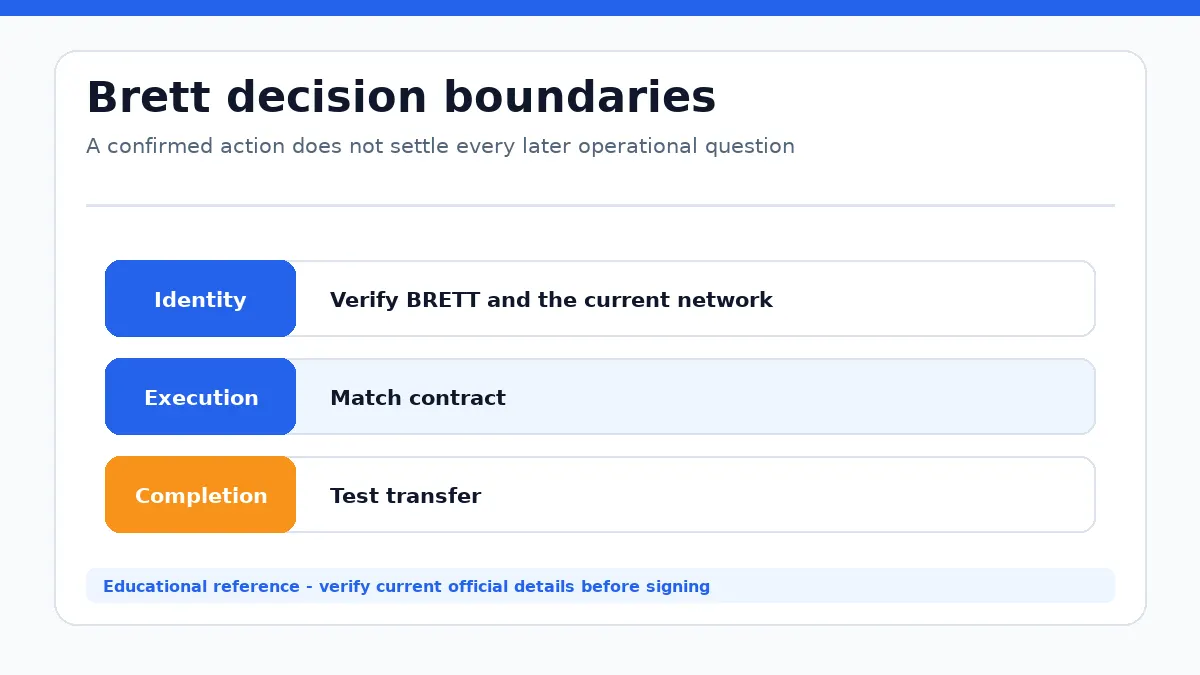
Brett decision diagram separating identity, execution and completion checks
Brett confirmation does not settle every later operational question.

Token controls and market claims

Official material describes a community allocation, treasury and exchange wallet, contract renouncement and locked liquidity. Onchain records can test contract ownership and balances, but those facts do not make BRETT an official Base gas token, give holders rights in Coinbase or guarantee future partnerships.

Inspect current liquidity, holder concentration, contract code and approvals. A renounced owner cannot eliminate price, custody, sequencer, bridge or social-channel risk. Treat broad promotional claims as claims to verify, not as features encoded by the token contract.

Choose the Next BRETT Check

Confirm host network and contract before assessing a venue. Check the Base chain ID, complete contract, destination network and ETH gas balance together. Save the swap route or withdrawal record so a token problem can be distinguished from a bridge, exchange or wallet-display delay. Verify custody terms too.

Holder, trader or transfer user

Verify Base, the canonical contract, destination support and ETH balance. For a trade, inspect pool address, depth, price impact and minimum received. For custody, confirm the wallet exposes Base recovery and the contract identity rather than a ticker alone.

Save the transaction hash and revoke unused allowances. Ignore copy tokens and fake bridge recovery offers. Continue to Base for finality and withdrawal behavior and use security tools for the actual spender or contract.

Browse security tools

Brett Operating Context

The BRETT result needs context

A Base contract records BRETT balances and approvals, Base settles transactions using ETH, and independent pools and exchanges provide liquidity.

A token can display the BRETT ticker and Brett branding without being the canonical contract or mint. BRETT is the meme token shown in the snapshot. ETH pays Base transaction gas.

What Brett users should verify and why this design differs

Liquidity and exchange routes can change. Community branding does not create Base governance rights.

For Brett, the practical sequence is Check official source, Verify host chain, Match contract or mint, Fund gas, Test transfer. Confirm the official destination and current network, then inspect the final balance, position, receipt or documented exit state that actually completes the task: Verify and transfer canonical BRETT on Base while understanding gas, contract and meme-token risk.

Brett Token verification FAQ

Does BRETT pay Base gas?

No. ETH pays Base network gas.

Is an Ethereum BRETT token the same asset?

No. Verify the canonical Base contract.

Is BRETT the official governance token of Base?

No such protocol role is established by the token contract described here.

Known Limitations

Market Data Methodology

The page uses a CoinGecko aggregated BRETT/USD snapshot. No exchange chart is rendered for this entity.

Market Snapshot Source
CoinGecko aggregated market data (BRETT/USD)
Cache
Snapshot cache is approximately 60 seconds.
Failure Handling
Verified cached data is labeled Cached or Delayed. Missing values remain unavailable.
Snapshot Status
Delayed
Report Issue
Report a market-data problem →

Technical Sources

Selected primary sources support the operational explanations. Market-provider attribution remains separate.

Editorial Information

Verified technical content, reviewed sources and update history.

Published
Last Review
Data Verification
Sources
Official documentation