Skip to content
BitcoinToolkit

Bittensor (TAO): How Emissions Are Allocated

Bittensor is a network of specialized subnets where miners produce digital services and validators evaluate their output. TAO is the native network asset, while Dynamic TAO introduces subnet-specific alpha assets and liquidity-based staking exposure. This page focuses on how Bittensor Emissions Are Allocated and the checks users need before using the protocol or evaluating the token role.

Understand TAO and subnet-specific risk before staking, delegating or operating in Bittensor.

Subject:
Bittensor
Market mode:
Snapshot Only
Fee asset:
TAO
Timezone:
UTC

This page does not rank subnets, recommend validators, estimate emissions or audit miner output.

Content ownership: BitcoinToolkit Editorial Team Technical references: Official protocol and developer documentation. Review approach: Technical explanations are checked against primary sources and updated when the network or asset changes. Last content review: Data integration last tested:

How Bittensor Emissions Are Allocated

Rewards reflect protocol evaluation and subnet economics, not a universal proof that the underlying service is correct.

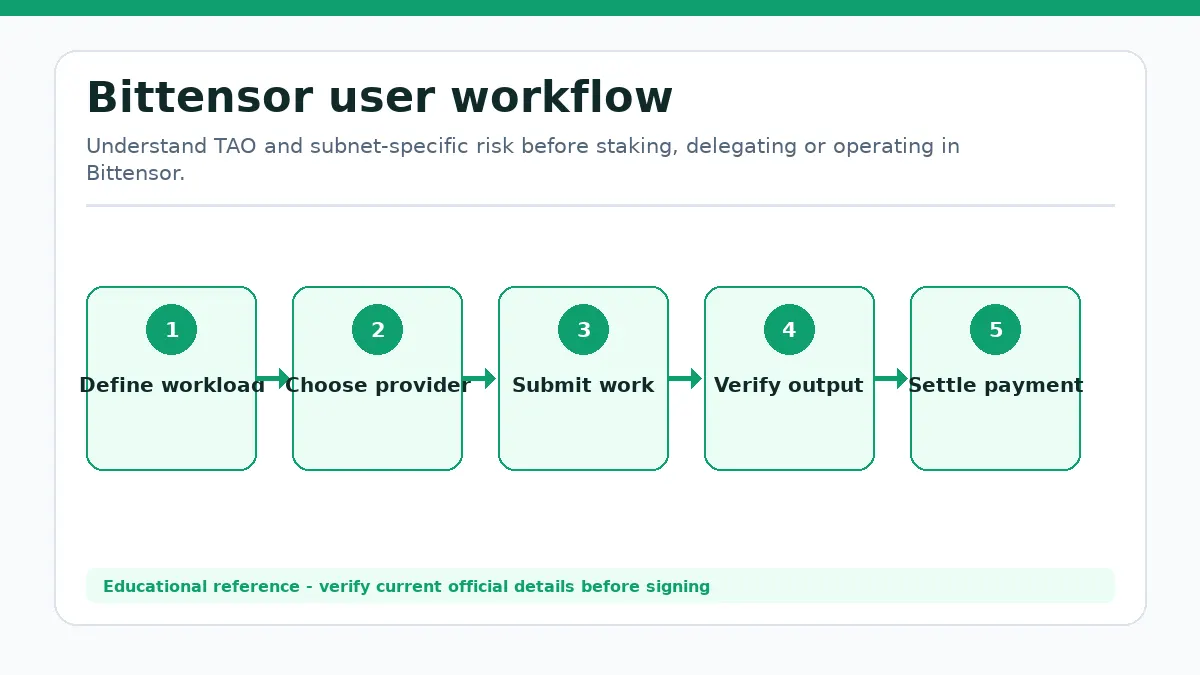
Bittensor workflow showing Define workload, Choose provider, Submit work, Verify output, Settle payment
Bittensor workflow from the first user decision to a verified outcome.

Yuma Consensus and Dynamic TAO

Yuma Consensus processes validator weights to determine miner and validator incentives within a subnet. The coinbase process coordinates emissions across the network. Under Dynamic TAO, TAO and alpha enter subnet reserves and participant allocations according to current protocol rules.

Emission changes, registration competition, validator concentration and subnet parameter updates can materially change outcomes. A technically valid weight process can still reward a metric that users consider low value. Evaluation design and market demand should therefore be reviewed separately from consensus execution.

Bittensor Is a Network of Subnets

The useful unit of analysis is a subnet and its task, not a generic claim that the network runs artificial intelligence.

Miners, validators and incentives

A Bittensor subnet defines a digital service, registration rules, miner outputs and validator evaluation process. Miners compete to provide useful responses or resources. Validators sample or assess those outputs and publish weights. The quality of one subnet does not prove the quality, demand or security of another.

TAO connects the wider network economy, registration and staking. Current Dynamic TAO mechanics also create subnet-specific alpha assets and liquidity pools. A quoted TAO market price therefore does not describe the value, emissions or exit conditions of a particular subnet position.

Coldkeys, Hotkeys and Staking Authority

Separating custody from operational identity is central to Bittensor participation.

Protect the controlling key

A coldkey controls funds and ownership-sensitive operations. Hotkeys identify operational participants such as miners or validators and can be attached to subnet UIDs. Keeping operational keys separate reduces some exposure, but a compromised coldkey can still threaten stake and ownership.

Staking can expose a user to validator behavior, subnet alpha pricing, liquidity and protocol delays. Root and subnet staking paths differ. Before delegating, users should identify the subnet, validator hotkey, received exposure and withdrawal process rather than relying on one displayed annualized rate.

Why Bittensor's Design Matters

Subnet choice, key handling and token exposure create distinct failure modes.

What Bittensor users should verify and why this design differs

Estimate operational costs and recognize that emissions can decline. Alpha liquidity can add price and exit risk beyond TAO itself. Subnet software may process untrusted inputs, so miners and validators should isolate workloads and review code even when the network transaction is valid.

  • Identify the exact subnet and task.
  • Keep coldkeys away from operational systems.
  • Understand TAO versus alpha exposure.
  • Treat emissions as variable, not guaranteed.

Bittensor Resource use FAQ

What pays transaction fees when using Bittensor?

Tao (TAO) pays the applicable network fee. Verify the selected network before signing because a later approval, bridge, claim or exit can require another transaction.

How is work or data verified before Bittensor settlement?

Subnets define tasks and incentive logic. Verification depends on the network's documented provider, proof, availability or result-checking process; a token transfer alone does not prove useful work.

Known Limitations

Market Data Methodology

The page uses a CoinGecko aggregated TAO/USD snapshot. No exchange chart is rendered for this entity.

Market Snapshot Source
CoinGecko aggregated market data (TAO/USD)
Cache
Snapshot cache is approximately 60 seconds.
Failure Handling
Verified cached data is labeled Cached or Delayed. Missing values remain unavailable.
Snapshot Status
Fresh
Report Issue
Report a market-data problem →

Technical Sources

Selected primary sources support the operational explanations. Market-provider attribution remains separate.

Editorial Information

Verified technical content, reviewed sources and update history.

Published
Last Review
Data Verification
Sources
Official documentation