Skip to content
BitcoinToolkit

Arweave (AR): An Arweave Upload Is a Signed Data Transaction

Arweave is a decentralized network designed for permanent data storage. Users submit signed data transactions and pay AR toward immediate inclusion and a long-term storage endowment. This page focuses on an Arweave Upload Is a Signed Data Transaction and the checks users need before integrating the service or using the token.

Publish and verify permanent Arweave data without confusing gateway delivery with the underlying transaction.

Subject:
Arweave
Market mode:
Snapshot Only
Fee asset:
AR
Timezone:
UTC

This page does not upload data, estimate a live fee, guarantee every gateway serves content, remove published bytes or determine whether content is lawful.

Content ownership: BitcoinToolkit Editorial Team Technical references: Official protocol and developer documentation. Review approach: Technical explanations are checked against primary sources and updated when the network or asset changes. Last content review: Data integration last tested:

An Arweave Upload Is a Signed Data Transaction

The transaction commits data, metadata tags, owner and fee into a permanent identifier.

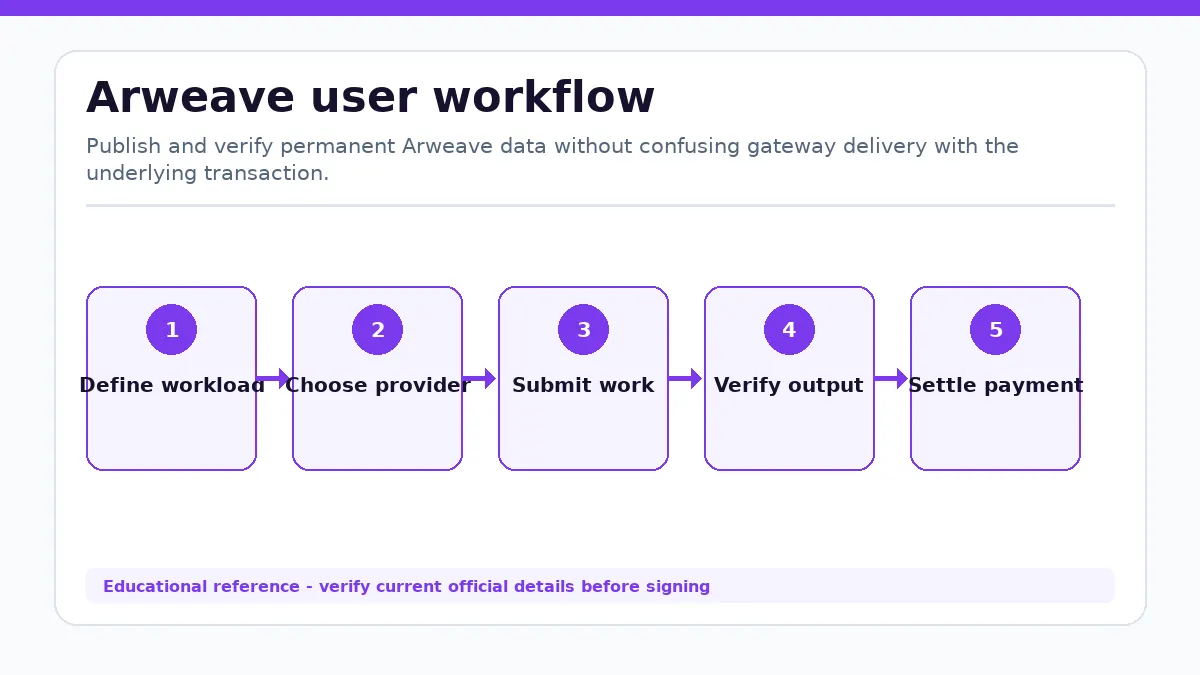
Arweave workflow showing Define workload, Choose provider, Submit work, Verify output, Settle payment
Arweave workflow from the first user decision to a verified outcome.

Prepare, price, sign and submit

An uploader prepares bytes and tags, obtains the current network price, signs with an Arweave wallet and submits the transaction directly or through a bundling service. The transaction ID derives from the signed transaction and becomes the durable reference for verification. Larger payloads require a larger storage contribution denominated in winston, the smallest AR unit.

Hash the source file before upload, review tags for private information and retain the transaction ID and manifest. Bundlers can improve convenience and small-item handling but add their own receipt and settlement states. Confirm that a bundle item has been anchored to Arweave rather than treating an upload API acknowledgment as final network inclusion.

Arweave Transaction and Fee Checks

Storage pricing is not a recurring monthly invoice to one provider.

Placement reward and endowment

Arweave pricing includes an immediate incentive for transaction inclusion and a contribution to a storage endowment intended to pay providers over time as storage costs decline. Upload cost scales with data size and current network parameters. Even an AR transfer without a data payload imposes a transaction fee, and creating a new account can add protocol cost.

Fetch a fresh price quote immediately before signing and leave a balance margin for fee changes. Compare bundler charges separately from the underlying network price. A low AR token price does not guarantee a low storage quote in fiat, and the endowment design is an economic mechanism rather than a contractual service-level agreement with one storage company.

Permanent Publication Requires a Privacy Decision First

Encryption can protect readable content, but it does not erase the published ciphertext or metadata.

Data, tags and gateway availability

Confirmed Arweave data is designed to remain in the network dataset. Gateways index and serve that data but can cache slowly, filter requests or go offline. A missing response from one gateway does not necessarily mean the transaction is absent, and a successful gateway response does not replace transaction-level verification across independent sources.

Do not upload secrets, personal data, access tokens or material that may require future deletion. Client-side encryption can limit who reads content, but leaked keys cannot be revoked by deleting the original ciphertext. Tags are also public. Test retrieval through more than one gateway and retain local originals and hashes for independent comparison.

Choose the Next Arweave Check

Treat transaction identity and content identity as separate evidence.

Publisher, developer or verifier

Publishers should remove private metadata, calculate size and fee and preserve the signed ID. Developers should inspect bundler anchoring, retries, content type and manifest paths. Verifiers should compare transaction owner, tags, data hash, block status and retrieval from independent gateways before relying on a file.

Do not use a human-readable gateway URL as the only record, assume a mutable DNS name proves immutable content or overwrite an application reference without preserving version history. Keep enough AR for the transaction and validate the exact wallet address because Arweave addresses and signing keys differ from EVM formats.

Browse developer tools

Arweave Guidance for Holders

The AR result needs context

Storage providers maintain replicated portions of the dataset, blocks reference historical data through proof-of-access mechanisms, and transaction IDs anchor immutable bytes and metadata.

A Arweave payment can settle even when useful work, storage, availability or output quality has not been verified for the user's requirement. AR is the market asset shown in the snapshot. AR funds transaction placement and storage endowment contributions.

What Arweave users should verify and why this design differs

Gateway availability is independent of underlying data inclusion. Fee estimates change with size and network parameters.

For Arweave, the practical sequence is Define workload, Choose provider, Submit work, Verify output, Settle payment. Confirm the official destination and current network, then inspect the final balance, position, receipt or documented exit state that actually completes the task: Publish and verify permanent Arweave data without confusing gateway delivery with the underlying transaction.

Arweave Resource use FAQ

Can confirmed Arweave data be deleted like a cloud file?

The protocol is designed for permanence; gateways may filter content, but that is not deletion from the dataset.

What pays an Arweave upload fee?

AR, denominated in its smallest unit for transaction pricing.

Does one gateway error prove data is missing?

No. Check the transaction and try independent gateways.

Known Limitations

Market Data Methodology

The page uses a CoinGecko aggregated AR/USD snapshot. No exchange chart is rendered for this entity.

Market Snapshot Source
CoinGecko aggregated market data (AR/USD)
Cache
Snapshot cache is approximately 60 seconds.
Failure Handling
Verified cached data is labeled Cached or Delayed. Missing values remain unavailable.
Snapshot Status
Delayed
Report Issue
Report a market-data problem →

Technical Sources

Selected primary sources support the operational explanations. Market-provider attribution remains separate.

Editorial Information

Verified technical content, reviewed sources and update history.

Published
Last Review
Data Verification
Sources
Official documentation