Skip to content
BitcoinToolkit

Ondo (ONDO): Eligibility, Minting and Redemption

Ondo is a tokenized-finance ecosystem that includes products representing or providing exposure to real-world financial assets. ONDO is a governance token and is not itself a share of every Ondo product, a stablecoin or a host-network gas currency. This page focuses on eligibility, Minting and Redemption and the checks users need before using the protocol or evaluating the token role.

Distinguish ONDO governance from tokenized-asset products and verify access, network and redemption rules.

Subject:
Ondo
Market mode:
Snapshot Only
Fee asset:
Varies
Timezone:
UTC

This page does not determine investor eligibility, verify a product token, quote redemption value or provide securities advice.

Content ownership: BitcoinToolkit Editorial Team Technical references: Official protocol and developer documentation. Review approach: Technical explanations are checked against primary sources and updated when the network or asset changes. Last content review: Data integration last tested:

Eligibility, Minting and Redemption

A complete workflow begins with product documentation and eligibility rather than a wallet connection.

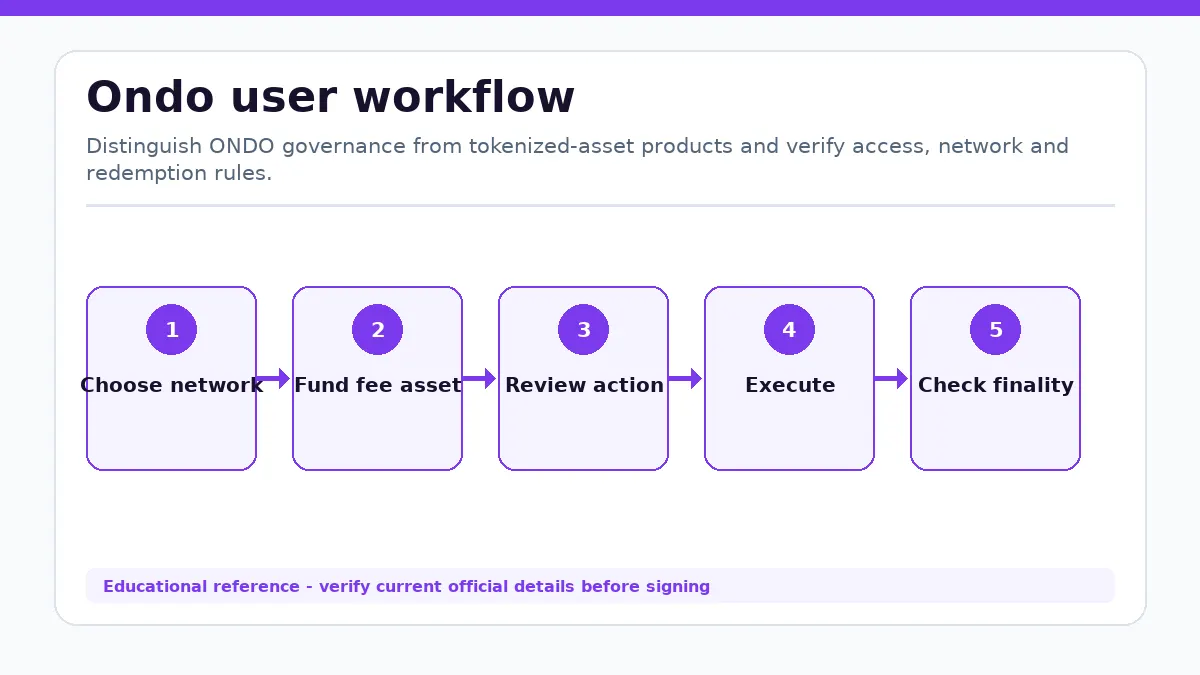
Ondo workflow showing Choose network, Fund fee asset, Review action, Execute, Check finality
Ondo workflow from the first user decision to a verified outcome.

Before acquisition

Identify the exact product, issuer and token contract, review eligibility and onboarding requirements, confirm the supported network and understand how yield or value accrual is represented. Compare direct subscription terms with any secondary-market price and liquidity before transferring funds.

Keep records of the legal product documents and transaction route. Token custody, tax treatment and transfer restrictions can differ from an ordinary permissionless token even when the balance appears in the same wallet.

Redemption is a separate process

Review minimums, timing, settlement assets, fees and operating windows before relying on redemption. A secondary-market sale may be faster but can occur at a discount and depends on available liquidity.

Where Ondo Differs for Users

Ondo develops tokenized finance products and infrastructure. Product tokens such as OUSG or USDY have different claims and access rules from the ONDO governance token.

Separate the product from the ecosystem token

A user evaluating a tokenized Treasury or yield-bearing dollar product should study its issuer, underlying assets, eligibility, transfer restrictions, yield treatment and redemption process. An ONDO holder is evaluating governance and ecosystem exposure, not purchasing the underlying portfolio represented by a separate product token.

Ondo products can suit eligible users seeking onchain access to specified real-world financial exposures. They are a poor fit for users who cannot satisfy access rules, require unrestricted transfers, expect instant redemption in every market condition or assume the token has deposit insurance.

Jurisdiction is part of product design

Availability and transferability can depend on user type and location. Interface access does not establish legal eligibility.

Why Ondo Brings Traditional Asset Exposure Onchain

Traditional securities and cash-management products operate through brokers, custodians, settlement systems and eligibility controls that do not map directly to public blockchains.

Tokenization connects two operating systems

Ondo structures products that reference or hold defined offchain assets while issuing tokens that can interact with supported blockchain infrastructure. This can improve transferability, settlement and integration for eligible users, but the economic claim still depends on legal entities, custodians, asset managers and product documents outside the smart contract.

The blockchain records token movement; it does not replace the legal ownership chain, guarantee portfolio value or make market hours and redemption operations disappear.

Different products solve different cash needs

OUSG and USDY should not be treated as alternate tickers for one asset. Their structure, target users, yield treatment, transfer rules and risk disclosures can differ.

What ONDO Governs and What It Does Not Own

ONDO is associated with governance in the Ondo ecosystem. It is distinct from the product tokens and underlying financial assets offered through separate structures.

No automatic claim on product assets

Holding ONDO does not automatically provide ownership of Treasuries, OUSG, USDY reserves, product yield or redemption rights. It is not the gas token for every network where Ondo products appear. Product access and claims come from the relevant token and legal terms, not from an ONDO wallet balance.

Governance utility can evolve and should not be confused with equity in every operating company or fund connected to the ecosystem.

Risks cross onchain and offchain systems

Users may face issuer, custodian, asset-manager, interest-rate, smart-contract, liquidity, regulatory and transfer-restriction risks. Common mistakes include buying the governance token when seeking the product's yield, ignoring jurisdiction limits, treating token price as net asset value and assuming a blockchain transfer guarantees legal settlement.

Ondo Risks Before Completion

Both may be denominated in dollars, but their claims, liquidity and user restrictions can be very different.

What Ondo users should verify and why this design differs

An Ondo product may pass through or reflect returns from specified financial assets and can include eligibility or transfer controls. A payment stablecoin such as USDC is designed more directly for dollar-denominated transfer and settlement under its issuer's reserve and redemption model. Neither structure is risk-free.

Users should compare the claim, issuer, redemption, liquidity, tax and legal treatment needed for their task instead of selecting by displayed yield alone.

Ondo Network use FAQ

What should I verify before a Ondo transaction?

Check the official destination, current network, asset representation, amount, recipient and requested permissions. Different Ondo products use distinct legal issuers, eligibility rules, custody arrangements, price feeds, transfer restrictions and redemption processes. Their tokens execute on supported host networks, while governance and product ownership remain separate roles. After confirmation, inspect the resulting balance or protocol state instead of relying only on a wallet success message.

Does holding ONDO make every Ondo application transaction-ready?

No. ONDO is the market-profiled governance token. The wallet still needs the correct network, fee asset, contract or program, and any application-specific token or permission.

Known Limitations

Market Data Methodology

The page uses a CoinGecko aggregated ONDO/USD snapshot. No exchange chart is rendered for this entity.

Market Snapshot Source
CoinGecko aggregated market data (ONDO/USD)
Cache
Snapshot cache is approximately 60 seconds.
Failure Handling
Verified cached data is labeled Cached or Delayed. Missing values remain unavailable.
Snapshot Status
Fresh
Report Issue
Report a market-data problem →

Technical Sources

Selected primary sources support the operational explanations. Market-provider attribution remains separate.

Editorial Information

Verified technical content, reviewed sources and update history.

Published
Last Review
Data Verification
Sources
Official documentation