Hedera is a public distributed ledger that uses hashgraph consensus rather than a linear blockchain data structure. HBAR is the native asset used for fees, account activity and staking, while Hedera services provide tokens, consensus messages and EVM-compatible smart contracts. This page focuses on how Hedera Reaches Consensus and the checks users need before sending funds, paying fees or using the network.
Prepare a Hedera transaction and distinguish HBAR, network services, account aliases and token associations.
Subject:
Hedera
Market mode:
Snapshot Only
Fee asset:
HBAR
Timezone:
UTC
This page does not calculate a live fee, assess Governing Council policy, select a node or audit a Hedera token.
Content ownership: BitcoinToolkit Editorial TeamTechnical references: Official protocol and developer documentation.Review approach: Technical explanations are checked against primary sources and updated when the network or asset changes.Last content review: Data integration last tested:
How Hedera Reaches Consensus
Hashgraph orders events through shared gossip history instead of selecting one miner-created chain.
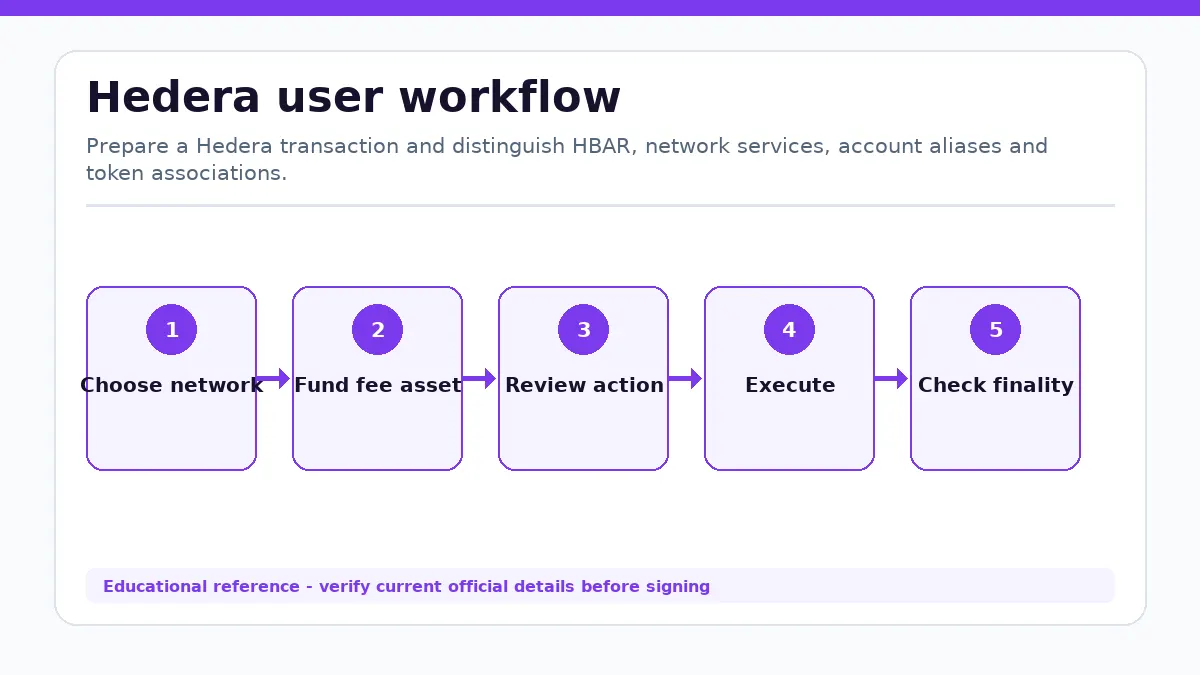
Hedera workflow from the first user decision to a verified outcome.
Gossip and virtual voting
Hedera nodes gossip transactions and information about previous gossip events. Because participants can reconstruct who learned what and when, the network can apply virtual voting without sending a separate vote message for every consensus decision. The result is a consensus timestamp and final order for submitted transactions.
HBAR protects the network economically and pays for services. Staking weight contributes to consensus security, while governance and node operation have their own rules. Owning HBAR does not make a user a Governing Council member or guarantee permission to operate a consensus node.
Hedera exposes several services, so the identifier and transaction type matter.
Account identity and token association
Hedera accounts can be referenced by account IDs and aliases, including EVM-compatible address forms. Wallets and applications must use the representation expected by the service being called. Token Service assets may require an account association before receipt, and association rules can affect fees and maximum automatic associations.
Smart Contract Service supports EVM-compatible execution, but Hedera-native services and precompiles can expose behavior not represented by a generic Ethereum transfer. A token ID and an EVM contract address should be verified through current Hedera tooling rather than inferred from a ticker.
HBAR Fees and Final Transaction Results
Predictable dollar schedules still require a current HBAR conversion and transaction-specific limits.
Service fees and receipts
Hedera publishes fee schedules in USD terms and converts the amount to HBAR using network exchange-rate information. The total can include node, network and service components. Contract execution and token operations can cost more than a simple HBAR transfer, so a wallet should query or estimate the actual transaction rather than reuse one fixed amount.
A submitted transaction has a valid start and duration, targets a node and carries required signatures. Consensus finality means the ordered result does not wait for additional proof-of-work blocks, but an application must still inspect the receipt or record to determine whether the transaction succeeded and what fees were charged.
Identifier confusion and token-association assumptions create many preventable failures.
Verify the service and account state
Confirm the destination account or alias, the intended network, token ID and association status. Review all required signatures and leave enough HBAR for fees. Do not send a token solely because its symbol matches an asset on another chain, and do not assume every exchange supports an alias or token deposit format.
For contract calls, estimate gas and review precompile interactions. For scheduled or multi-signature actions, verify which signatures remain pending. Use a current mirror node or receipt source to confirm the final result, while remembering that mirror data availability can lag consensus briefly.
Match account ID or alias to the receiving service.
Nodes gossip events and use virtual voting to establish consensus order and timestamps. Fees use published USD-denominated schedules converted into HBAR, and transactions carry explicit valid-duration, node and signature requirements.
A Hedera transaction can execute successfully while the application state, contract permission or later exit remains wrong for the user's goal. HBAR is the market asset shown in the snapshot. Network fees are denominated in USD schedules and paid in HBAR.
What Hedera users should verify and why this design differs
Fee schedules and network governance can change. The page does not validate an account or token ID.
For Hedera, the practical sequence is Choose network, Fund fee asset, Review action, Execute, Check finality. Confirm the official destination and current network, then inspect the final balance, position, receipt or documented exit state that actually completes the task: Prepare a Hedera transaction and distinguish HBAR, network services, account aliases and token associations.
Hedera Network use FAQ
Are Hedera fees paid in dollars?
Fee schedules are denominated in USD terms, but network fees are paid in HBAR after conversion.
Does Hedera use a blockchain?
Hedera uses the hashgraph consensus data structure and algorithm rather than a conventional linear blockchain.
Why might a Hedera token transfer fail?
The account may lack the required token association, signatures, balance or HBAR for fees.
What pays transaction fees when using Hedera?
HBAR (HBAR) pays the applicable network fee. Verify the selected network before signing because a later approval, bridge, claim or exit can require another transaction.
Known Limitations
Fee schedules and network governance can change.
The page does not validate an account or token ID.
Mirror-node visibility can differ from consensus timing.
Market Data Methodology
The page uses a CoinGecko aggregated HBAR/USD snapshot. No exchange chart is rendered for this entity.
Market Snapshot Source
CoinGecko aggregated market data (HBAR/USD)
Cache
Snapshot cache is approximately 60 seconds.
Failure Handling
Verified cached data is labeled Cached or Delayed. Missing values remain unavailable.