Stellar (XLM): How Payments, Anchors and Trustlines Work
Stellar is an account-based network designed for asset issuance, exchange and payments. The lumen, or XLM, is its native asset, fee currency and reserve asset; non-native assets are issued by identified accounts and commonly require trustlines. This page focuses on how Stellar Payments, Anchors and Trustlines Work and the checks users need before sending funds, paying fees or using the network.
Prepare a Stellar payment while accounting for XLM reserves, fees and issued-asset trustlines.
Subject:
Stellar
Market mode:
Snapshot Only
Fee asset:
XLM
Timezone:
UTC
This page does not validate an issuer, quote a path payment, calculate a Soroban footprint or recommend a validator quorum.
Content ownership: BitcoinToolkit Editorial TeamTechnical references: Official protocol and developer documentation.Review approach: Technical explanations are checked against primary sources and updated when the network or asset changes.Last content review: Data integration last tested:
How Stellar Payments, Anchors and Trustlines Work
A token name alone is not enough to identify a Stellar asset.
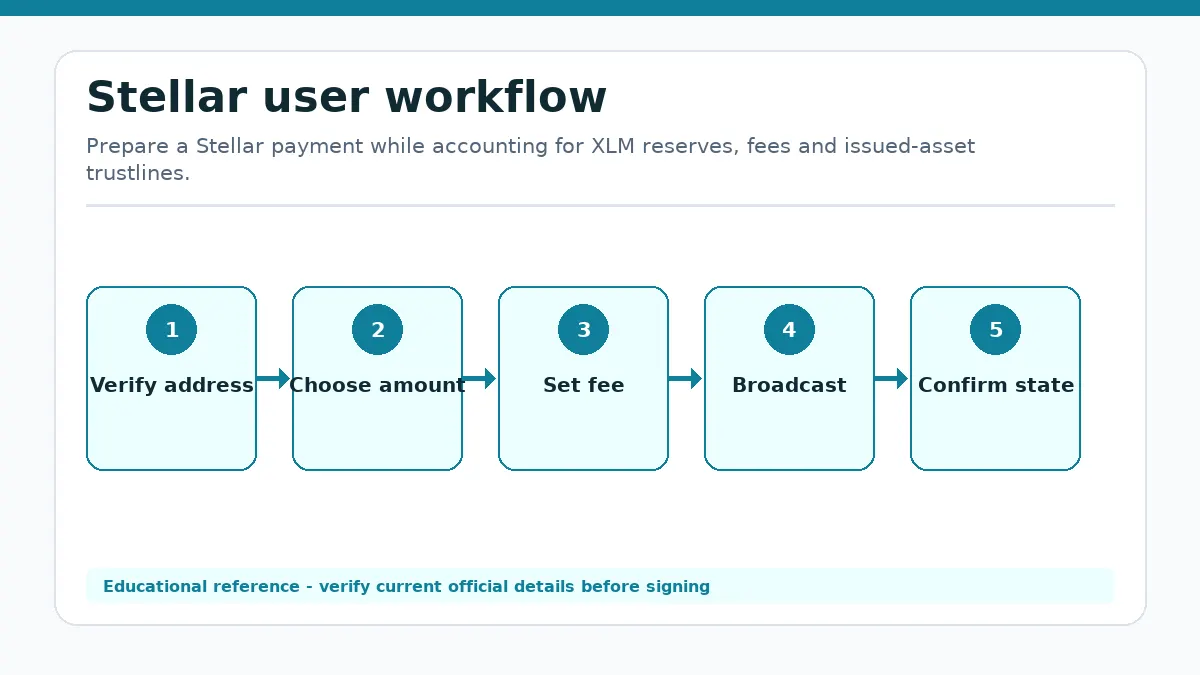
Stellar workflow from the first user decision to a verified outcome.
Code plus issuer
Non-native Stellar assets are identified by an asset code and issuing account. A trustline authorizes an account to hold a specific issued asset and adds a ledger entry. Two assets can share a code while having different issuers, so receiving or trading based on the ticker alone can select the wrong asset.
Stellar transactions can bundle several operations, including payments, trustline changes and decentralized exchange actions. Path payments can convert between assets while delivering a requested destination amount, but the route and limits must be reviewed. Network finality does not compensate for choosing a fraudulent issuer or an unfavorable path.
Stellar Risks Before Completion
XLM supports payments but also keeps accounts and ledger entries economically bounded.
Native asset, fees and minimum balances
XLM is the only Stellar asset without an issuer or trustline. It pays transaction fees, funds rent and contributes to minimum balance requirements. An account starts with a base reserve requirement, and additional entries such as trustlines, offers or signers can increase the XLM that must remain reserved.
A wallet may display an XLM balance larger than the amount immediately spendable because part is locked by reserve rules. Before sending the maximum balance or adding an asset, users should inspect current ledger entries and leave enough XLM for the operation and the resulting minimum balance.
Classic operations and smart-contract transactions share XLM fees but use different resource accounting.
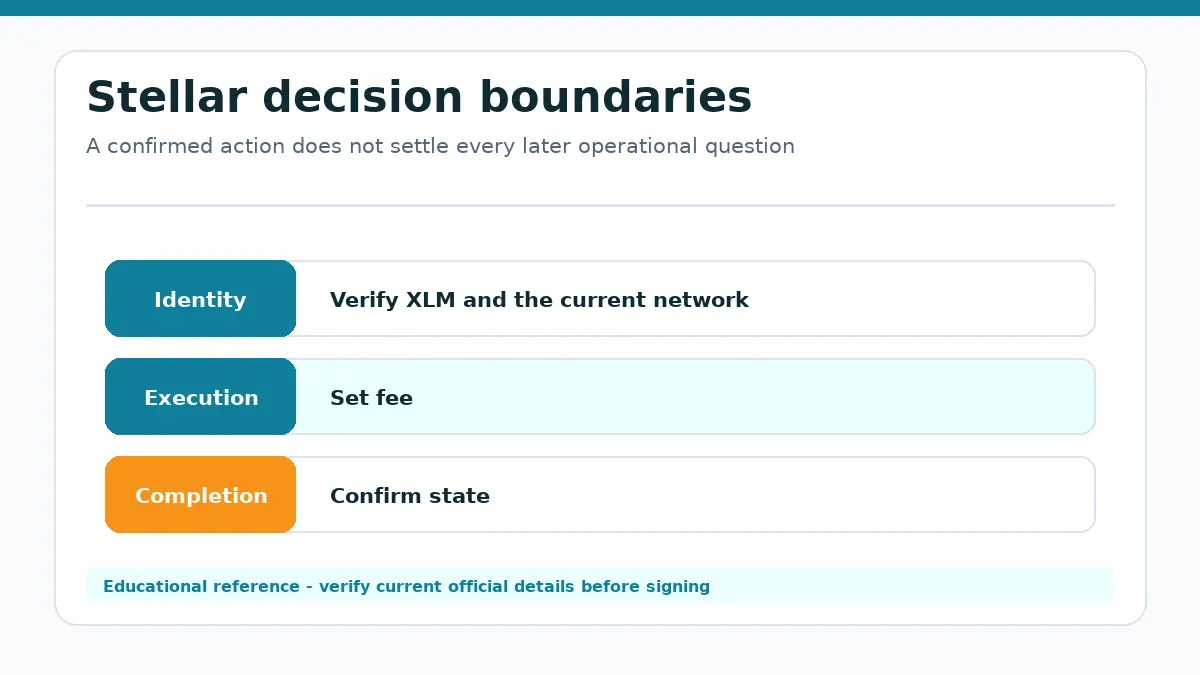
Stellar confirmation does not settle every later operational question.
Inclusion and resource charges
Every transaction pays an inclusion fee in XLM. During congestion, the submitted fee determines competition for ledger space. Soroban smart-contract transactions also pay resource charges based on computation and state use, including storage rent. A classic XLM payment estimate is therefore not a reliable estimate for a contract call.
Stellar validators use quorum slices under the Stellar Consensus Protocol to agree on ledger state. Once a ledger closes through consensus, applications can treat its results as final according to their operational policy. Services should still inspect the transaction result and every operation result before crediting funds.
A correct destination can still reject or mishandle an unsupported asset.
Asset and account preparation
Confirm the destination account, memo requirements and whether the recipient has a trustline for the exact code-and-issuer pair. Check the sender's spendable XLM after reserves, estimate the correct fee type and review all bundled operations. Exchanges often require a memo even though the network address is valid without one.
For Soroban interactions, simulate the transaction using current network tooling and review resource limits. For issued assets, research the issuer and authorization settings independently. A successful Stellar settlement proves protocol execution, not the issuer's solvency or willingness to redeem.
Validators reach agreement through the Stellar Consensus Protocol. Transactions contain ordered operations, pay inclusion fees in XLM, and can interact with issued assets or Soroban smart contracts that add resource fees and storage requirements.
A Stellar transaction can be valid while the recipient still waits for more confirmations or cannot use the selected address type. XLM is the market asset shown in the snapshot. XLM pays inclusion and smart-contract resource fees.
What Stellar users should verify and why this design differs
Base reserve and fee parameters can change. The page does not assess an asset issuer.
For Stellar, the practical sequence is Verify address, Choose amount, Set fee, Broadcast, Confirm state. Confirm the official destination and current network, then inspect the final balance, position, receipt or documented exit state that actually completes the task: Prepare a Stellar payment while accounting for XLM reserves, fees and issued-asset trustlines.
Stellar Transactions FAQ
Why can I not send my full XLM balance?
Part of the balance may be reserved for the account and its ledger entries, and fees also require XLM.
How is a Stellar token identified?
An issued asset is identified by both its asset code and issuer account.
Do Soroban transactions use XLM fees?
Yes. They pay inclusion fees and additional resource charges in XLM.
What pays transaction fees when using Stellar?
Lumen (XLM) pays the applicable network fee. XLM pays inclusion and smart-contract resource fees. Verify the selected network before signing because a later approval, bridge, claim or exit can require another transaction.
Known Limitations
Base reserve and fee parameters can change.
The page does not assess an asset issuer.
A payment route must be quoted at execution time.
Market Data Methodology
The page uses a CoinGecko aggregated XLM/USD snapshot. No exchange chart is rendered for this entity.
Market Snapshot Source
CoinGecko aggregated market data (XLM/USD)
Cache
Snapshot cache is approximately 60 seconds.
Failure Handling
Verified cached data is labeled Cached or Delayed. Missing values remain unavailable.