XRP (XRP): How Ledger Transactions and Account Reserves Work
The XRP Ledger is a non-EVM account-based network for payments and issued assets. XRP is its native asset and fee asset; it is not equity in Ripple and is distinct from RLUSD or other issued currencies. This page focuses on how XRP Ledger Transactions and Account Reserves Work and the checks users need before sending funds, paying fees or using the network.
Prepare and verify an XRP Ledger payment with the correct reserve, fee, destination and finality checks.
Subject:
XRP
Market mode:
Chart and Snapshot
Fee asset:
XRP
Timezone:
UTC
This page does not represent Ripple, quote a payment route, guarantee exchange recovery or treat a provisional server result as final.
Content ownership: BitcoinToolkit Editorial TeamTechnical references: Official protocol and developer documentation.Review approach: Technical explanations are checked against primary sources and updated when the network or asset changes.Last content review: Data integration last tested:
How XRP Ledger Transactions and Account Reserves Work
An address becomes a usable on-ledger account only after it is funded to the current reserve requirement.
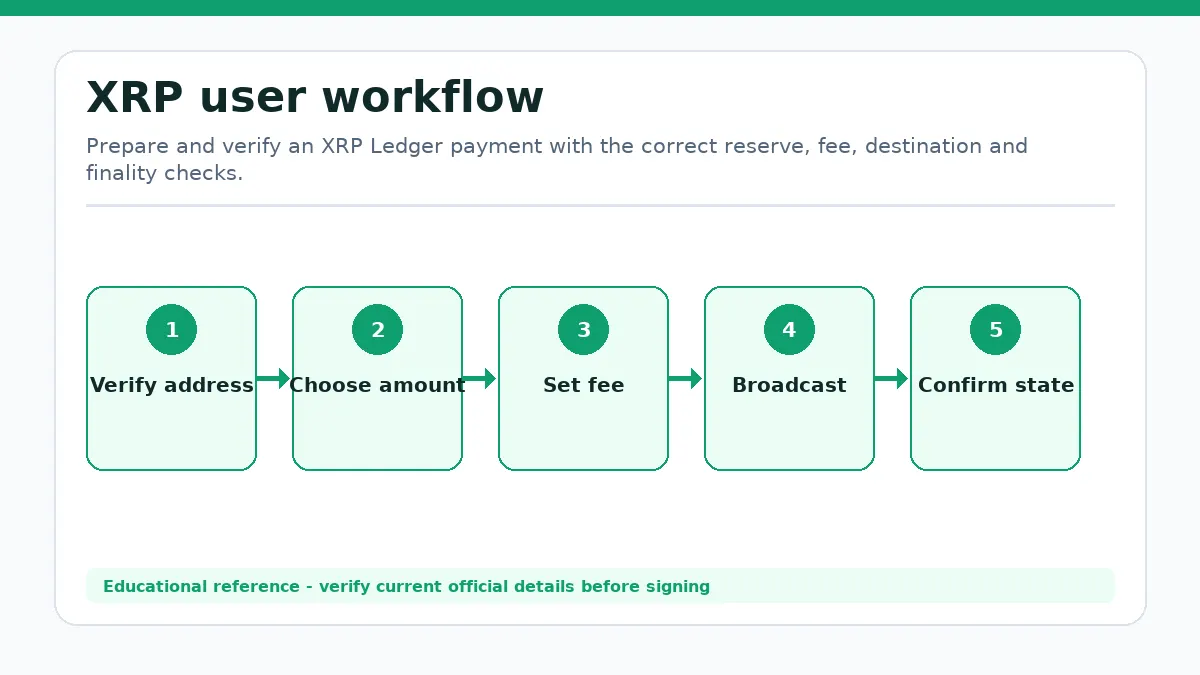
XRP workflow from the first user decision to a verified outcome.
Account state
An XRP Ledger account has an address, XRP balance, sequence number, signing configuration and owned ledger objects. A payment to a mathematically valid address can create the account when enough XRP is delivered to meet the current base reserve.
The reserve protects shared ledger storage. A base reserve applies to the account, and additional owned objects can add owner reserve. Reserved XRP is not a service fee, but it can limit what the account may send or create. Current values are network parameters and should be queried rather than hardcoded forever.
Identity boundary
The XRP Ledger is the network, XRP is its native asset, Ripple is a company, and RLUSD is an issued stable asset. None of those names should be used as interchangeable ownership or backing claims.
Historical Binance Spot candles are available. JavaScript is required for current-candle updates.
Historical Binance Spot candles are available. JavaScript is required for current-candle updates.
Recent OHLC and volume data
Time (UTC)
Open (USDT)
High (USDT)
Low (USDT)
Close (USDT)
Volume (XRP)
Oct 11, 2026 04:00:00 UTC
1.39 USDT
1.39 USDT
1.39 USDT
1.39 USDT
700,022.50 XRP
Oct 11, 2026 03:00:00 UTC
1.40 USDT
1.40 USDT
1.39 USDT
1.39 USDT
2,993,113.20 XRP
Oct 11, 2026 02:00:00 UTC
1.40 USDT
1.40 USDT
1.40 USDT
1.40 USDT
760,586.00 XRP
Oct 11, 2026 01:00:00 UTC
1.40 USDT
1.40 USDT
1.40 USDT
1.40 USDT
1,022,414.60 XRP
Oct 11, 2026 00:00:00 UTC
1.40 USDT
1.40 USDT
1.40 USDT
1.40 USDT
1,590,440.50 XRP
Market data: Binance Spot XRP/USDT
Charting library: TradingView Lightweight Charts
XRP Guidance for Holders
Native XRP payments and issued-currency payments use different amount representations and account relationships.
Transaction cost and sequence
Every ordinary signed transaction specifies a cost in XRP. The cost protects the network from spam and is destroyed rather than paid to a validator. The sender sequence orders transactions and prevents the same sequence from being applied twice. Under load, a fee that is too low can be queued or rejected.
Native XRP is represented directly. Issued assets identify a currency and issuer, and can require trust lines or other ledger objects. A familiar currency code does not prove the issuer or terms. The built-in decentralized exchange can match offers, but price and liquidity remain market conditions.
Destination checks
Verify the destination address, destination tag when required by a service, delivered amount rules and the exact issued-asset issuer. A missing tag on a custodial deposit can require manual recovery even if the ledger payment is valid.
When an XRP Transaction Is Final
The first response from a server is provisional; validation in a consensus ledger makes the outcome final.
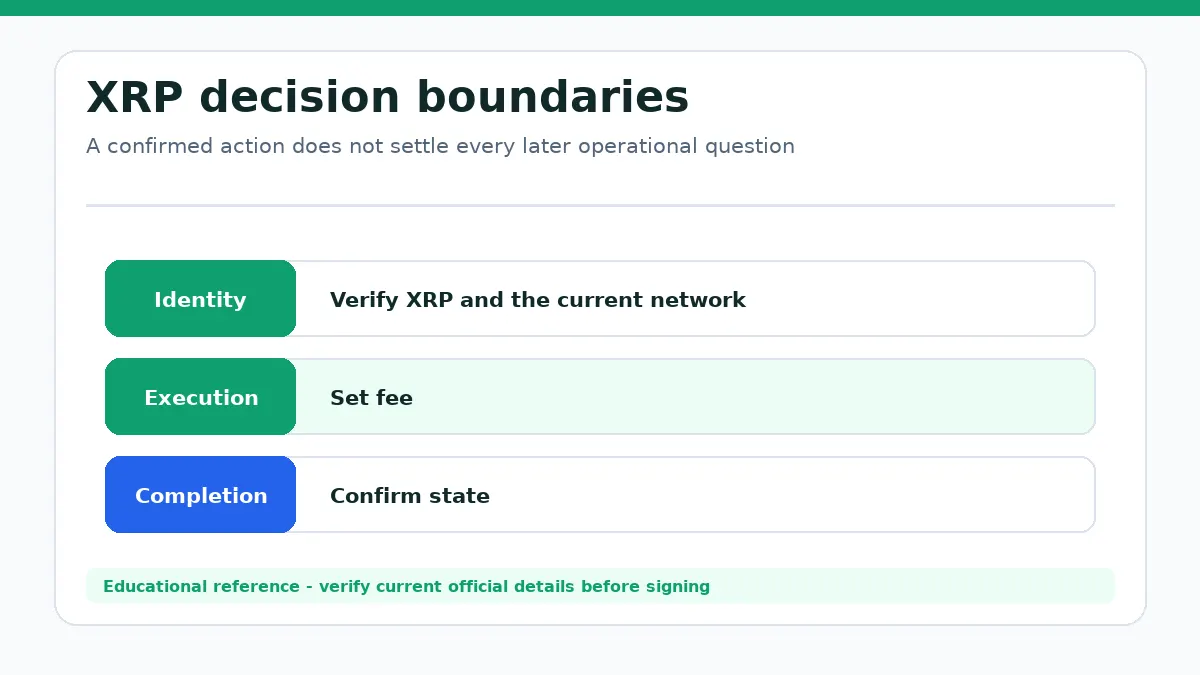
XRP confirmation does not settle every later operational question.
Consensus and validated ledgers
Servers propose transaction sets and compare results through the XRP Ledger consensus process. A transaction is final when it appears with its result in a validated ledger version. Successful and certain fee-claiming failures can both be included; the validated metadata is the authoritative outcome.
A tentative success returned after submission can change before consensus because ordering, load or expiry conditions differ. Reliable submission uses a bounded LastLedgerSequence, tracks the account sequence and checks independent validated-ledger data until the result is final or safely expired.
Application limit
Consensus finality does not validate an issuer, exchange or destination tag. Those are application-layer checks that remain the sender's responsibility.
Verify ledger rules and the receiving service before signing.
Before submission
Confirm XRP Ledger as the network, the recipient and destination tag, the current reserve, the fee and LastLedgerSequence, and any issued-asset issuer.
Do not describe XRP as Ripple shares.
Do not treat a provisional result as final.
Do not confuse issued assets with native XRP.
Do not omit a destination tag required by a custodian.
Next action
After broadcast, look up the transaction in a validated ledger and verify its final result and delivered amount.
Transactions are signed by accounts, provisionally evaluated and then accepted into validated ledger versions through the XRP Ledger consensus process. Fees are destroyed, and reserve requirements limit account and object creation.
A XRP transaction can be valid while the recipient still waits for more confirmations or cannot use the selected address type. XRP is the profiled market asset. XRP is destroyed to pay the anti-spam transaction cost.
What XRP users should verify and why this design differs
Reserve and fee parameters can change. Issued assets add issuer-specific risk.
For XRP, the practical sequence is Verify address, Choose amount, Set fee, Broadcast, Confirm state. Confirm the official destination and current network, then inspect the final balance, position, receipt or documented exit state that actually completes the task: Prepare and verify an XRP Ledger payment with the correct reserve, fee, destination and finality checks.
XRP Transactions FAQ
Is XRP ownership in Ripple?
No. XRP is the native asset of the XRP Ledger and is not company equity.
Who receives XRP transaction fees?
No one. The specified XRP transaction cost is destroyed when applied.
When is an XRP payment final?
When its outcome is included in a validated ledger version.
Known Limitations
Reserve and fee parameters can change.
Issued assets add issuer-specific risk.
The page does not verify a destination or payment route.
Market Data Methodology
The snapshot is CoinGecko aggregated XRP/USD data. The chart is Binance Spot XRP/USDT data. USD and USDT are separate quote units and values may differ.
Market Snapshot Source
CoinGecko aggregated market data (XRP/USD)
Candlestick Source
Binance Spot market data (XRP/USDT)
Pair
XRP/USDT
Venue
Binance Spot
Market Type
Spot
Timezone
UTC
Cache
Snapshot cache is approximately 60 seconds.
Failure Handling
Verified cached data is labeled Cached or Delayed. Missing values remain unavailable.