Celo is an OP Stack based Ethereum Layer 2. CELO is its profiled native and governance asset, while Celo fee abstraction can let approved ERC-20 currencies pay transaction fees. This page focuses on how CELO and Fee Currencies Work and the checks users need before sending funds, paying fees or using the network.
Use Celo after its Layer 2 migration with the correct network, fee currency and settlement expectations.
Subject:
Celo
Market mode:
Snapshot Only
Fee asset:
CELO/ERC-20
Timezone:
UTC
This page explains the current public architecture and user workflow. It does not guarantee bridge timing, fee-currency availability, sequencer uptime or investment performance.
Content ownership: BitcoinToolkit Editorial TeamTechnical references: Official protocol and developer documentation.Review approach: Technical explanations are checked against primary sources and updated when the network or asset changes.Last content review: Data integration last tested:
How CELO and Fee Currencies Work
Celo fee abstraction is a user-facing difference from ordinary ETH-only gas flows.
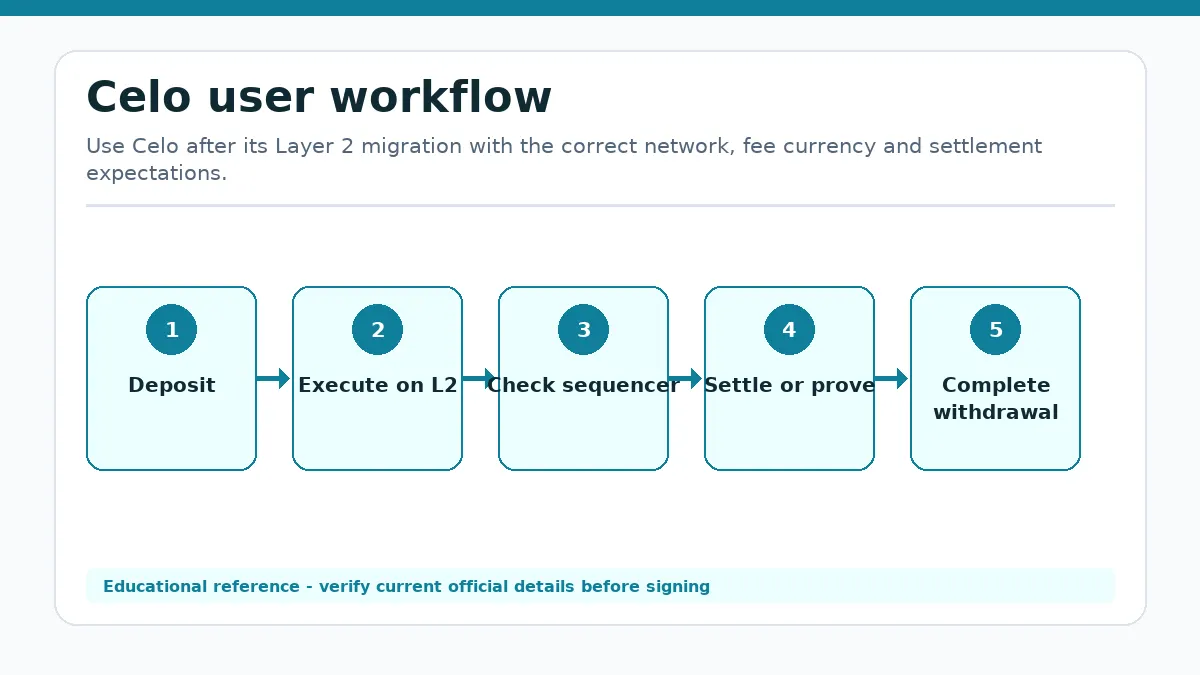
Celo workflow from the first user decision to a verified outcome.
CELO and approved tokens
CELO remains a native account balance and can be transferred without requiring an ERC-20 call, even though an ERC-20 interface is also available for compatibility. A wallet or indexer must account for both representations when interpreting activity.
Celo transactions can specify an approved ERC-20 fee currency instead of CELO. The permitted currencies are governed by protocol contracts and can change. A wallet must construct the correct Celo transaction type, quote the chosen fee currency and leave enough of that token to cover execution.
Common integration mistake
Fee abstraction does not mean every token can pay gas, and it does not mean a token transfer is free. Non-CELO fee currencies add transaction fields and overhead. Confirm support in the current fee-currency directory and in the signing wallet before presenting the option to a user.
The Next Celo Step
Current Celo behavior must be understood through its post-migration architecture.
Execution and settlement today
Celo runs EVM-compatible execution as an OP Stack based Layer 2 on Ethereum. Developers can use Solidity and familiar Ethereum transaction types, but Celo remains a separate chain with its own chain ID, state, RPC endpoints, block production and deployed contract addresses.
Older material may describe Celo as an independent proof-of-stake Layer 1 with its former validator lifecycle. That history can explain legacy tooling, but it should not be used to decide current settlement, sequencing or node responsibilities. Integrations need current Celo L2 documentation and current bridge routes.
Why the distinction matters
An L2 confirmation can describe successful Celo execution before every upstream settlement dependency reaches its strongest state. Applications should distinguish the fast local result from the Ethereum-aligned settlement state required for a high-value withdrawal or cross-chain action.
Moving between Ethereum and Celo is a cross-chain operation, not a normal same-chain transfer.
Before moving funds
Confirm the source network, destination network, canonical bridge route, token representation and destination address. A deposit usually locks or transfers an asset through bridge contracts and creates the corresponding L2 balance. A withdrawal follows the current Celo-to-Ethereum process and may have different completion assumptions from a Celo-local transfer.
Do not infer safety from a matching token symbol. Verify contract addresses and whether the destination service supports the exact Celo representation. Keep a supported fee currency on the network where the next transaction will be signed.
Finality expectation
Celo documentation describes fast local blocks and the current data-settlement design. Receiving services should still define which L2 and Ethereum states they require instead of treating a wallet success message as universal finality.
Current chain settings matter more than remembered pre-migration assumptions.
Use the current network
Update RPC and bridge configuration, verify the current Celo chain ID, check the chosen fee currency, and confirm that monitoring distinguishes a local L2 result from downstream settlement. Developers should test Celo-specific transaction types rather than assuming every Ethereum library path handles fee abstraction.
Do not use old L1 validator instructions.
Do not assume every ERC-20 can pay gas.
Do not send a token by symbol alone.
Do not promise a fixed bridge completion time.
Next action
Check the current Celo documentation and inspect the fee currency, bridge route and transaction receipt before moving production funds.
Celo executes EVM transactions in an L2 environment and settles through its current Ethereum-aligned architecture. Its migration changed validator, sequencing and settlement assumptions, so older standalone-L1 descriptions are no longer sufficient.
A Celo transaction can be accepted on the execution layer before settlement or a parent-chain withdrawal is complete. CELO is the profiled market asset. CELO or a governance-approved fee currency can pay transaction fees through Celo fee abstraction.
What Celo users should verify and why this design differs
This page explains the current public architecture and user workflow. Fee-currency and bridge support can change. Local L2 confirmation and cross-chain completion are different states.
For Celo, the practical sequence is Deposit, Execute on L2, Check sequencer state, Settle or prove, Complete withdrawal. Confirm the official destination and current network, then inspect the final balance, position, receipt or documented exit state that actually completes the task: Use Celo after its Layer 2 migration with the correct network, fee currency and settlement expectations.
Celo is an OP Stack based Ethereum Layer 2.
Celo Layer 2 use FAQ
Is Celo still an independent Layer 1?
No. Current Celo documentation describes an OP Stack based Ethereum Layer 2.
Can a stablecoin pay Celo fees?
An approved fee currency can pay gas when the wallet and current protocol directory support it.
Is a Celo confirmation the same as an Ethereum withdrawal completion?
No. Local execution and cross-chain settlement are different states.
What pays transaction fees when using Celo?
Approved Celo fee currencies (CELO/ERC-20) pays the applicable network fee. Verify the selected network before signing because a later approval, bridge, claim or exit can require another transaction.
Known Limitations
Fee-currency and bridge support can change.
Local L2 confirmation and cross-chain completion are different states.
The page does not quote bridge costs or completion times.
Market Data Methodology
The page uses a CoinGecko aggregated CELO/USD snapshot. No exchange chart is rendered for this entity.
Market Snapshot Source
CoinGecko aggregated market data (CELO/USD)
Cache
Snapshot cache is approximately 60 seconds.
Failure Handling
Verified cached data is labeled Cached or Delayed. Missing values remain unavailable.