XDC Network (XDC): How XDC Transactions and Gas Work
XDC Network is an EVM-compatible Layer 1 blockchain, and XDC is its native asset for transfers, gas and network economics. This page focuses on how XDC Transactions and Gas Work and the checks users need before sending funds, paying fees or using the network.
Understand XDC gas and XDPoS finality before sending a transaction or deploying an EVM contract.
Subject:
XDC Network
Market mode:
Snapshot Only
Fee asset:
XDC
Timezone:
UTC
This page does not provide an exchange chart, executable quote, validator recommendation or trade-finance endorsement.
Content ownership: BitcoinToolkit Editorial TeamTechnical references: Official protocol and developer documentation.Review approach: Technical explanations are checked against primary sources and updated when the network or asset changes.Last content review: Data integration last tested:
How XDC Transactions and Gas Work
An XDC transaction follows an account-based lifecycle from signing through EVM execution.
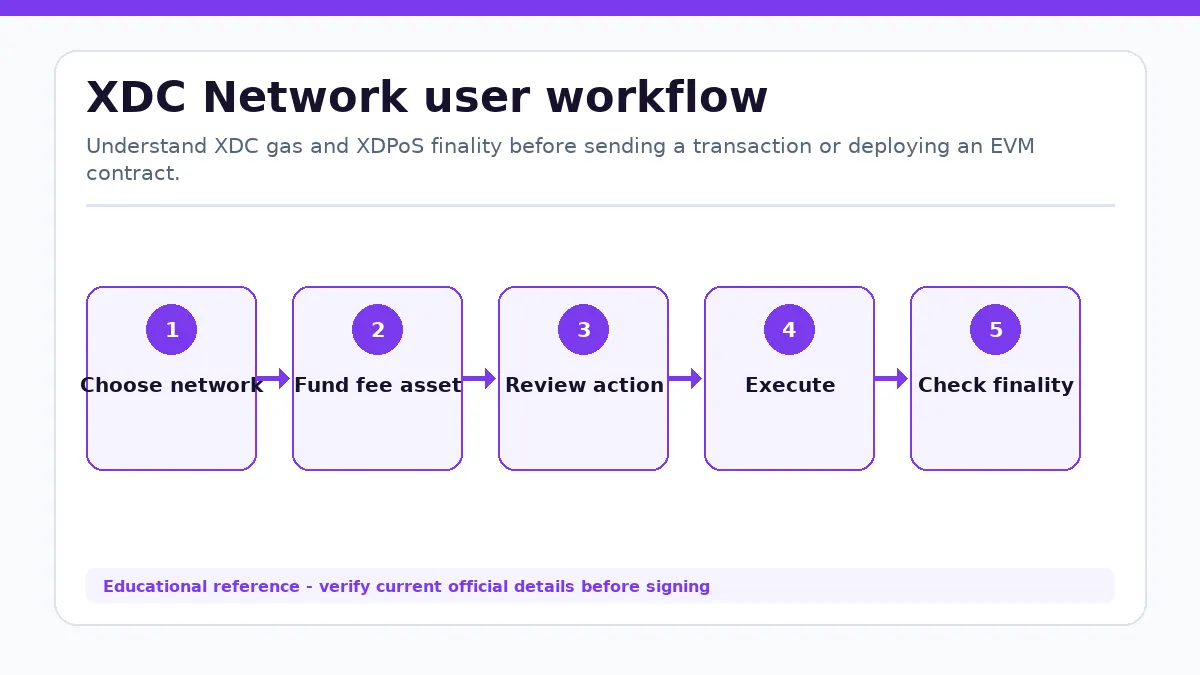
XDC Network workflow from the first user decision to a verified outcome.
From wallet to receipt
The sender selects the XDC Network chain, recipient, value or contract data, nonce and gas settings. The wallet signs the serialized payload, and an RPC node checks the signature, sender sequence, balance and fee limit before propagating it. A validator can then include it in a block and the EVM produces a receipt with status, logs and gas used.
Gas measures computation and storage work. The final fee is based on gas consumed and the applicable gas price, paid in native XDC. A failed contract call can still consume gas because nodes performed work. A token transfer therefore requires both the token balance and enough native XDC.
Compatibility check
Some interfaces display an xdc-prefixed address while EVM tools use a hexadecimal form. Verify the network and wallet presentation instead of changing a prefix blindly, and confirm the destination software supports the same address representation.
Where XDC Network Differs for Users
XDC Network combines an EVM execution environment with its own delegated validator and finality system.
Network and asset
XDC Network is the blockchain; XDC is the protocol-native balance used for value transfers and transaction fees. XRC-20 tokens are contract-managed balances. They can move through EVM calls, but they do not automatically replace XDC as the fee asset for the sending account.
EVM compatibility means familiar Solidity contracts, account addresses and RPC methods can be used. It does not mean XDC transactions settle on Ethereum or share Ethereum state. Applications must use XDC Network chain settings, deployed contract addresses and finality signals.
Positioning with evidence
Official materials describe enterprise and trade-finance use cases, but a network label does not validate a particular invoice, token or counterparty. Users still need to verify the application, contract and legal workflow involved in a transaction.
XDC Network block production and finality are governed by XDPoS rather than Ethereum proof of stake.
Validator behavior
XDPoS uses stake-supported validators and an active validator set. A scheduled proposer builds a candidate block, while other participating validators check it and exchange votes. The HotStuff-based state machine replication process seeks the quorum needed to commit a consistent block under Byzantine fault assumptions.
A transaction hash returned by an RPC endpoint proves submission, not finality. Initial inclusion gives a block reference; the committed state reported by current network software is the stronger application signal. Services should use a bounded expiration and verify the receipt on an independent endpoint when the action is valuable.
Limits
Finality assumes the documented validator and quorum model remains healthy. Validator set rules, fee parameters and software behavior can change through upgrades, so production applications should monitor current official releases.
A short network and asset check prevents most irreversible mistakes.
Transaction checklist
Confirm XDC Network rather than another EVM chain, verify the recipient and token contract, preserve enough native XDC for gas, and review the nonce and fee limit before signing. After broadcast, wait for a validated receipt and the finality policy required by the receiving service.
Do not treat XRC-20 balances as gas.
Do not infer Ethereum settlement from EVM compatibility.
Do not use a Snapshot Only price as an executable quote.
Check current network parameters before operating a validator.
Next action
Use an XDC-compatible wallet and a current explorer or RPC endpoint to inspect the transaction status. Developers should test address presentation, revert handling and finalized-state checks before enabling deposits or automated contract actions.
XDC Network is an EVM-compatible Layer 1 with its own validators, state and XDPoS finality.
What pays XDC transaction fees?
Native XDC pays gas for transfers and contract execution.
Why is there no chart?
The page intentionally uses a verified CoinGecko snapshot without inferring an exchange pair.
What should I verify before a XDC Network transaction?
Check the official destination, current network, asset representation, amount, recipient and requested permissions. XDPoS 2.0 combines delegated validator participation with a HotStuff-based Byzantine fault tolerant process. Transactions use EVM-compatible accounts and contracts, but finality depends on XDC Network validators rather than Ethereum Mainnet. After confirmation, inspect the resulting balance or protocol state instead of relying only on a wallet success message.
Known Limitations
The market module provides no exchange candles.
Network parameters and validator rules can change.
Enterprise positioning is not proof of a counterparty or asset claim.
Market Data Methodology
The page uses a CoinGecko aggregated XDC/USD snapshot. No exchange chart is rendered for this entity.
Market Snapshot Source
CoinGecko aggregated market data (XDC/USD)
Cache
Snapshot cache is approximately 60 seconds.
Failure Handling
Verified cached data is labeled Cached or Delayed. Missing values remain unavailable.