Bitcoin Cash is a peer-to-peer payment network, and BCH is its native asset. Transactions spend existing unspent outputs, create recipient and change outputs, and pay fees from the difference between inputs and outputs. This page focuses on how Bitcoin Cash Payments Work and the checks users need before sending funds, paying fees or using the network.
Help users understand how bitcoin cash payments work and make safer usage and transaction decisions for Bitcoin Cash.
Snapshot:
CoinGecko - BCH/USD reference
Chart:
Binance Spot - BCH/USDT
Network focus:
Payments, CashAddr and UTXO settlement
Timezone:
UTC
This page is an educational network and market reference. It is not a payment processor, executable exchange quote, price forecast or investment recommendation.
Content ownership: BitcoinToolkit Editorial TeamTechnical references: Official Bitcoin Cash protocol documentation.Review approach: Technical explanations are checked against primary Bitcoin Cash sources.Last content review: Data integration last tested:
Bitcoin Cash Payment Decisions
BitcoinToolkit separates CoinGecko BCH/USD data from Binance Spot BCH/USDT candles and explains payment-oriented transaction construction, CashAddr formats, fees and confirmation policies.
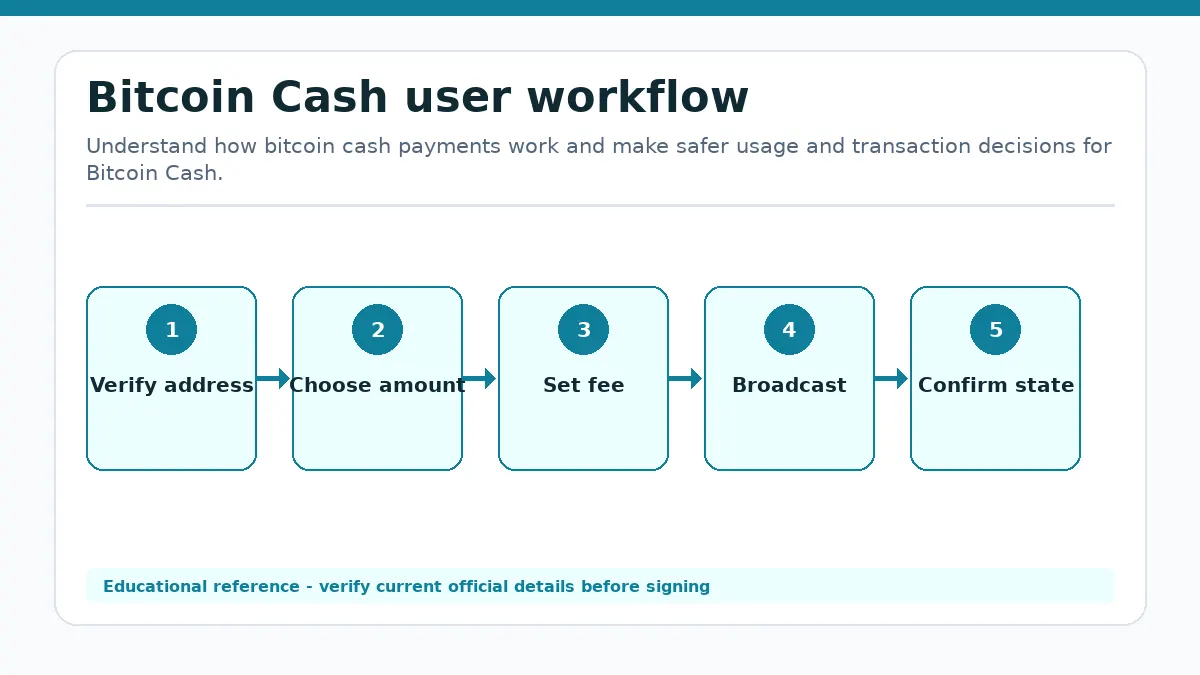
Bitcoin Cash workflow from the first user decision to a verified outcome.
What the Bitcoin Cash user is confirming
Bitcoin Cash miners use SHA-256 proof of work to order transactions into blocks. Nodes validate blocks and UTXO ownership under Bitcoin Cash rules, while confirmation depth reflects probabilistic settlement rather than instant finality.
BCH and transaction costs
Bitcoin Cash (BCH) is the asset profiled on this page. BCH is the asset displayed in the market snapshot and exchange chart.
Bitcoin Cash (BCH) pays the applicable transaction cost. BCH pays transaction fees on Bitcoin Cash.
BCH Candlestick Chart
BCH/USDT · Binance Spot · UTC
Historical Only
Pair
BCH/USDT
Venue
Binance Spot
Market Type
Spot
Interval
1H
Timezone
UTC
Last Update
Oct 11, 2026 00:45:24 UTC
Interval
Range
Long ranges automatically use a compatible candle interval.
Build outputsRecipient and change outputs are created.
Set feeThe input-output difference becomes the transaction fee.
SignRequired unlocking data authorizes each spend.
BroadcastPeers validate and relay the transaction.
Mine and confirmA proof-of-work block includes the transaction and later blocks add depth.
Payment flow
Wallets choose spendable outputs, build destination and change outputs, sign, then broadcast.
Fee note
The fee depends on serialized transaction size and network policy, not only the BCH amount sent.
Bitcoin Cash Address Formats
CashAddr is the preferred Bitcoin Cash address encoding; legacy Base58 strings can resemble Bitcoin addresses and require extra network checks.
Address Type
Common Prefix
Encoding
Typical Use
Compatibility Note
CashAddr P2PKH
bitcoincash:q
CashAddr
Standard BCH payment
Preferred when supported
CashAddr P2SH
bitcoincash:p
CashAddr
Script-hash destination
Confirm script and wallet support
Legacy P2PKH
1
Base58Check
Backward compatibility
Can resemble a Bitcoin address
Legacy P2SH
3
Base58Check
Backward compatibility
Can resemble a Bitcoin address
Preferred format
Use CashAddr when both sender and receiver support it.
Safety check
A similar-looking legacy address does not prove that the destination supports the intended network.
Bitcoin Cash Confirmations
A BCH confirmation means inclusion in an accepted block; subsequent proof-of-work blocks make reversal progressively more difficult.
0 confirmations
Seen before block inclusion; acceptance depends on receiver policy.
1 confirmation
Included in an accepted Bitcoin Cash block.
Additional confirmations
Greater accumulated proof of work reduces reversal risk.
Payment policy
Merchants and exchanges set confirmation requirements according to their risk tolerance.
Timing
The target interval is not a guarantee that each block arrives on schedule.
Bitcoin Cash Operating Context
This page is an educational network and market reference.
Before the next transaction
This page is an educational network and market reference.
Verify address for the current Bitcoin Cash route.
Choose amount for the current Bitcoin Cash route.
Set fee for the current Bitcoin Cash route.
Broadcast for the current Bitcoin Cash route.
Confirm state for the current Bitcoin Cash route.
Bitcoin Cash Transaction and Fee Checks
The BCH result needs context
A Bitcoin Cash transaction can be valid while the recipient still waits for more confirmations or cannot use the selected address type. BCH pays transaction fees on Bitcoin Cash.
What Bitcoin Cash users should verify and why this design differs
This page is an educational network and market reference. Wallet and service support for address encodings varies. Zero-confirmation acceptance is a merchant policy, not deterministic settlement.
For Bitcoin Cash, the practical sequence is Verify address, Choose amount, Set fee, Broadcast, Confirm state. Confirm the official destination and current network, then inspect the final balance, position, receipt or documented exit state that actually completes the task: Understand how bitcoin cash payments work and make safer usage and transaction decisions for Bitcoin Cash.
Bitcoin Cash Transactions FAQ
Is BCH the same asset as BTC?
No. Bitcoin Cash and Bitcoin are separate networks with separate ledgers and assets.
What is CashAddr?
CashAddr is the preferred Bitcoin Cash address encoding and can include a bitcoincash network prefix.
How are BCH fees calculated?
A transaction fee is the input total minus the output total; wallets estimate it from transaction size and policy.
How many confirmations are required?
The receiver chooses its own policy based on value and risk; confirmation depth is probabilistic rather than instant finality.
What pays transaction fees when using Bitcoin Cash?
Bitcoin Cash (BCH) pays the applicable network fee. BCH pays transaction fees on Bitcoin Cash. Verify the selected network before signing because a later approval, bridge, claim or exit can require another transaction.
Known Limitations
Wallet and service support for address encodings varies.
CoinGecko USD and Binance Spot BCH/USDT are separate datasets.
Market Data Methodology
The snapshot is CoinGecko aggregated BCH/USD data. The chart is Binance Spot BCH/USDT data. USD and USDT are different quote assets, so displayed values can differ.
Market Snapshot Source
CoinGecko aggregated market data (USD)
Candlestick Source
Binance Spot market data (BCH/USDT)
Pair
BCH/USDT
Venue
Binance Spot
Market Type
Spot
Timezone
UTC
Cache
Snapshot cache is approximately 60 seconds; historical candle cache varies by interval.
Failure Handling
Verified cache is labeled Cached or Delayed. Missing values remain unavailable.