Skip to content
BitcoinToolkit

The Sandbox (SAND): SAND, LAND and Creator Assets Have Different Roles

The Sandbox is a virtual-world platform where users create experiences and own tokenized LAND and assets. SAND is its fungible utility token across Ethereum and Polygon. This page focuses on sAND, LAND and Creator Assets Have Different Roles and the checks users need before using the protocol or evaluating the token role.

Use The Sandbox marketplace or creator tools while understanding SAND, LAND, Polygon and Ethereum asset states.

Subject:
The Sandbox
Market mode:
Snapshot Only
Fee asset:
ETH / POL
Timezone:
UTC

This page does not sell LAND, create an experience, bridge SAND, verify a collection, promise creator revenue, estimate staking yield or provide account support.

Content ownership: BitcoinToolkit Editorial Team Technical references: Official protocol and developer documentation. Review approach: Technical explanations are checked against primary sources and updated when the network or asset changes. Last content review: Data integration last tested:

SAND, LAND and Creator Assets Have Different Roles

A fungible marketplace balance is not the same property as an NFT parcel or game item.

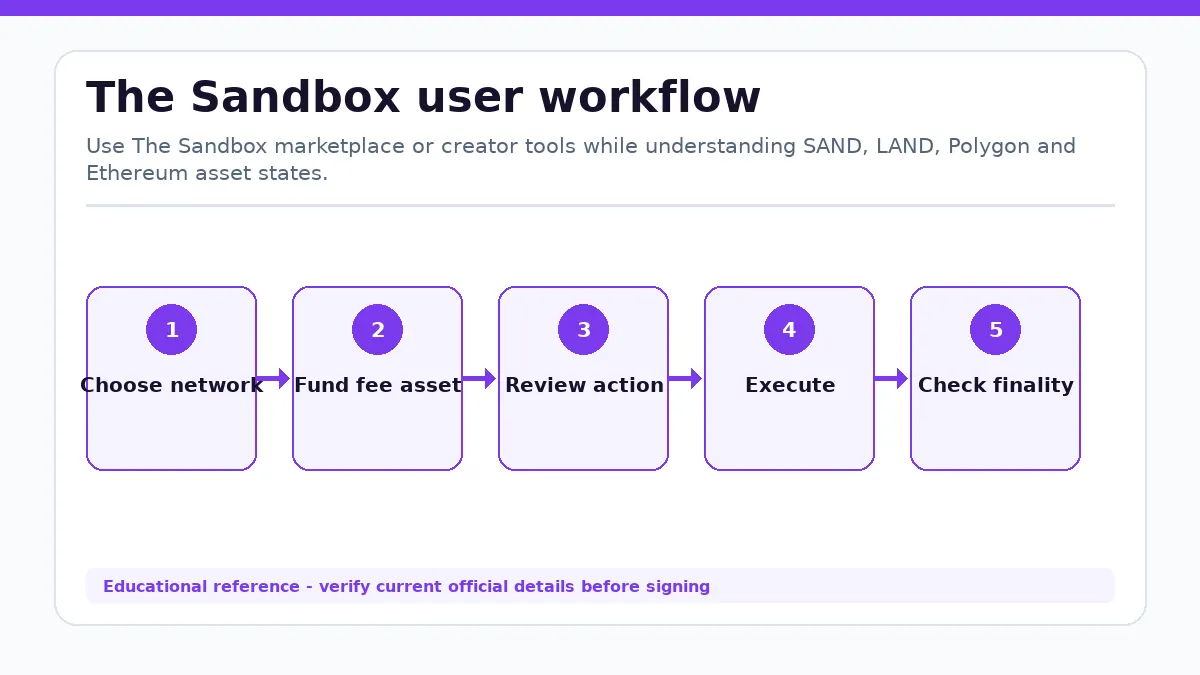
The Sandbox workflow showing Choose network, Fund fee asset, Review action, Execute, Check finality
The Sandbox workflow from the first user decision to a verified outcome.

Currency, parcels and experiences

SAND is the ecosystem medium used for marketplace and supported governance or staking activity. LAND is a finite NFT parcel used to locate published experiences. Creator assets, avatars and Catalysts use separate NFT contracts and attributes. Owning SAND does not grant LAND, and owning LAND does not automatically publish playable content.

Verify contract, network, token ID, coordinates, listing and seller before buying. A screenshot of the map is not ownership evidence. Check whether an asset is an official collection, a creator item or an external NFT and whether it is compatible with the intended game or publishing workflow.

Why The Sandbox's Design Matters

Older Ethereum assets and newer Polygon activity can coexist in one account.

Bridge and network selection

The Sandbox supports SAND and LAND on Ethereum and Polygon, while official LAND sales and newer marketplace activity use Polygon. The official bridge locks or releases the source representation and completes the destination transfer through checkpointed steps. Some items can still remain on Ethereum.

Check the asset contract and network before listing or purchasing. Keep ETH or POL when gas is not sponsored. A gasless allowance is a platform service with limits, not a fee-free property of Polygon. Save both bridge transactions and wait for the documented completion state before retrying.

Publishing Requires More Than Owning an NFT

Creation, minting, listing and publishing are separate platform actions.

Build and release

Creators can build voxel assets and experiences, mint eligible items, create marketplace listings and publish experiences to owned or rented LAND under current platform rules. Account verification, content review, file compatibility, royalties and seasonal availability can affect each step.

Do not upload copyrighted content without rights, buy an NFT assuming it includes commercial rights or grant a marketplace approval to an imitation site. Preserve source files and version records. Creator revenue depends on audience, pricing, royalties, platform policy and market demand rather than LAND ownership alone.

Choose the Next Sandbox Check

Start from the exact asset and action. Verify whether the item is SAND, LAND, an ASSET or a game inventory record, then match its contract, token ID, network and marketplace order before approving payment or publishing an experience.

Player, buyer or creator

Players should verify item compatibility and account custody. Buyers should check network, contract, listing and LAND coordinates. Creators should confirm review, mint and publishing requirements. Bridge users should track source, checkpoint and destination states before taking another action.

Keep wallet and game credentials separate, revoke unused approvals and preserve receipts. Use Polygon or Ethereum tools for the chain holding the asset and security tools for collection and spender verification.

Browse security tools

The Sandbox Operating Context

The SAND result needs context

LAND defines virtual parcels, creator tools publish experiences and assets, marketplace contracts exchange items for SAND, and a bridge moves supported SAND and LAND representations between Ethereum and Polygon.

A The Sandbox transaction can execute successfully while the application state, contract permission or later exit remains wrong for the user's goal. SAND is the ecosystem asset shown in the snapshot. ETH or POL pays gas when transactions are not sponsored.

What The Sandbox users should verify and why this design differs

Marketplace, bridge and sponsored-gas rules can change. NFT ownership does not guarantee compatibility or revenue.

For The Sandbox, the practical sequence is Choose network, Fund fee asset, Review action, Execute, Check finality. Confirm the official destination and current network, then inspect the final balance, position, receipt or documented exit state that actually completes the task: Use The Sandbox marketplace or creator tools while understanding SAND, LAND, Polygon and Ethereum asset states.

The Sandbox Network use FAQ

Is SAND the same as LAND?

No. SAND is fungible; LAND is a parcel NFT.

Does every Sandbox asset live on Polygon?

No. Ethereum and Polygon assets coexist, so verify the contract and network.

Are Polygon transactions always free?

No. The platform may sponsor eligible actions, but Polygon itself still has gas.

What pays transaction fees when using The Sandbox?

Host-chain gas asset (ETH / POL) pays the applicable network fee. ETH or POL pays gas when transactions are not sponsored. Verify the selected network before signing because a later approval, bridge, claim or exit can require another transaction.

Known Limitations

Market Data Methodology

The page uses a CoinGecko aggregated SAND/USD snapshot. No exchange chart is rendered for this entity.

Market Snapshot Source
CoinGecko aggregated market data (SAND/USD)
Cache
Snapshot cache is approximately 60 seconds.
Failure Handling
Verified cached data is labeled Cached or Delayed. Missing values remain unavailable.
Snapshot Status
Delayed
Report Issue
Report a market-data problem →

Technical Sources

Selected primary sources support the operational explanations. Market-provider attribution remains separate.

Editorial Information

Verified technical content, reviewed sources and update history.

Published
Last Review
Data Verification
Sources
Official documentation