Skip to content
BitcoinToolkit

Livepeer (LPT): A Video Job Moves Through Gateways and Orchestrators

Use or support Livepeer video infrastructure while understanding LPT, ETH fees and operator responsibilities.

Subject:
Livepeer
Market mode:
Snapshot Only
Fee asset:
ETH
Timezone:
UTC

This page does not transcode video, quote a job, operate a node, predict staking rewards or state that every Livepeer AI workload uses video-network staking.

Content ownership: BitcoinToolkit Editorial Team Technical references: Official protocol and developer documentation. Review approach: Technical explanations are checked against primary sources and updated when the network or asset changes. Last content review: Data integration last tested:

A Video Job Moves Through Gateways and Orchestrators

The customer-facing endpoint and the machine doing the media work are separate protocol roles.

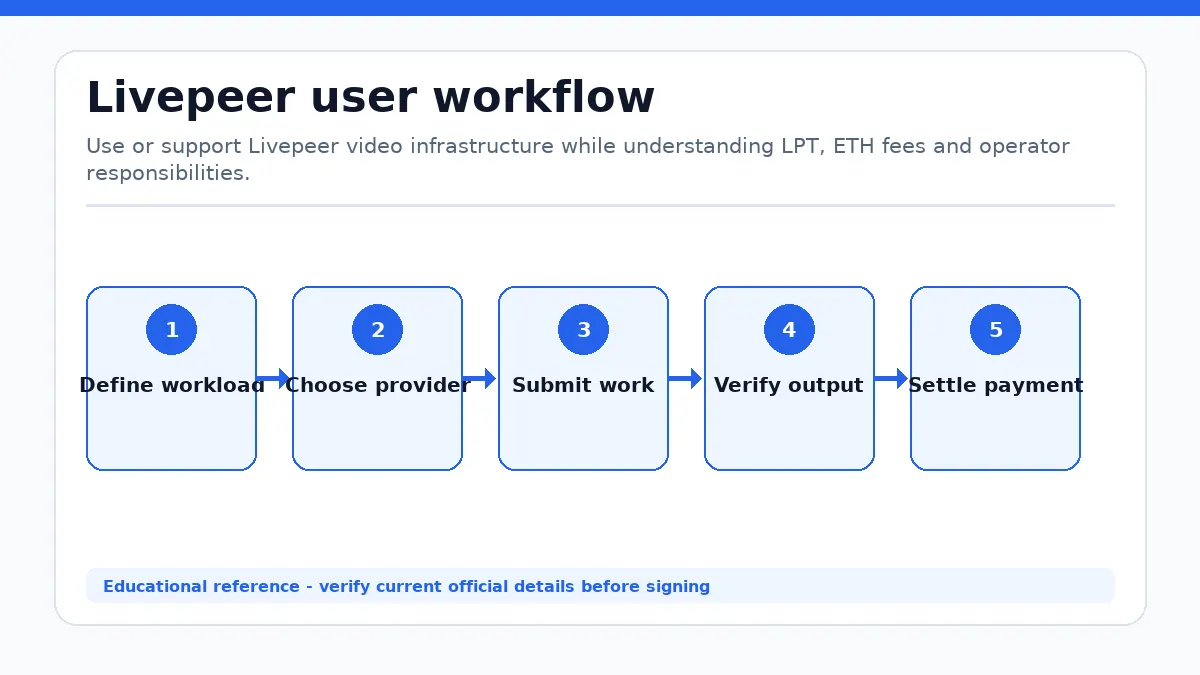
Livepeer workflow showing Define workload, Choose provider, Submit work, Verify output, Settle payment
Livepeer workflow from the first user decision to a verified outcome.

Route, transcode and return

A broadcaster or application sends source media and a set of output requirements to a gateway. The gateway discovers orchestrators, evaluates price and service signals, and routes segments for transcoding. An orchestrator coordinates one or more transcoders, returns renditions and receives payment when its work satisfies the requested job conditions.

Before production use, test codecs, resolutions, latency, geographic reach, gateway failover and output verification. Record the gateway, manifest or stream identifier and payment account. A decentralized provider set does not eliminate application-level monitoring, storage, delivery-network or content-rights obligations.

LPT Delegation Coordinates Video-Network Capacity

Delegation is exposure to an operator and protocol rules, not a fixed-income account.

Stake, service and rewards

Orchestrators bond LPT and can attract delegated LPT.

Compare recent activity, fee share, reward cut, reliability and claimed capacity rather than choosing only the largest operator. Delegation changes require Arbitrum gas and may be subject to protocol rounds or unbonding rules. Historical reward rates are not a promise of future jobs, emissions or token value.

Video and AI Compute Have Different Operating Paths

A shared brand and provider community do not make every workload economically identical.

Check the product path

Livepeer video uses the established gateway, orchestrator, staking and payment mechanisms documented for media transcoding. Livepeer AI also connects applications to distributed GPU providers, but current AI job routing and payment behavior can differ from the video active-set and inflation model. Product documentation should decide which flow applies.

Do not infer that holding LPT reserves a GPU, that delegating LPT runs a transcoder, or that an AI endpoint inherits the same verification and pricing as video. Confirm model, image, region, container, billing unit, data handling and result-verification terms before sending a workload.

Choose the Next Livepeer Check

The useful evidence depends on whether you buy service, operate capacity or delegate stake. Verify each role independently.

Customer, operator or delegator

Customers should benchmark quality, latency, price and failover using their actual media. Operators should verify hardware, pricing, public reachability, ETH payment setup and LPT bond state. Delegators should verify the orchestrator address, network, commission, reward history and unbonding workflow before signing.

Keep ETH for host-chain transactions and distinguish an LPT transfer on Ethereum from protocol activity on Arbitrum. Preserve transaction hashes and job identifiers separately. Use wallet tools to verify addresses and Arbitrum tools to inspect delegation or operator transactions.

Browse developer tools

Livepeer Resource use FAQ

What pays transaction fees when using Livepeer?

Ether (ETH) pays the applicable network fee. Verify the selected network before signing because a later approval, bridge, claim or exit can require another transaction.

How is work or data verified before Livepeer settlement?

Verification depends on the network's documented provider, proof, availability or result-checking process; a token transfer alone does not prove useful work.

Known Limitations

Market Data Methodology

The page uses a CoinGecko aggregated LPT/USD snapshot. No exchange chart is rendered for this entity.

Market Snapshot Source
CoinGecko aggregated market data (LPT/USD)
Cache
Snapshot cache is approximately 60 seconds.
Failure Handling
Verified cached data is labeled Cached or Delayed. Missing values remain unavailable.
Snapshot Status
Delayed
Report Issue
Report a market-data problem →

Technical Sources

Selected primary sources support the operational explanations. Market-provider attribution remains separate.

Editorial Information

Verified technical content, reviewed sources and update history.

Published
Last Review
Data Verification
Sources
Official documentation