Skip to content
BitcoinToolkit

FLOKI (FLOKI): Gas, Token Tax and Product Fees Are Separate Costs

FLOKI is a brand and application ecosystem token represented on Ethereum and BNB Smart Chain. It is not the native currency of either network and does not operate an independent consensus system. This page focuses on gas, Token Tax and Product Fees Are Separate Costs and the checks users need before holding, transferring or verifying the token.

Transfer or use canonical FLOKI while distinguishing host chains, fees, taxes and product-specific risks.

Subject:
FLOKI
Market mode:
Snapshot Only
Fee asset:
ETH / BNB
Timezone:
UTC

This page does not quote a trade, bridge tokens, predict returns, verify a product balance, promise ecosystem delivery or treat a brand statement as independent evidence.

Content ownership: BitcoinToolkit Editorial Team Technical references: Official protocol and developer documentation. Review approach: Technical explanations are checked against primary sources and updated when the network or asset changes. Last content review: Data integration last tested:

Gas, Token Tax and Product Fees Are Separate Costs

A successful transaction can include more than one economic layer.

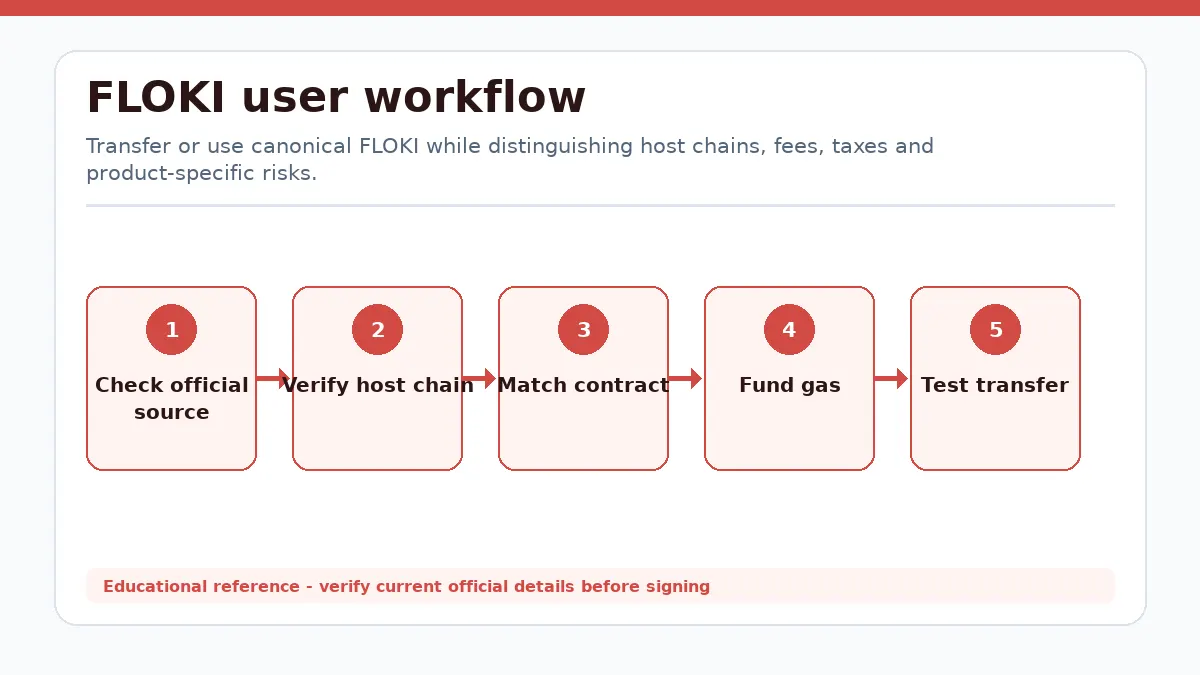
FLOKI workflow showing Check official source, Verify host chain, Match contract or mint, Fund gas, Test transfer
FLOKI workflow from the first user decision to a verified outcome.

Host execution and token rules

ETH or BNB pays host-chain execution. Current Floki documentation also describes a token tax on qualifying onchain buys and sells, while ordinary transfers and supported chain movement can follow different rules. Individual ecosystem products, including lockers or trading tools, can charge their own service fees.

Estimate received amount from the actual router or exchange path rather than subtracting gas alone. Review approval targets and minimum output. Product fee and buyback descriptions can change, and a no-tax transfer does not make an unknown contract safe. Never approve a copied spender before verifying the official product domain.

Why FLOKI's Design Matters

The same ticker appears on two networks with different contracts and gas assets.

Ethereum and BNB Smart Chain

FLOKI launched on Ethereum and later added a BNB Smart Chain representation. Official material describes the two supplies as connected through supported exchange-based 1:1 movement rather than one token account existing simultaneously on both chains. Ethereum transactions use the ERC-20 contract; BNB Smart Chain transactions use the BEP-20 contract.

Before a withdrawal or swap, verify network, contract, decimals, destination and exchange support. Keep ETH for Ethereum or BNB for BNB Smart Chain gas. A balance on one chain cannot be sent directly to an address deposit route that supports only the other representation, even when the wallet address text looks compatible.

Ecosystem Uses Must Be Verified Product by Product

A broad ecosystem label is not a guarantee that every announced feature is live or available everywhere.

Application and token boundaries

Floki documentation associates FLOKI with gaming, staking, education, locker, card and trading products. Each product has separate contracts, access conditions, regions, custody and fees. Holding FLOKI does not automatically create an account, confer ownership of a product or guarantee that a planned feature has launched.

Check the current product page and contract at the time of use. Separate token staking from game balances, card funds, locker positions and bot wallets. Avoid sending tokens to a product address without an explicit deposit flow, and do not infer that treasury spending or burn policy creates a guaranteed market outcome.

Choose the Next FLOKI Check

Start with chain identity, then evaluate the intended product action.

Holder, trader or product user

Holders should verify contract, host chain and custody. Traders should compare gas, token tax, liquidity and minimum return. Product users should read the specific terms and approval path. Anyone moving between chains should confirm that the selected exchange or service explicitly supports both representations.

Save transaction hashes and the contract address used. Revoke unnecessary approvals and ignore unsolicited replacement tokens. Continue to Ethereum or BNB Chain pages for host-network behavior, and use wallet or security tools for the actual address and spender.

Browse security tools

The Next FLOKI Step

The FLOKI result needs context

Canonical contracts track FLOKI balances on each host chain, exchange-supported movement links the representations under current policy, and ecosystem products can use fees, staking or token-related mechanisms.

A token can display the FLOKI ticker and FLOKI branding without being the canonical contract or mint. FLOKI is the ecosystem asset shown in the snapshot. ETH or BNB pays transaction gas for the selected FLOKI representation.

What FLOKI users should verify and why this design differs

Products, fees and token rules can change. Cross-chain support depends on the selected service.

For FLOKI, the practical sequence is Check official source, Verify host chain, Match contract or mint, Fund gas, Test transfer. Confirm the official destination and current network, then inspect the final balance, position, receipt or documented exit state that actually completes the task: Transfer or use canonical FLOKI while distinguishing host chains, fees, taxes and product-specific risks.

FLOKI Token verification FAQ

Does FLOKI pay Ethereum or BNB Chain gas?

No. ETH or BNB pays gas on the selected chain.

Can FLOKI be sent directly between the two chains?

Use a currently supported movement route; a normal token transfer stays on its source chain.

Does holding FLOKI activate every ecosystem product?

No. Each product has separate access and operating rules.

Known Limitations

Market Data Methodology

The page uses a CoinGecko aggregated FLOKI/USD snapshot. No exchange chart is rendered for this entity.

Market Snapshot Source
CoinGecko aggregated market data (FLOKI/USD)
Cache
Snapshot cache is approximately 60 seconds.
Failure Handling
Verified cached data is labeled Cached or Delayed. Missing values remain unavailable.
Snapshot Status
Delayed
Report Issue
Report a market-data problem →

Technical Sources

Selected primary sources support the operational explanations. Market-provider attribution remains separate.

Editorial Information

Verified technical content, reviewed sources and update history.

Published
Last Review
Data Verification
Sources
Official documentation