Skip to content
BitcoinToolkit

Grass (GRASS): Grass Nodes Relay Authenticated Public-Web Requests

Grass is a distributed network that uses participant bandwidth to retrieve public web data for structured datasets and AI workflows. GRASS is its Solana-hosted network asset. This page focuses on grass Nodes Relay Authenticated Public-Web Requests and the checks users need before integrating the service or using the token.

Contribute bandwidth or use GRASS while understanding node traffic, provenance, staking and Solana fees.

Subject:
Grass
Market mode:
Snapshot Only
Fee asset:
SOL
Timezone:
UTC

This page does not install a node, estimate points or rewards, approve an IP address, guarantee data buyers, validate legal use or certify privacy.

Content ownership: BitcoinToolkit Editorial Team Technical references: Official protocol and developer documentation. Review approach: Technical explanations are checked against primary sources and updated when the network or asset changes. Last content review: Data integration last tested:

Grass Nodes Relay Authenticated Public-Web Requests

The node supplies a route to public data; it is not advertised as remote access to personal files.

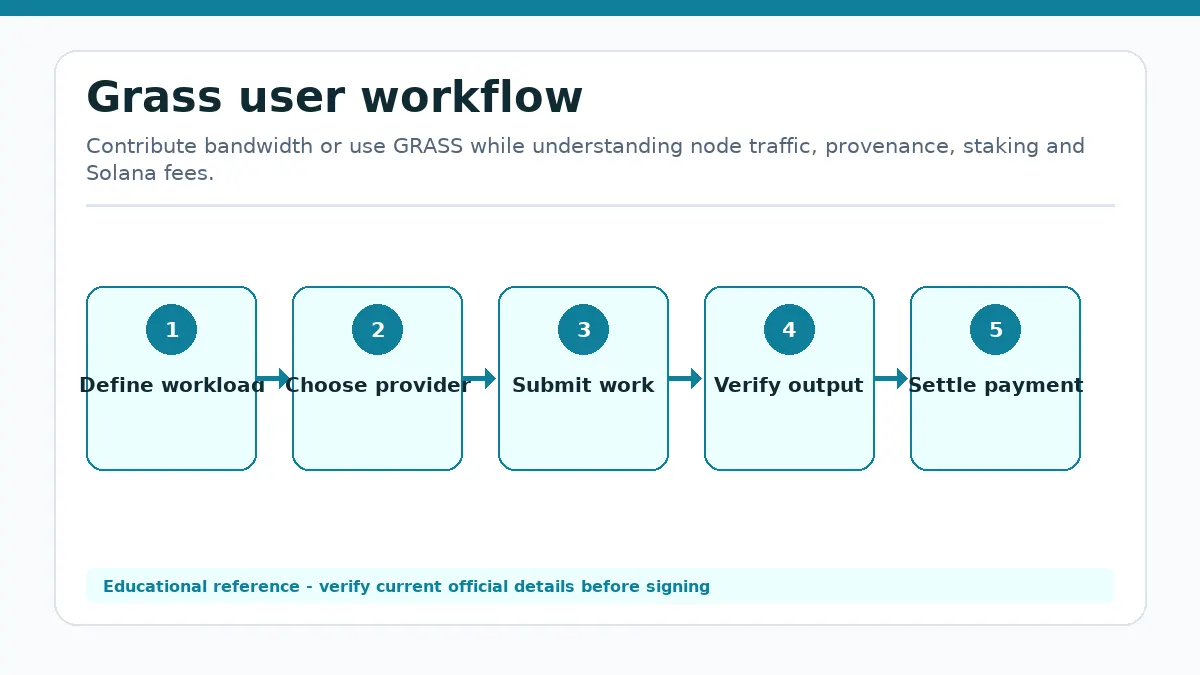
Grass workflow showing Define workload, Choose provider, Submit work, Verify output, Settle payment
Grass workflow from the first user decision to a verified outcome.

Node, Router and validator path

A Grass Node receives an encrypted request, connects to the specified public web destination and returns the response to a Router. Routers coordinate traffic from many nodes, while validators measure traffic and reputation signals used by the network. Downstream systems can transform collected public data into datasets and provenance records.

Run only the official client on a network and device you are authorized to use. Monitor destination complaints, bandwidth use, uptime and account status. The claim that a node does not inspect personal activity is not permission to ignore employer, ISP, housing, jurisdiction or application terms.
Reputation and Demand Shape Node Activity

A connected node can remain idle when its location or service quality is not needed.

Completeness, consistency and availability

Keep the client current and avoid running duplicate, modified or unsupported software that can distort device identity. Record account, node and claim information separately. When a dashboard value changes, distinguish node uptime, network scoring, reward program timing and Solana settlement instead of treating them as one state.

Bandwidth Sharing Creates an IP and Policy Decision

Encrypted traffic can still leave a public destination seeing the operator connection address.

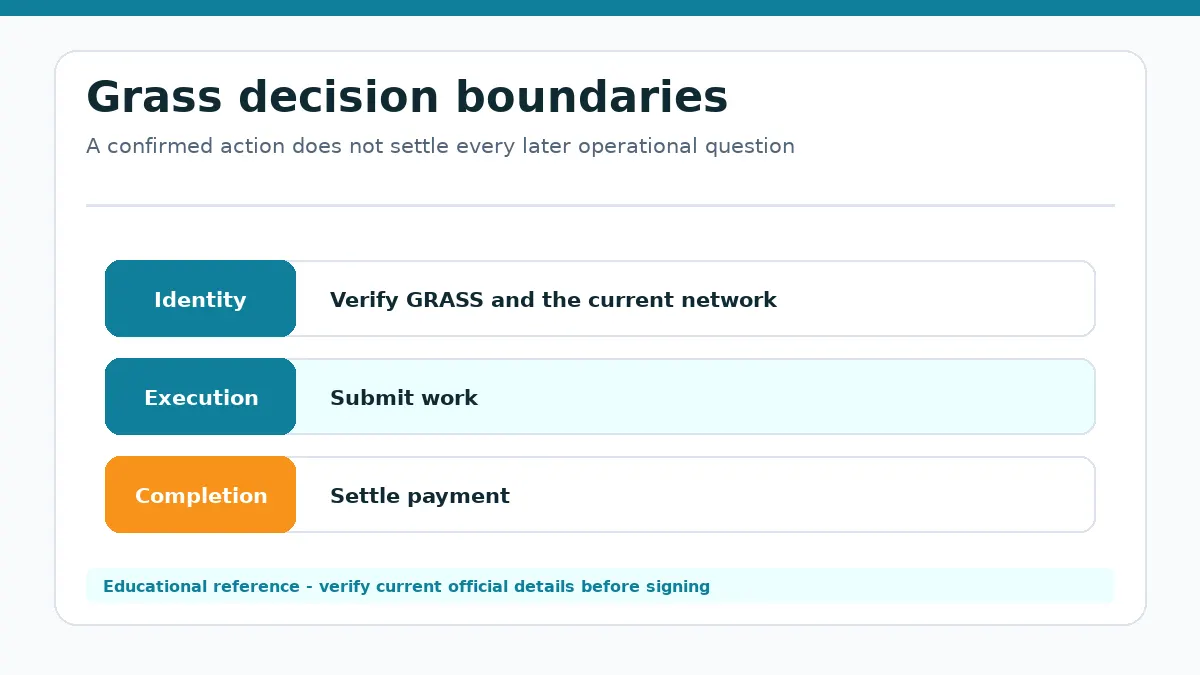
Grass decision diagram separating identity, execution and completion checks
Grass confirmation does not settle every later operational question.

Private data and public egress

The official model says the node relays public-web requests and does not browse private files, but the operator still supplies bandwidth and a network egress point. Endpoint security, account security, local policy and the destinations reached through that egress remain practical concerns even when payload handling is constrained by the client.

Do not install on a corporate machine without authorization, disable endpoint protection to improve points or publish account credentials for support. Review application permissions and remove the client cleanly when leaving. A token reward does not transfer responsibility for local network or device rules.

Choose the Next Grass Check

Separate node operation, staking and token custody before taking action.

Operator, Router delegator or token holder

Node operators should confirm client origin, IP permission, uptime and account eligibility. Router delegators should verify the Router, commission, stake state and slashing rules. Token holders should verify the official Solana mint and fixed-supply disclosures rather than relying on a ticker or an unsolicited airdrop.

Keep SOL for transactions and token-account rent. GRASS can support service, reward, staking and governance roles, but SOL still executes Solana transactions. Save claim and stake transaction hashes and use wallet tools for addresses actually controlled by the user.

Browse wallet tools

Grass Resource use FAQ

What pays transaction fees when using Grass?

Solana (SOL) pays the applicable network fee. SOL pays Solana transaction fees. Verify the selected network before signing because a later approval, bridge, claim or exit can require another transaction.

How is work or data verified before Grass settlement?

Verification depends on the network's documented provider, proof, availability or result-checking process; a token transfer alone does not prove useful work.

Known Limitations

Market Data Methodology

The page uses a CoinGecko aggregated GRASS/USD snapshot. No exchange chart is rendered for this entity.

Market Snapshot Source
CoinGecko aggregated market data (GRASS/USD)
Cache
Snapshot cache is approximately 60 seconds.
Failure Handling
Verified cached data is labeled Cached or Delayed. Missing values remain unavailable.
Snapshot Status
Delayed
Report Issue
Report a market-data problem →

Technical Sources

Selected primary sources support the operational explanations. Market-provider attribution remains separate.

Editorial Information

Verified technical content, reviewed sources and update history.

Published
Last Review
Data Verification
Sources
Official documentation