Skip to content
BitcoinToolkit

Helium (HNT): HNT, Data Credits and SOL Pay for Different Things

Helium is a decentralized wireless network for IoT and mobile connectivity. Its protocol programs and tokens run on Solana; HNT can be burned into Data Credits used for network services. This page focuses on hNT, Data Credits and SOL Pay for Different Things and the checks users need before integrating the service or using the token.

Use HNT or operate Helium hardware while understanding Data Credits, Solana fees and subnetwork roles.

Subject:
Helium
Market mode:
Snapshot Only
Fee asset:
SOL
Timezone:
UTC

This page does not predict Hotspot rewards, validate coverage, onboard hardware, calculate radio compliance, sell connectivity or recover a legacy Helium-chain wallet.

Content ownership: BitcoinToolkit Editorial Team Technical references: Official protocol and developer documentation. Review approach: Technical explanations are checked against primary sources and updated when the network or asset changes. Last content review: Data integration last tested:

HNT, Data Credits and SOL Pay for Different Things

A Helium wallet needs to track protocol usage and blockchain execution separately.

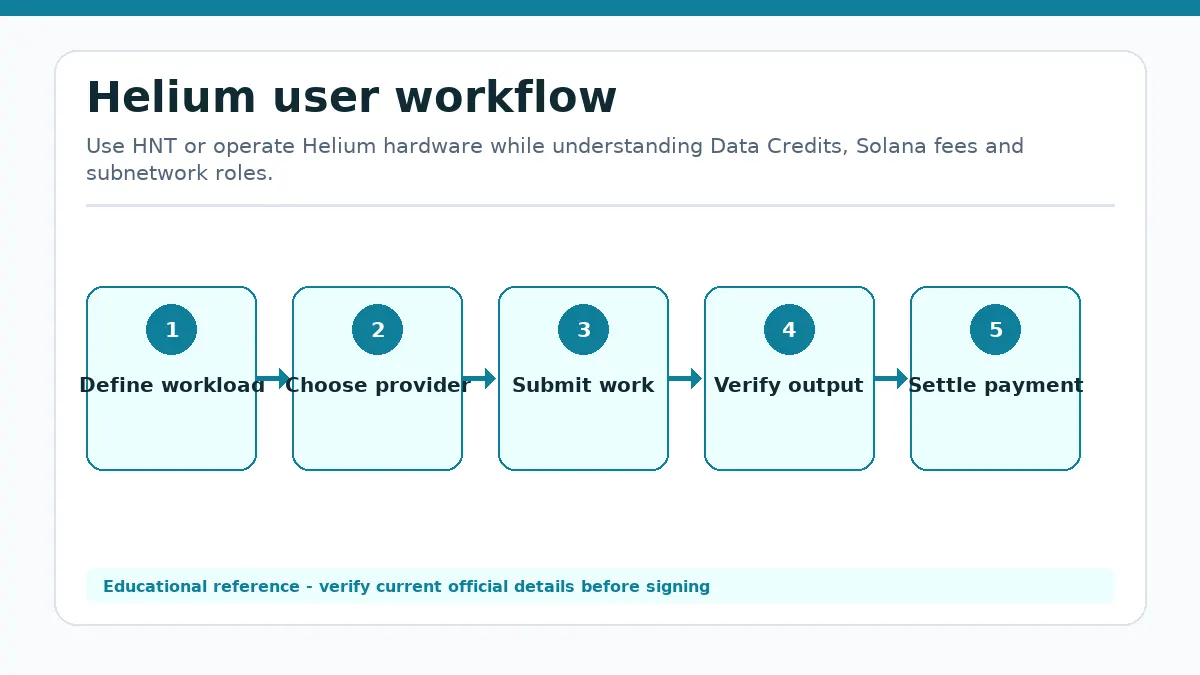
Helium workflow showing Define workload, Choose provider, Submit work, Verify output, Settle payment
Helium workflow from the first user decision to a verified outcome.

Protocol asset, usage credit and host gas

HNT is the central Helium protocol asset and can be burned to create Data Credits. DC is a USD-oriented utility credit used for wireless data and specified network operations; the conversion is one-way and DC is not an ordinary transferable investment token. SOL pays Solana transaction fees and account rent for HNT transfers, reward claims and program interactions.

Keep enough SOL before claiming, moving or locking Helium tokens. Estimate DC from the intended wireless payload or onboarding action, not from Solana gas. Burning HNT permanently changes it into service credit, so confirm the destination organization or delegated account first. Do not buy a token named DC or assume HNT alone can submit a Solana transaction.
Hotspots Provide Wireless Service, Not Blockchain Consensus

Radio operations, coverage evidence and reward distribution are distinct from Solana validators.

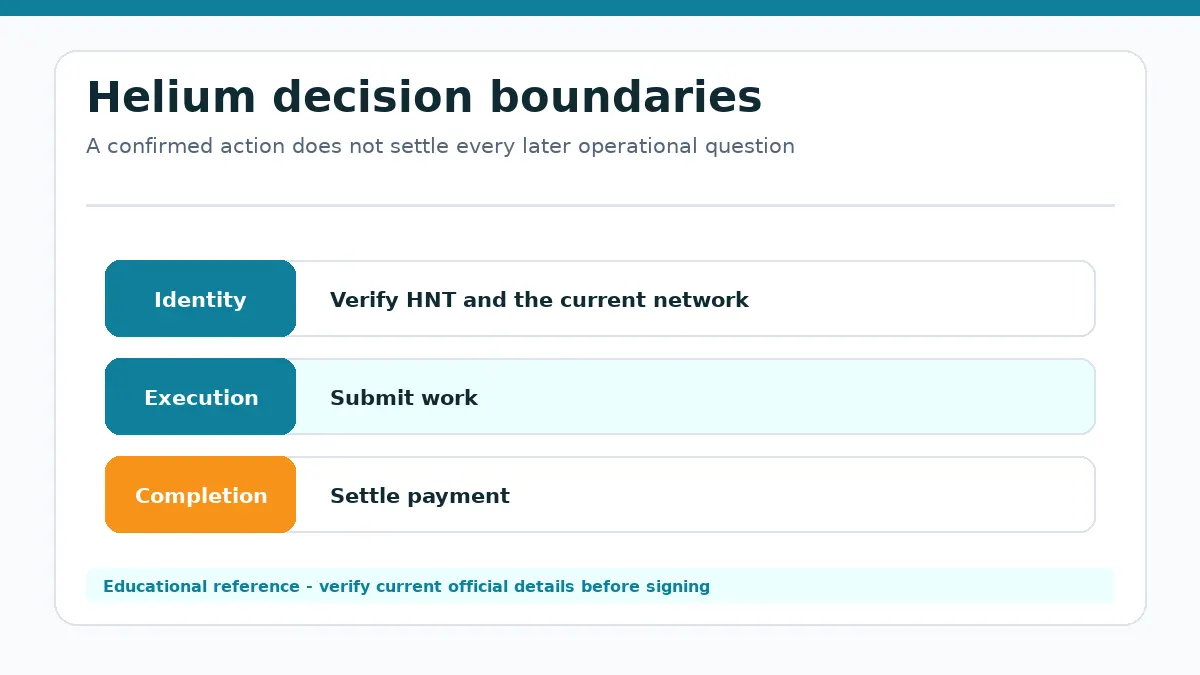
Helium decision diagram separating identity, execution and completion checks
Helium confirmation does not settle every later operational question.

Onboard, serve traffic and claim

Helium Hotspots or converted Wi-Fi networks register rewardable entities through Helium programs on Solana. IoT gateways carry LoRaWAN device traffic, while mobile deployments support approved cellular or Wi-Fi offload flows. Current reward rules evaluate eligible coverage and data activity and distribute HNT through program-controlled mechanisms.

Before deployment, verify hardware, region, antenna or access-point placement, backhaul, local radio requirements, onboarding fees and operator terms. A coverage-map hex or successful onboarding transaction does not guarantee meaningful traffic or rewards. Record the Hotspot asset, owner wallet and reward destination, and use current network tools to diagnose activity.

Helium Migrated to Solana in 2023

Current HNT, IOT, MOBILE and DC identities are Solana token mints or program records.

Mints, accounts and legacy assumptions

Verify the HNT mint and Solana network before importing a token. IOT and MOBILE are subnetwork-related assets with their own mints and roles; they are not aliases for HNT. A wallet may need separate token accounts and SOL rent. Never send a current SPL token to a legacy address or trust a duplicate ticker without checking the mint.

Helium Guidance for Holders

Match the checklist to network use or infrastructure operation.

What Helium users should verify and why this design differs

Device operators should estimate DC consumption and fund the correct organization. Hotspot operators should verify ownership, location, connectivity, coverage and reward destination. Token holders should verify mints, SOL balance and program approvals. Governance participants should distinguish network-wide HNT decisions from subnetwork-specific processes.

Do not calculate Hotspot profitability from token emissions alone, burn HNT before confirming the irreversible DC destination or treat a Solana explorer record as proof that radio traffic occurred. Preserve entity keys and onboarding records, and use Solana and wallet tools for transaction, mint and account checks.

Helium Resource use FAQ

What pays transaction fees when using Helium?

Solana (SOL) pays the applicable network fee. SOL pays onchain Helium transaction fees and account rent. Verify the selected network before signing because a later approval, bridge, claim or exit can require another transaction.

How is work or data verified before Helium settlement?

Verification depends on the network's documented provider, proof, availability or result-checking process; a token transfer alone does not prove useful work.

Known Limitations

Market Data Methodology

The page uses a CoinGecko aggregated HNT/USD snapshot. No exchange chart is rendered for this entity.

Market Snapshot Source
CoinGecko aggregated market data (HNT/USD)
Cache
Snapshot cache is approximately 60 seconds.
Failure Handling
Verified cached data is labeled Cached or Delayed. Missing values remain unavailable.
Snapshot Status
Delayed
Report Issue
Report a market-data problem →

Technical Sources

Selected primary sources support the operational explanations. Market-provider attribution remains separate.

Editorial Information

Verified technical content, reviewed sources and update history.

Published
Last Review
Data Verification
Sources
Official documentation