Skip to content
BitcoinToolkit

Akash Network (AKT): Compute Escrow and Blockchain Gas Use Different Accounting

Akash Network is a Cosmos SDK marketplace for leasing container compute from independent providers. AKT secures the chain and pays transaction gas; deployment escrow uses the current compute-credit model. This page focuses on compute Escrow and Blockchain Gas Use Different Accounting and the checks users need before integrating the service or using the token.

Deploy a workload on Akash while understanding order, lease, escrow and provider responsibilities.

Subject:
Akash Network
Market mode:
Snapshot Only
Fee asset:
AKT
Timezone:
UTC

This page does not validate SDL, select a provider, fund escrow, monitor uptime, back up storage or guarantee workload confidentiality.

Content ownership: BitcoinToolkit Editorial Team Technical references: Official protocol and developer documentation. Review approach: Technical explanations are checked against primary sources and updated when the network or asset changes. Last content review: Data integration last tested:

Compute Escrow and Blockchain Gas Use Different Accounting

A deployment must keep both the marketplace escrow and transaction wallet usable.

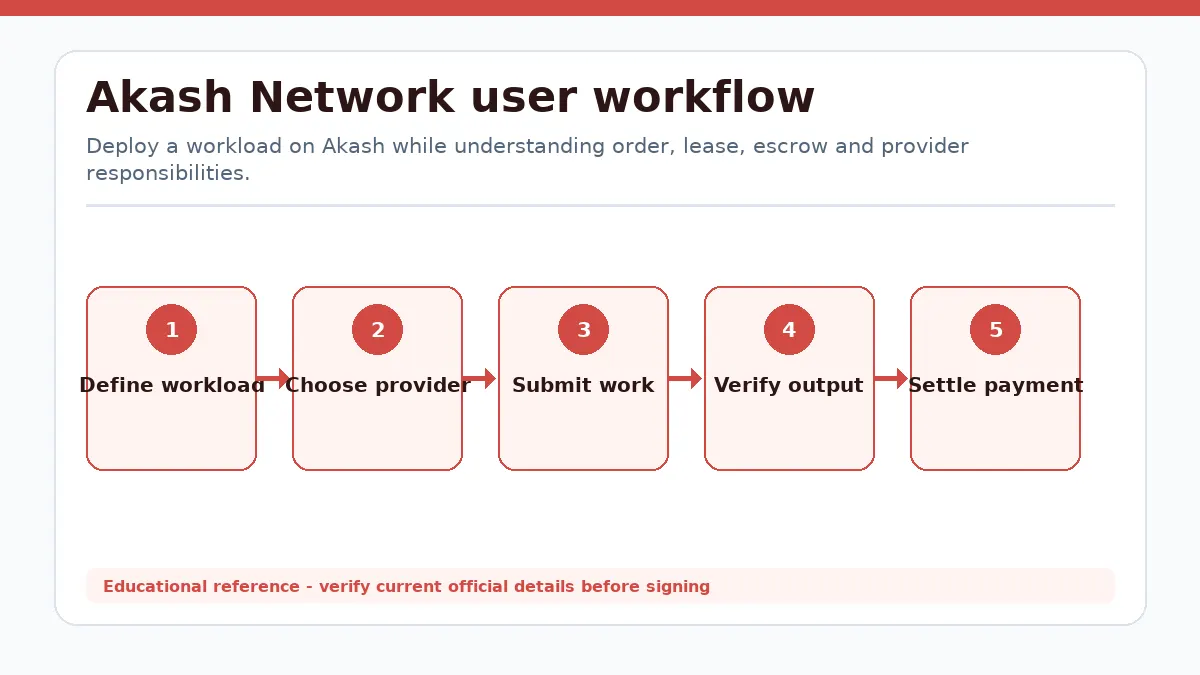
Akash Network workflow showing Define workload, Choose provider, Submit work, Verify output, Settle payment
Akash Network workflow from the first user decision to a verified outcome.

ACT settlement and AKT transactions

Current Akash documentation describes ACT as the USD-oriented compute credit used to fund deployment escrow and pay providers per block. AKT remains the native staking and transaction-fee asset and can serve documented fallback or conversion roles in the current payment system. Exact accepted funding paths depend on active chain configuration and interface.

Estimate bid cost per block and deployment duration, then add an operating buffer. Keep AKT for create, update, deposit and close transactions. Monitor escrow outside the workload because a depleted balance can stop the service. Do not assume an AKT market price fixes compute cost or that a credit-card console deposit changes the onchain lease and provider risks.
An Akash Deployment Becomes an Order, Bid and Lease

The chain coordinates marketplace state; the selected provider runs the actual containers.

SDL to running service

The tenant writes an SDL describing images, CPU, memory, storage, ports, count and placement constraints. Creating the deployment records it onchain and opens orders. Providers submit bids that satisfy maximum price and attributes. Accepting a bid creates a lease, after which the detailed manifest is sent to the provider to start containers.

Record DSEQ, group, order and provider address. Compare bid price with provider attributes, location, audit status, resource availability and operational history. The manifest is delivered to the chosen provider rather than stored as the complete running workload onchain. A confirmed lease therefore proves an agreement, not that an application is healthy or correctly configured.

Provider Choice Defines the Workload Boundary

Independent providers control the machines, network path and local storage used by a lease.

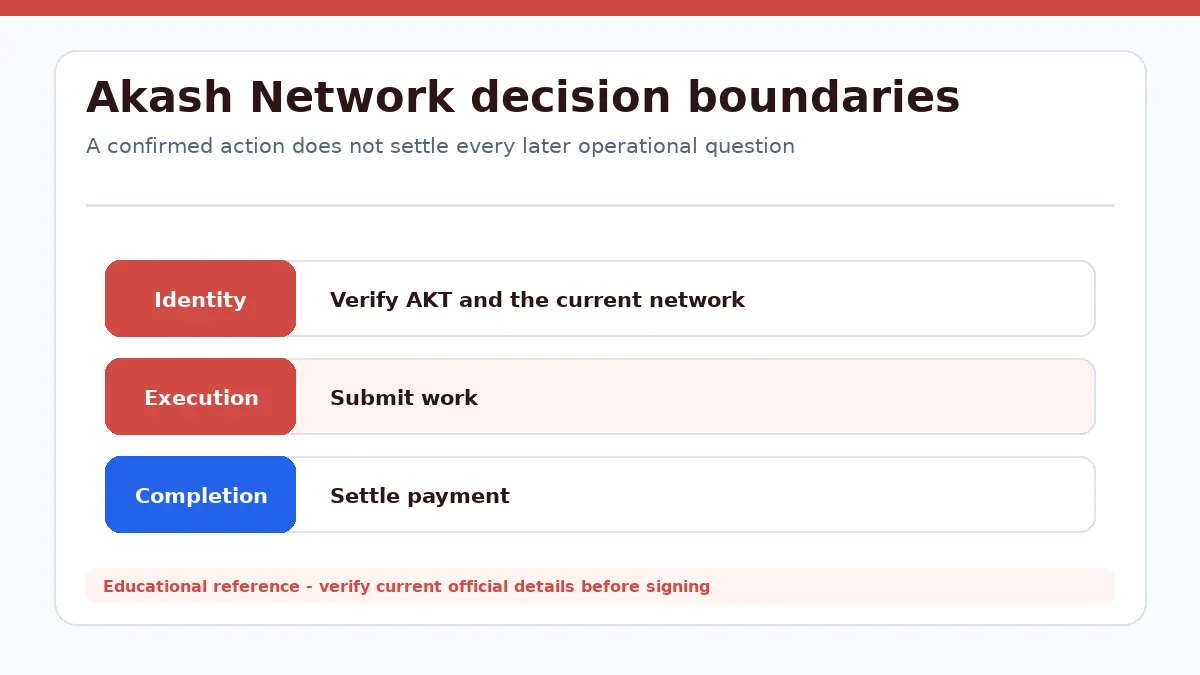
Akash Network decision diagram separating identity, execution and completion checks
Akash Network confirmation does not settle every later operational question.

Availability, data and updates

Use immutable image tags or digests, external backups and independent uptime checks. Avoid placing long-lived secrets directly in a public SDL. Verify exposed ports and TLS. Test recovery with another provider before production. An audited-provider attribute helps selection but does not replace application hardening or guarantee physical security and continuity.

Choose the Next Akash Check

Preserve enough state to recreate the workload elsewhere.

Prepare, deploy and operate

Before deployment, validate SDL and calculate resource and escrow requirements. During bidding, compare providers rather than accepting only the lowest price. After lease creation, upload the manifest, verify endpoints, monitor escrow and export logs and data. Close unused deployments to stop charges and recover eligible remaining escrow.

Keep the SDL, image digest, DSEQ, provider address, lease identifiers and external backups together. Do not expect an update to change every resource field, assume workload logs are onchain or leave an unfunded service without alerts. Use current Akash CLI and Console documentation because commands and payment labels can evolve.

Browse developer tools

Akash Network Resource use FAQ

What pays transaction fees when using Akash Network?

Akash Network (AKT) pays the applicable network fee. Verify the selected network before signing because a later approval, bridge, claim or exit can require another transaction.

How is work or data verified before Akash Network settlement?

Verification depends on the network's documented provider, proof, availability or result-checking process; a token transfer alone does not prove useful work.

Known Limitations

Market Data Methodology

The page uses a CoinGecko aggregated AKT/USD snapshot. No exchange chart is rendered for this entity.

Market Snapshot Source
CoinGecko aggregated market data (AKT/USD)
Cache
Snapshot cache is approximately 60 seconds.
Failure Handling
Verified cached data is labeled Cached or Delayed. Missing values remain unavailable.
Snapshot Status
Delayed
Report Issue
Report a market-data problem →

Technical Sources

Selected primary sources support the operational explanations. Market-provider attribution remains separate.

Editorial Information

Verified technical content, reviewed sources and update history.

Published
Last Review
Data Verification
Sources
Official documentation