Skip to content
BitcoinToolkit

Sushi (SUSHI): A Sushi Swap Can Cross Several Pools

Swap or provide liquidity through Sushi with correct route, contract, fee and pool assumptions.

Subject:
Sushi
Market mode:
Snapshot Only
Fee asset:
ETH / varies
Timezone:
UTC

This page does not quote a swap, verify a pool, calculate impermanent loss, manage liquidity or state that all Sushi deployments use identical contracts.

Content ownership: BitcoinToolkit Editorial Team Technical references: Official protocol and developer documentation. Review approach: Technical explanations are checked against primary sources and updated when the network or asset changes. Last content review: Data integration last tested:

A Sushi Swap Can Cross Several Pools

The displayed pair is a request; the route defines the actual contracts and assets used.

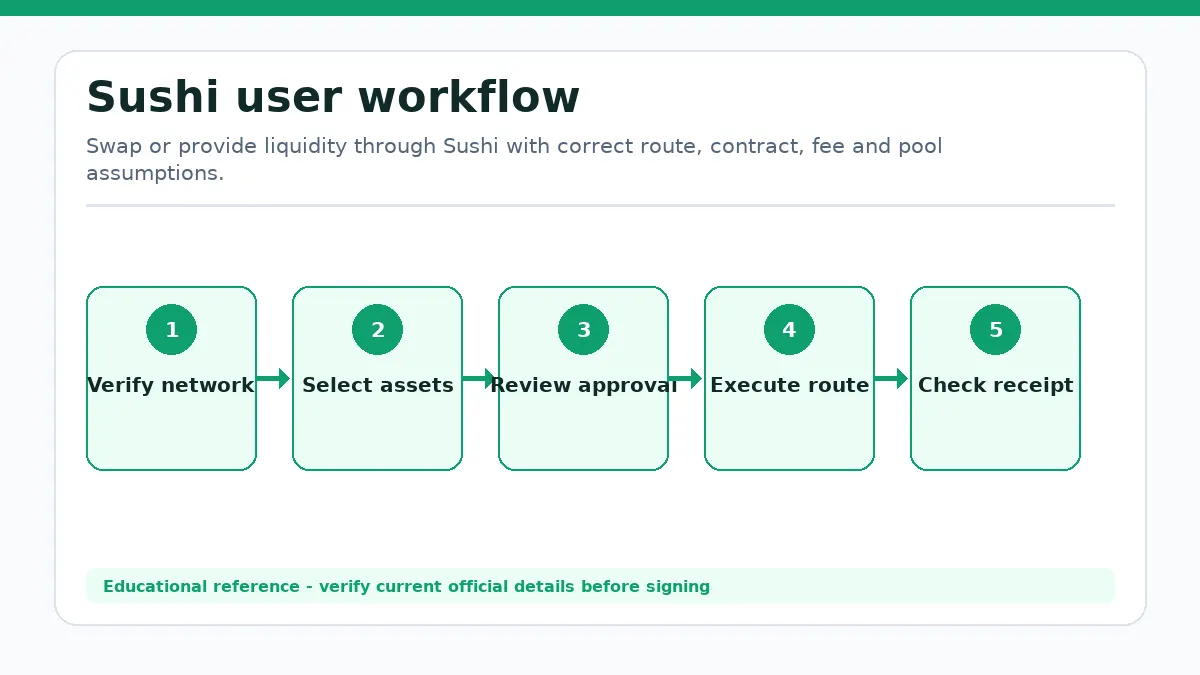
Sushi workflow showing Verify network, Select assets, Review approval, Execute route, Check receipt
Sushi workflow from the first user decision to a verified outcome.

Quote, approval and execution

Sushi routing can compare direct and multi-hop paths across supported pool types. The wallet approves the input token when necessary, then submits a router transaction containing amount, path and minimum-output conditions. Every hop can contribute pool fees and price impact, while the host chain charges gas independently.

Inspect the network, input and output contract, route processor, allowance target, hop sequence, minimum received and deadline. A quote is temporary and can fail or produce a worse route after liquidity changes. A successful transaction should be verified from emitted transfers and the final wallet balance, not only an interface confirmation screen.

Pool Type Determines How Capital Is Used

Full-range and concentrated liquidity respond differently to price movement.

Constant product and selected ranges

Liquidity providers should verify both token contracts, reserves, fee setting, current price and withdrawal path. Model changing token composition and impermanent loss separately from displayed rewards. A high annual rate can combine short-lived incentives with fees and does not compensate automatically for a depeg, malicious token, inactive range or smart-contract failure.

Sushi Is Multichain but Balances Are Chain-Specific

A familiar interface can hide different gas assets and contract addresses.

Network and token boundaries

Each deployment relies on its host chain for ordering, finality, gas and token standards. SUSHI or another token held on Ethereum does not automatically exist on every supported network. Bridged representations carry bridge or issuer dependencies, and pools with the same symbols on two chains can hold unrelated contracts and liquidity.

Confirm network before every approval and transaction. Keep that network native asset for gas. Do not paste a pool address from another chain, send LP or position tokens directly to an exchange, or assume the cheapest route includes bridge costs. Cross-chain movement is a separate operation from a local Sushi swap.

Choose the Next Sushi Check

Use a different checklist for trading and liquidity provision.

Trader, provider or SUSHI holder

Traders should verify contracts, route, price impact, minimum output and gas. Providers should inspect pool version, fee tier, reserve quality, range and reward source. SUSHI holders considering governance should read the current proposal and execution process rather than infer voting rights from an exchange balance.

Revoke unnecessary allowances, keep transaction hashes and record the pool address before depositing. Compare Sushi with another venue using executable output after gas rather than a headline rate. Continue to the relevant host-chain page for finality and fee behavior, then use wallet tools to inspect approvals and received assets.

Browse wallet tools

Sushi Swaps and liquidity FAQ

Can a Sushi swap succeed at a worse price than the preview?

Yes. Pool state, routing, price impact, slippage settings, fees and transaction ordering can change execution.

Known Limitations

Market Data Methodology

The page uses a CoinGecko aggregated SUSHI/USD snapshot. No exchange chart is rendered for this entity.

Market Snapshot Source
CoinGecko aggregated market data (SUSHI/USD)
Cache
Snapshot cache is approximately 60 seconds.
Failure Handling
Verified cached data is labeled Cached or Delayed. Missing values remain unavailable.
Snapshot Status
Delayed
Report Issue
Report a market-data problem →

Technical Sources

Selected primary sources support the operational explanations. Market-provider attribution remains separate.

Editorial Information

Verified technical content, reviewed sources and update history.

Published
Last Review
Data Verification
Sources
Official documentation