Synthetix is an EVM derivatives-liquidity protocol. Its V3 core lets collateral vaults supply credit to pools and markets; SNX is a protocol asset, not a synthetic market position. This page focuses on liquidity Providers Underwrite Market Debt and the checks users need before using the protocol or evaluating the token role.
Understand current Synthetix liquidity and SNX position status without following obsolete staking instructions.
Subject:
Synthetix
Market mode:
Snapshot Only
Fee asset:
ETH / varies
Timezone:
UTC
This page does not open a position, quote a derivative, calculate collateralization, migrate legacy debt or state that a wound-down staking pool is available.
Content ownership: BitcoinToolkit Editorial TeamTechnical references: Official protocol and developer documentation.Review approach: Technical explanations are checked against primary sources and updated when the network or asset changes.Last content review: Data integration last tested:
Liquidity Providers Underwrite Market Debt
Onchain derivatives need collateral, oracle prices, market accounting and settlement rules even when users trade through different interfaces.
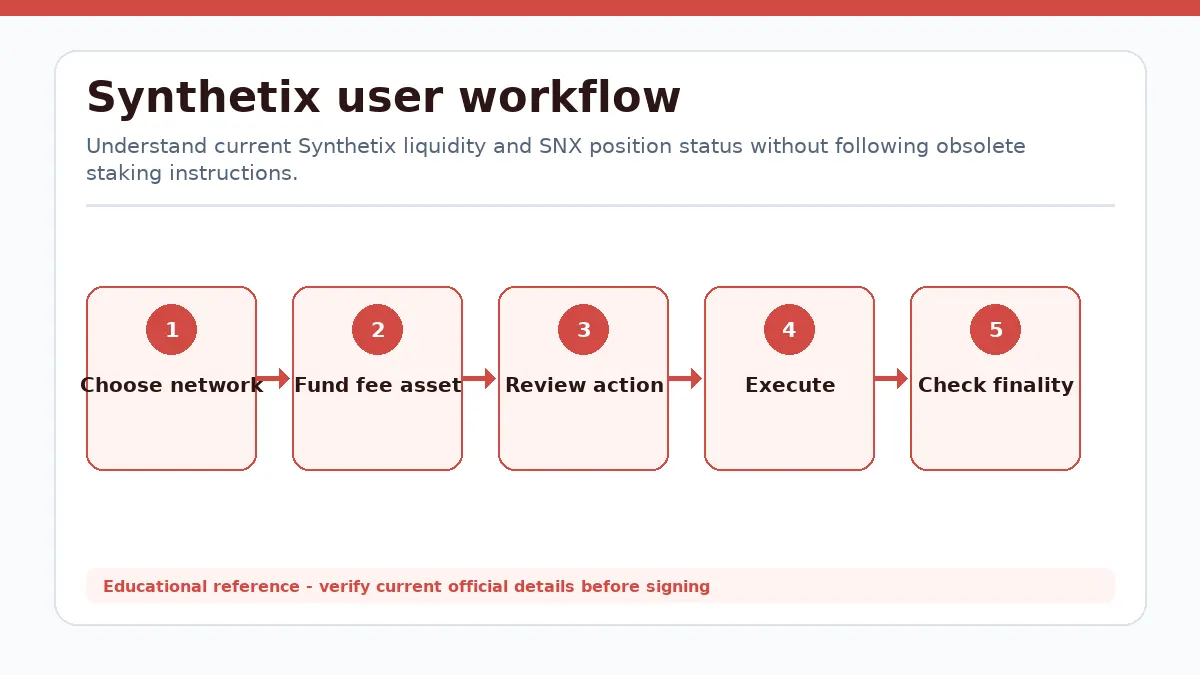
Synthetix workflow from the first user decision to a verified outcome.
A base layer for derivatives markets
Synthetix coordinates collateral and market modules so integrators can build trading experiences without recreating the entire liquidity system. Oracle inputs help determine market values and account health, while protocol rules allocate fees and losses according to the relevant configuration.
This modular approach can support specialized markets and front ends. It also means users must understand which interface, market implementation and collateral pool they are using; the Synthetix brand alone does not describe every execution rule.
Liquidity providers are not neutral intermediaries
Depending on the deployment, collateral can back trader positions and protocol debt. Trader gains, market skew and oracle behavior can affect liquidity-provider outcomes alongside collected fees.
Where Synthetix Differs for Users
Synthetix is derivatives and liquidity infrastructure used to support onchain markets. Liquidity providers, integrators and traders interact with different layers rather than one universal SNX product.
Different audiences, different exposure
A front-end or market integrator can use Synthetix infrastructure to offer derivatives. A trader may access those markets through an interface built on the protocol. A liquidity provider supplies collateral and can take exposure to fees, debt and market outcomes under the relevant deployment's rules.
Synthetix may fit technically capable users and applications that understand oracle-based derivatives and collateral accounting. It is a poor fit for users seeking spot ownership of an underlying asset, guaranteed liquidity-provider returns or leverage without liquidation and counterparty-like pool exposure.
Identify the deployment
Synthetix has evolved across versions and networks. Product rules, collateral and market modules should be verified for the exact deployment instead of inferred from historical documentation.
How Collateral Supports a Synthetix Market
The practical flow links collateral providers, market modules, oracle prices and the interfaces traders use.
For liquidity providers
A provider verifies the network, supported collateral and pool or market assignment, deposits or delegates collateral under the applicable rules, and monitors collateralization, debt, rewards and liquidation thresholds. Fees can compensate risk, but they do not cap losses or guarantee a positive result.
Exiting may require reducing debt or meeting collateral conditions before funds are fully withdrawable. The provider should keep enough native gas asset to manage the position during volatile periods.
For traders and integrators
A trader checks the front end, market, collateral, fees, funding and liquidation rules before opening a position. Developers must additionally validate contract versions, oracle dependencies and failure handling rather than treating liquidity as an always-on API.
What SNX Does and Why Staking Can Create Debt Exposure
SNX is associated with governance, collateral and incentive roles, but the exact role depends on the current Synthetix deployment and market design.
SNX is not a synthetic asset claim
Holding SNX does not automatically create a derivatives position, guarantee protocol fees or pay gas on the host network. It does not represent direct ownership of the external asset referenced by a synthetic market. Staking or delegating collateral can create obligations that passive token holding does not.
Users should verify whether SNX, another collateral asset or multiple assets support the particular pool they are considering.
Material failure modes
Risks include oracle errors, smart-contract defects, collateral volatility, undercollateralization, market skew, liquidation, governance changes and integration failures. Common mistakes include assuming rewards are fixed, overlooking changing debt, confusing a synthetic position with spot ownership and using guidance from an older protocol version.
Synthetix Risks Before Completion
Both can support onchain perpetual markets, but their liquidity-provider and integration models are not interchangeable.
What Synthetix users should verify and why this design differs
Synthetix emphasizes derivatives infrastructure, collateral pools and market modules that integrators can use. GMX exposes its own perpetual trading and pool structures on supported networks. Their approaches differ in collateral accounting, oracle execution, market access and how trader outcomes reach liquidity providers.
Users should compare a specific market's collateral, fees, liquidity, liquidation process and exit path rather than choosing from token price or aggregate volume alone.
Synthetix Network use FAQ
Does holding SNX make every Synthetix application transaction-ready?
No. SNX is the protocol asset shown in the market snapshot. The wallet still needs the correct network, fee asset, contract or program, and any application-specific token or permission.
Known Limitations
Synthetix deployments and staking states can change.
Pool and market risk is configuration-specific.
The page does not inspect or migrate a wallet position.
Market Data Methodology
The page uses a CoinGecko aggregated SNX/USD snapshot. No exchange chart is rendered for this entity.
Market Snapshot Source
CoinGecko aggregated market data (SNX/USD)
Cache
Snapshot cache is approximately 60 seconds.
Failure Handling
Verified cached data is labeled Cached or Delayed. Missing values remain unavailable.