Skip to content
BitcoinToolkit

Osmosis (OSMO): Osmosis Pools Price Liquidity in Different Ways

Osmosis is a Cosmos SDK appchain focused on decentralized exchange and liquidity. OSMO is its native staking and governance asset and one supported fee currency. This page focuses on osmosis Pools Price Liquidity in Different Ways and the checks users need before using the protocol or evaluating the token role.

Move an asset through IBC and trade or stake on Osmosis without confusing chain fees, pool fees and transfer states.

Subject:
Osmosis
Market mode:
Snapshot Only
Fee asset:
OSMO / supported tokens
Timezone:
UTC

This page does not quote a live swap, verify an IBC channel, choose a validator, manage liquidity or guarantee an IBC refund.

Content ownership: BitcoinToolkit Editorial Team Technical references: Official protocol and developer documentation. Review approach: Technical explanations are checked against primary sources and updated when the network or asset changes. Last content review: Data integration last tested:

Osmosis Pools Price Liquidity in Different Ways

A pool label determines how liquidity, spread and position risk behave.

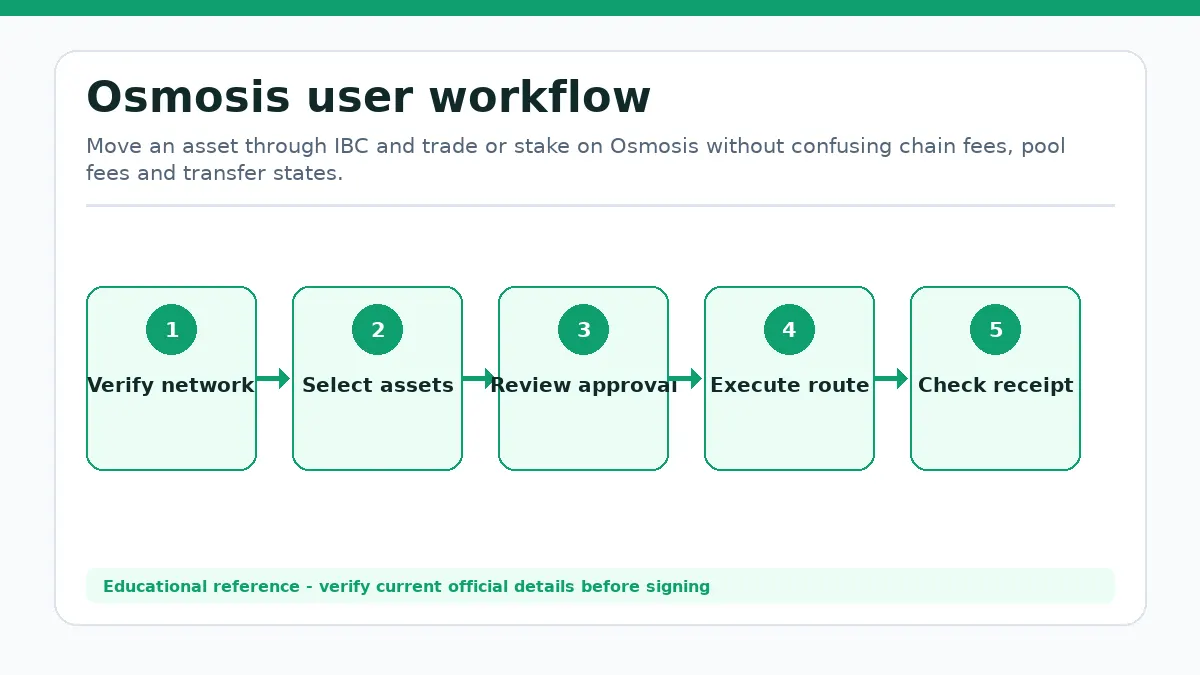
Osmosis workflow showing Verify network, Select assets, Review approval, Execute route, Check receipt
Osmosis workflow from the first user decision to a verified outcome.

Balancer-style and concentrated liquidity

Weighted pools distribute liquidity across their full curve, while concentrated-liquidity positions select a price range and can become one-sided when the market moves outside it. A swap can route across several pools. The user pays pool fees and experiences spread or price impact in addition to the chain transaction fee.

Review the exact route, minimum received, pool fee and price impact before signing. Liquidity providers should inspect range, token weights, incentives and impermanent-loss exposure. A high displayed APR can combine temporary emissions and fees and does not state the loss from a changing asset ratio.

An IBC Deposit Has a Source Chain and an Osmosis Trace

The asset reaches Osmosis through a channel-specific packet rather than a generic wallet transfer.

Send, relay and acknowledge

An IBC transfer locks or escrows the source representation, creates a packet with channel and timeout data, and relies on relayers to submit proofs between chains. Osmosis records the received denomination with its IBC trace. The same brand can therefore have several denominations if it arrived over different channel paths.

Before sending, confirm the source zone, destination address, current channel and timeout. After sending, track the packet acknowledgement on both explorers. A timed-out packet can require a refund transaction on the source chain, and an exchange deposit may reject an otherwise valid IBC denomination it does not support.

OSMO Staking Secures the Appchain, Not Every IBC Zone

Connected assets keep dependencies from their origin and transfer route.

Validators, governance and asset boundaries

OSMO governance can change chain and application parameters. Staking OSMO does not secure every connected zone.

Check validator commission, performance and unbonding rules before delegation. For traded assets, verify the IBC trace and issuer. Governance can update supported fee tokens, pool incentives and protocol behavior, so wallet defaults and old screenshots should not be treated as permanent network policy.

Choose the Next Osmosis Check

Use the transfer trace and pool route as the operational record.

Transfer, swap or stake

For a transfer, validate the IBC channel and destination denomination. For a swap, inspect route, pool fees, price impact and minimum output. For liquidity, model the selected range or weights. For staking, review validator and unbonding conditions while keeping a supported fee asset liquid.

Do not send a channel-specific voucher to a service that only recognizes another trace, assume a zero-looking gas estimate means the swap has no cost, or chase incentives without measuring pool exposure. Use current Osmosis interfaces and chain explorers for each step.

Browse converter tools

Osmosis Swaps and liquidity FAQ

What pays transaction fees when using Osmosis?

Osmosis fee assets (OSMO / supported tokens) pays the applicable network fee. Verify the selected network before signing because a later approval, bridge, claim or exit can require another transaction.

Can a Osmosis swap succeed at a worse price than the preview?

Yes. Pool state, routing, price impact, slippage settings, fees and transaction ordering can change execution.

Known Limitations

Market Data Methodology

The page uses a CoinGecko aggregated OSMO/USD snapshot. No exchange chart is rendered for this entity.

Market Snapshot Source
CoinGecko aggregated market data (OSMO/USD)
Cache
Snapshot cache is approximately 60 seconds.
Failure Handling
Verified cached data is labeled Cached or Delayed. Missing values remain unavailable.
Snapshot Status
Delayed
Report Issue
Report a market-data problem →

Technical Sources

Selected primary sources support the operational explanations. Market-provider attribution remains separate.

Editorial Information

Verified technical content, reviewed sources and update history.

Published
Last Review
Data Verification
Sources
Official documentation