OKB is the native and gas asset of X Layer, an Ethereum-aligned EVM network associated with the OKX ecosystem. Current OKX guidance says OKB no longer reduces exchange trading-fee tiers. This page focuses on oKB Is X Layer Native Gas and the checks users need before using the protocol or evaluating the token role.
Use OKB on X Layer without relying on obsolete exchange-discount or legacy-chain assumptions.
Subject:
OKB
Market mode:
Snapshot Only
Fee asset:
OKB
Timezone:
UTC
This page does not migrate OKT, verify an OKB withdrawal route, estimate gas or describe exchange benefits that no longer apply.
Content ownership: BitcoinToolkit Editorial TeamTechnical references: Official protocol and developer documentation.Review approach: Technical explanations are checked against primary sources and updated when the network or asset changes.Last content review: Data integration last tested:
OKB Is X Layer Native Gas
The current network role is more important than older descriptions of an exchange utility token.
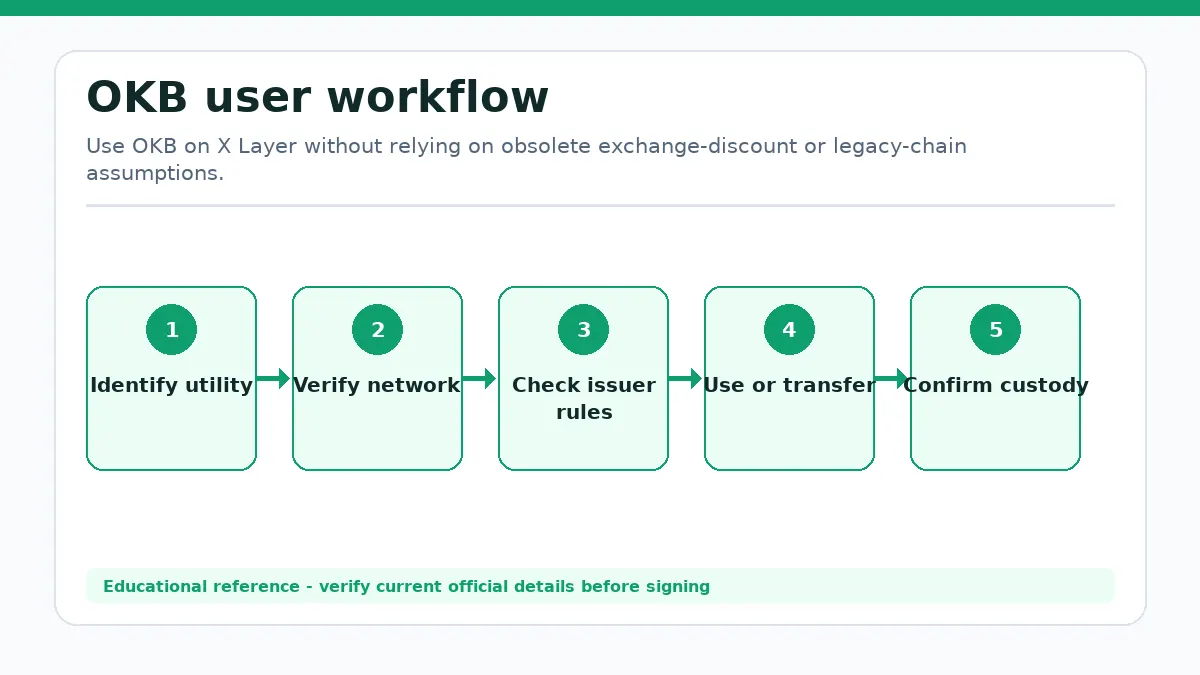
OKB workflow from the first user decision to a verified outcome.
Native balance and EVM execution
X Layer uses OKB as its native currency and the asset that pays gas for transfers and smart-contract execution. EVM wallets express gas through a limit and price, but the economic debit is OKB. A user sending USDT, ETH or another token on X Layer still needs a separate OKB balance unless a supported sponsored transaction explicitly covers the fee.
Current X Layer documentation describes an EVM Layer 2 built on an enhanced OP Stack implementation and aligned with Ethereum tooling. It is still a separate network with its own chain ID, blocks, bridges and confirmation path. An Ethereum address can look identical on X Layer while holding a different balance and interacting with different contracts.
Current utility versus old claims
OKX guidance updated in January 2026 states that OKB does not offset exchange trading fees and does not change fee-discount tiers. Pages or token summaries that repeat older trading-discount claims are therefore stale. Current utility centers on X Layer gas and ecosystem participation, subject to the active network and product rules.
An exchange account balance and an onchain X Layer balance are operationally different. A withdrawal must select X Layer to produce native OKB there. A market purchase alone does not move the token to a self-custody wallet or fund a pending transaction.
Several legacy token and network paths changed during the X Layer upgrade.
Fixed supply and contract changes
OKX announced a one-time burn of 65,256,712.097 OKB from historical repurchases and treasury reserves and a smart-contract upgrade that removed minting and burning functions, fixing total supply at 21 million. Supply claims should be checked against current official and onchain data rather than older whitepapers.
The Ethereum L1 version was scheduled to be phased out through exchange migration to X Layer, and OKB withdrawals to Ethereum were stopped. Holders of an old representation should not assume that a standard bridge or arbitrary contract can recreate native X Layer OKB. Use only the currently supported route.
OKTChain is a different legacy network
OKX announced the decommissioning of OKTChain and an exchange conversion process from OKT to OKB. OKT and OKB were different assets; a historical OKT balance is not automatically the same as native X Layer OKB. The published conversion window and current recovery support must be checked before moving old funds.
Using OKB on X Layer
Network selection, gas balance and bridge state determine whether a transaction can complete.
Before a withdrawal or contract call
Confirm X Layer in the wallet, check the chain ID and destination, and keep enough native OKB for gas. For token transfers, verify the token contract on X Layer. For a bridge, review source and destination assets, fees, finality and whether the destination output is native OKB or another representation.
A gasless exchange withdrawal or sponsored product is a service feature, not a protocol rule for every transaction. Once funds are in self-custody, ordinary contract interactions generally require the native gas asset. A failed contract call can still consume gas.
Legacy articles make network and benefit confusion unusually likely.
Use current network rules
Do not select Ethereum because an old page calls OKB an ERC-20 token, and do not send OKT to an X Layer address as if the assets were interchangeable. Check current exchange support before depositing a legacy asset. Ignore obsolete trading-fee-discount claims and verify any remaining product benefit in current regional terms.
Use the official X Layer bridge or supported exchange route, confirm contract addresses, and test a small transfer when appropriate. Network compatibility does not protect against malicious contracts, approvals or wrong destination chains.
OKB Risks Before Completion
Continue with the network, bridge or wallet task.
What OKB users should verify and why this design differs
Use current OKX and X Layer documentation for supported routes, gas and network parameters. Review Ethereum to understand the settlement relationship without confusing balances. Use the tools directory for address, fee and transaction utilities before sending a large amount.
Before treating the OKB task as complete, confirm each of these states separately: Identify utility, Verify network, Check issuer rules, Use or transfer, Confirm custody. The final check should use the current official interface, explorer or documented accounting state rather than a copied ticker or an interface notification alone.
OKB Ecosystem use FAQ
What pays gas on X Layer?
Native OKB pays X Layer gas.
Does OKB still reduce OKX trading fees?
Current OKX guidance says no; holding OKB does not affect exchange fee-discount tiers.
Is OKT the same asset as OKB?
No. OKT was the native asset of the decommissioned OKTChain and had a separate conversion process.
What should I verify before a OKB transaction?
Check the official destination, current network, asset representation, amount, recipient and requested permissions. A 2025 economic upgrade moved OKB toward X Layer as its primary onchain form, burned treasury holdings and fixed total supply at 21 million. X Layer transactions use OKB gas, while the network retains Ethereum-compatible accounts and smart contracts. After confirmation, inspect the resulting balance or protocol state instead of relying only on a wallet success message.
Known Limitations
Exchange support and network features can change by region.
Legacy OKB and OKT recovery depends on current provider support.
The page does not estimate gas or verify a bridge transaction.
Market Data Methodology
The page uses a CoinGecko aggregated OKB/USD snapshot. No exchange chart is rendered for this entity.
Market Snapshot Source
CoinGecko aggregated market data (OKB/USD)
Cache
Snapshot cache is approximately 60 seconds.
Failure Handling
Verified cached data is labeled Cached or Delayed. Missing values remain unavailable.