Sky (SKY): Staking and Borrowing Add Separate Risks
SKY is the Ethereum governance token of Sky Protocol. It is part of the protocol transition from its MakerDAO and MKR roots and is separate from the USDS and DAI stablecoins. This page focuses on staking and Borrowing Add Separate Risks and the checks users need before using the current asset or handling a legacy representation.
Understand SKY and verify the current MKR-to-SKY governance transition before converting or staking.
Subject:
Sky
Market mode:
Snapshot Only
Fee asset:
ETH
Timezone:
UTC
This page does not execute a token upgrade, forecast rewards, evaluate a governance proposal or recommend borrowing against staked SKY.
Content ownership: BitcoinToolkit Editorial TeamTechnical references: Official protocol and developer documentation.Review approach: Technical explanations are checked against primary sources and updated when the network or asset changes.Last content review: Data integration last tested:
Where Sky Differs for Users
Sky is an onchain credit and savings ecosystem with several assets that serve different jobs. Users should identify the product they need before treating SKY, USDS and DAI as interchangeable.
Match the asset to the action
USDS is designed as a stable-value unit within the Sky system, while DAI remains part of the wider Maker history and integration landscape. SKY is associated with governance and ecosystem participation rather than ordinary dollar-denominated payments. A user seeking a stable balance therefore faces a different decision from a user evaluating governance exposure.
Before connecting a wallet, confirm the exact asset, network, contract and interface. Migration or conversion routes can introduce eligibility, smart-contract and execution considerations that do not exist when simply holding an already supported token.
When Sky may be a poor fit
Sky is not a bank deposit, a guaranteed savings account or a way to avoid stablecoin risk. Users who need statutory deposit protection, fixed redemption access in every jurisdiction, or a completely governance-free asset should evaluate alternatives before relying on the ecosystem.
Why Sky Coordinates Stable Assets, Savings and Onchain Credit
Sky exists to coordinate collateral-backed credit, stable-value assets, savings mechanisms and governance through transparent smart-contract rules.
The problem is more than issuing a token
An onchain stable asset needs collateral policies, risk parameters, liquidity, accounting and a process for changing the system as market conditions evolve. Sky brings those functions into one governed ecosystem instead of asking users to negotiate credit with a single lender.
This design improves composability but shifts responsibility to protocol rules and governance. Stability depends on collateral quality, market liquidity, oracle behavior, risk controls and access to conversion or redemption pathways; it does not arise from the token name alone.
How this differs from a simple fiat token
A centrally issued stablecoin commonly depends on an issuer and offchain reserves. Sky's assets interact with a broader onchain credit system. That difference changes the relevant checks: users should examine collateral and protocol mechanics in addition to custody and issuer questions.
How Users Move Between Sky Assets and Features
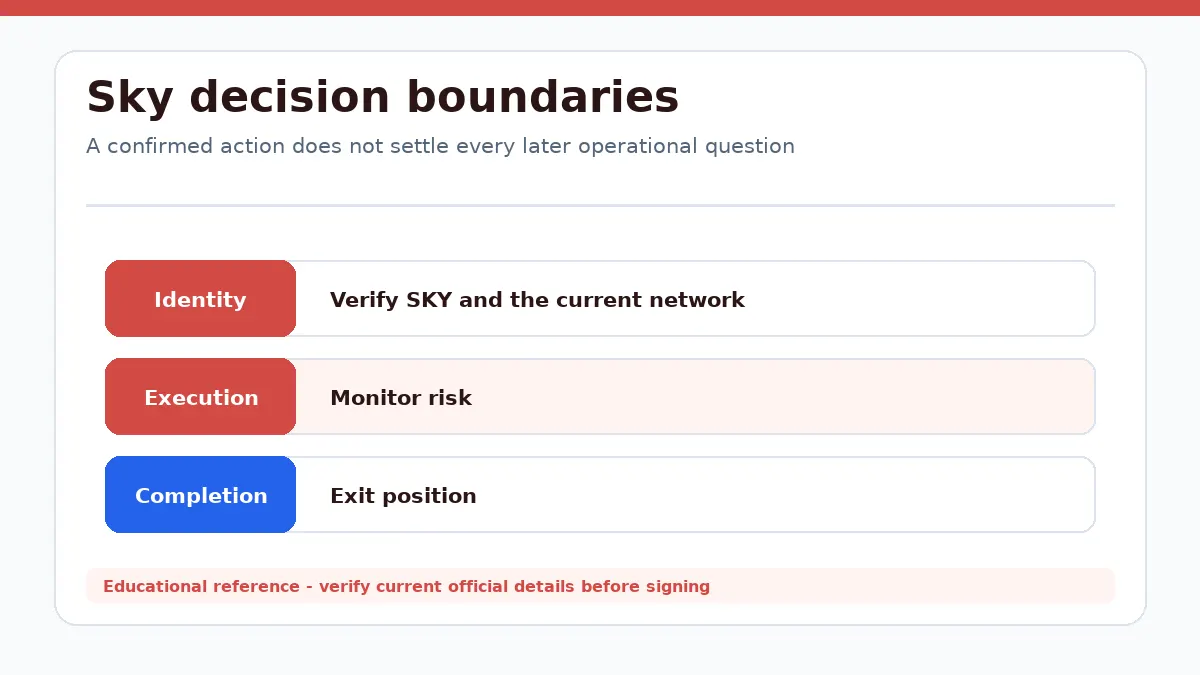
A useful Sky workflow separates asset verification, conversion, savings and exit decisions.
Sky confirmation does not settle every later operational question.
Verify before moving value
Start by identifying whether the intended action uses USDS, DAI, SKY or a savings representation. Check the supported network and official contract, review the interface terms, then inspect the quoted conversion or savings conditions before approving wallet access. A transaction may also require the network's native gas asset even when the asset being moved is a stable token.
After execution, verify the received token and balance onchain. For savings or conversion positions, record how the exit works and whether liquidity, governance limits, delays or jurisdiction rules can affect access.
Do not collapse every step into yield
A displayed rate is only one input. Contract risk, stable-value deviation, opportunity cost, transaction fees and the route back to the asset a user actually needs can matter more than a headline reward.
What SKY Does and What It Does Not Represent
The SKY token and the stable-value assets in the Sky ecosystem have different economic and operational roles.
Governance is not stable value
SKY is connected to governance and ecosystem incentives.
SKY does not replace the native gas asset of the network, guarantee protocol revenue, insure stablecoin holders or promise a fixed return. USDS and DAI do not automatically grant the same governance rights as SKY.
A common category mistake
Comparing SKY directly with a payment stablecoin can hide the very distinction users need. Compare stable assets with stable assets, governance mechanisms with governance mechanisms, and savings products by their actual contracts and exit conditions.
Sky Risks Before Completion
The practical decision is shaped by asset support, governance evolution and the dependencies behind stable value.
Risks to check
Relevant risks include smart-contract failure, collateral deterioration, oracle errors, stable-value deviation, governance changes, bridge exposure and liquidity fragmentation across networks. Migration paths can also create phishing risk when users search for unfamiliar contracts or interfaces.
USDS reflects the current Sky ecosystem direction, while DAI has a long integration history across wallets and protocols. The better asset for a task depends on support, conversion terms, governance exposure and the user's intended destination, not only on the shared goal of approximate dollar stability.
What Sky users should verify and why this design differs
Review DAI separately to understand its integrations and role before choosing a migration or liquidity route.
Sky Position management FAQ
What pays transaction fees when using Sky?
Ether (ETH) pays the applicable network fee. ETH pays Ethereum transaction fees for SKY actions. Verify the selected network before signing because a later approval, bridge, claim or exit can require another transaction.
Can a successful Sky transaction still leave a position unsafe?
Yes. Execution success does not measure collateral, debt, utilization, liquidity or liquidation exposure after the state change.
How does Sky differ from Sonic?
Compare the exact network, permissions, fee path, final state and exit requirement rather than token price alone.
Known Limitations
Upgrade timing, conversion direction and penalties can change through governance.
Reward and borrowing parameters are variable.
The page does not execute or verify a token conversion.
Market Data Methodology
The page uses a CoinGecko aggregated SKY/USD snapshot. No exchange chart is rendered for this entity.
Market Snapshot Source
CoinGecko aggregated market data (SKY/USD)
Cache
Snapshot cache is approximately 60 seconds.
Failure Handling
Verified cached data is labeled Cached or Delayed. Missing values remain unavailable.