Skip to content
BitcoinToolkit

Pendle (PENDLE): Trading Yield and Paying Fees

Pendle is a DeFi protocol that separates a yield-bearing asset into a principal claim and a time-limited yield claim. PENDLE is its governance and incentive token, not the principal or yield token in each market. This page focuses on trading Yield and Paying Fees and the checks users need before using the protocol or evaluating the token role.

Evaluate a Pendle PT or YT position before choosing a market and maturity.

Subject:
Pendle
Market mode:
Snapshot Only
Fee asset:
Varies
Timezone:
UTC

This page does not quote a live market, calculate a position return, verify a SY wrapper or recommend a maturity.

Content ownership: BitcoinToolkit Editorial Team Technical references: Official protocol and developer documentation. Review approach: Technical explanations are checked against primary sources and updated when the network or asset changes. Last content review: Data integration last tested:

Trading Yield and Paying Fees

Pendle is a yield-trading protocol that separates an eligible yield-bearing asset into principal and yield components with a defined maturity. Users should first decide which exposure they actually want.

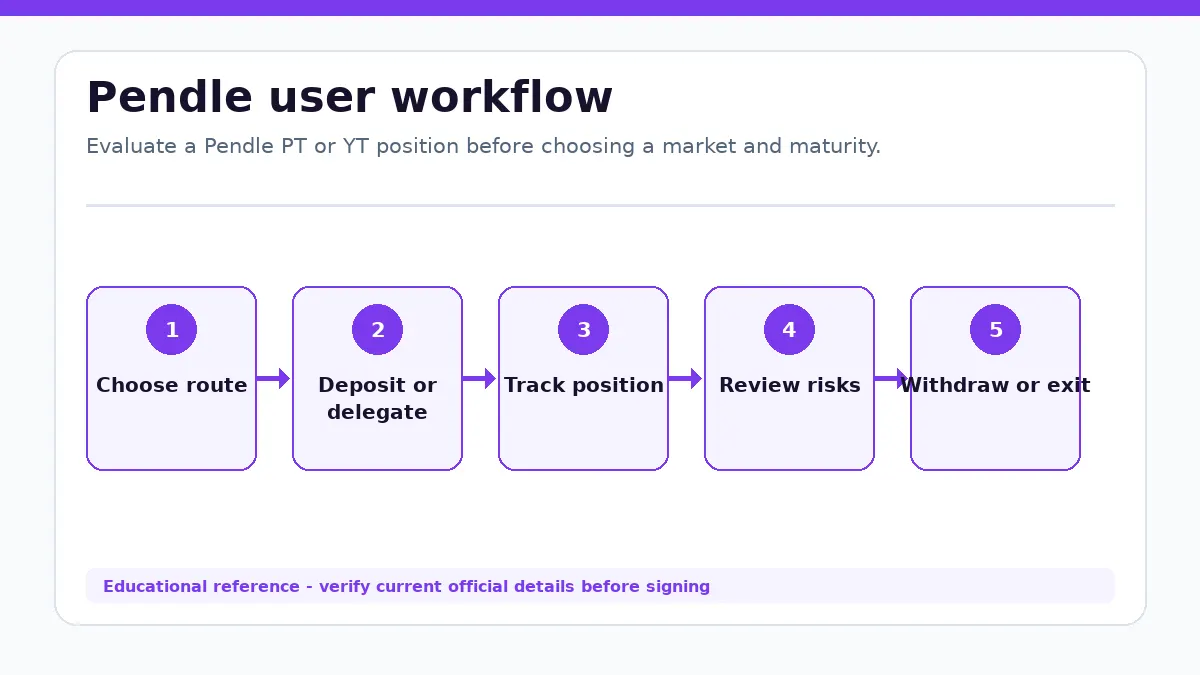
Pendle workflow showing Choose route, Deposit or delegate, Track position, Review risks, Withdraw or exit
Pendle workflow from the first user decision to a verified outcome.

Three materially different positions

A principal token position targets the underlying principal at maturity and is often used to express a fixed-yield view when purchased below its expected redemption value. A yield token isolates variable yield and can gain or lose value as expectations change. A liquidity position supports trading and adds pool, range and incentive exposure.

Pendle can suit experienced users who understand the underlying yield source and maturity mechanics. It is a poor fit for anyone who reads an implied rate as guaranteed, needs immediate redemption under all conditions or has not verified the underlying protocol risk.

The underlying asset comes first

Pendle restructures an existing yield source; it does not make that source safer. Review the original staking, lending or liquidity asset before comparing PT or YT prices.

Why Pendle Separates Principal From Future Yield

Most yield-bearing tokens bundle principal and future variable income into one asset, making it difficult to trade those expectations independently.

A time-based market for yield

Pendle wraps supported yield-bearing positions and separates them into principal tokens and yield tokens for a specified maturity. That structure lets one user prefer principal recovery while another takes the variability of future yield. Prices encode market expectations, liquidity and time remaining rather than a protocol promise.

The automated market maker is designed around assets whose behavior changes as maturity approaches. Time decay is therefore part of the product mechanics, not a cosmetic date attached to an ordinary token pair.

What separation cannot remove

Tokenization does not eliminate smart-contract, depeg, validator, lending or issuer risks inherited from the underlying asset. It changes how those economics are divided among users.

How a Pendle Position Reaches Maturity

A complete workflow includes the underlying asset, the selected market, the maturity date and the intended exit.

Enter with the maturity in view

Verify the chain, underlying yield-bearing token and market maturity. Decide whether to mint or acquire principal tokens, yield tokens or a liquidity position. Inspect implied yield, liquidity, price impact, fees and any points or incentives separately from the underlying protocol rate.

Holdings can be sold before maturity if liquidity exists, but the market price may differ from the expected maturity outcome. At maturity, redemption mechanics depend on the specific standardized yield asset and supported interface.

Measure the full result

Compare entry cost, realized yield, incentives, transaction fees and exit value. For YT, a high realized underlying rate can still be unprofitable if the purchase price already reflected greater expectations.

PENDLE Governance Does Not Guarantee Pendle Yield

PENDLE supports governance and incentive coordination, while PT, YT and liquidity positions carry the market-specific claims.

Keep token roles separate

Governance and incentive benefits can change over time.

A user can use a Pendle market without making PENDLE the underlying asset. The relevant economic exposure is defined by the selected PT, YT or LP position.

Risks that compound across layers

Users face Pendle contract risk plus the risks of the underlying token and protocol, including depegs, slashing, bad debt or issuer constraints. Thin liquidity, maturity confusion, price impact and incentive changes add further uncertainty. Common mistakes include comparing implied yield with unlike terms and buying YT without modeling time decay.

Why Pendle's Design Matters

Two markets with similar displayed rates can depend on entirely different staking, lending or stable-asset systems.

What Pendle users should verify and why this design differs

For liquid staking markets, inspect how the staking receipt accrues value, how withdrawals work and which validator risks remain. For lending markets, inspect collateral, utilization and bad-debt exposure. For stable assets, inspect backing and redemption. Only then compare maturity, implied yield and Pendle liquidity.

Lido DAO is a useful next reference for understanding one common category of liquid staking source before evaluating a related yield market.

Pendle Staking and yield FAQ

Can Pendle rewards or withdrawal timing change after staking?

Yes. Reward rates, validator performance, slashing exposure, liquidity and exit queues can change while the position remains open.

Known Limitations

Market Data Methodology

The page uses a CoinGecko aggregated PENDLE/USD snapshot. No exchange chart is rendered for this entity.

Market Snapshot Source
CoinGecko aggregated market data (PENDLE/USD)
Cache
Snapshot cache is approximately 60 seconds.
Failure Handling
Verified cached data is labeled Cached or Delayed. Missing values remain unavailable.
Snapshot Status
Unavailable
Report Issue
Report a market-data problem →

Technical Sources

Selected primary sources support the operational explanations. Market-provider attribution remains separate.

Editorial Information

Verified technical content, reviewed sources and update history.

Published
Last Review
Data Verification
Sources
Official documentation