Curve DAO (CRV): How Curve Gauges Direct Emissions
Curve is a decentralized exchange and lending ecosystem built around specialized onchain liquidity. CRV is its governance and emissions token; it is not the gas asset for Ethereum or other Curve deployments. This page focuses on how Curve Gauges Direct Emissions and the checks users need before using the protocol or evaluating the token role.
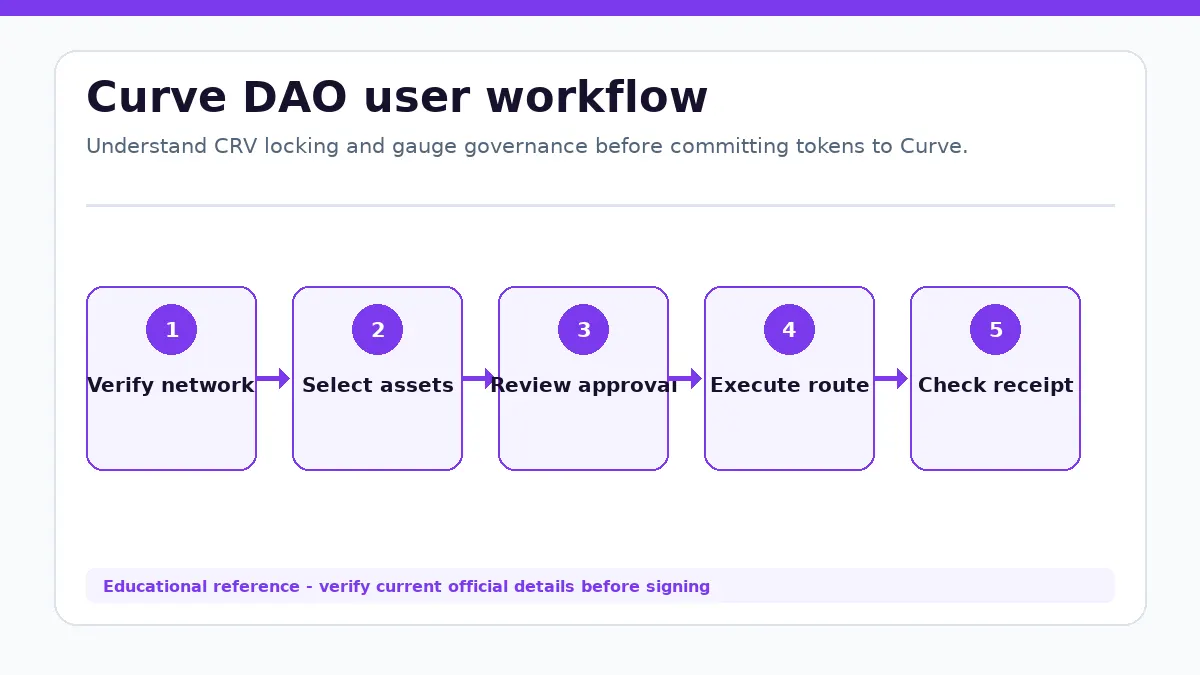
Understand CRV locking and gauge governance before committing tokens to Curve.
Subject:
Curve DAO
Market mode:
Snapshot Only
Fee asset:
Varies
Timezone:
UTC
This page does not recommend a pool, estimate yield, execute a lock or verify a governance proposal payload.
Content ownership: BitcoinToolkit Editorial TeamTechnical references: Official protocol and developer documentation.Review approach: Technical explanations are checked against primary sources and updated when the network or asset changes.Last content review: Data integration last tested:
How Curve Gauges Direct Emissions
Curve is an automated market maker designed around liquidity for assets expected to trade near a related value, including stable assets and different representations of a similar underlying asset.
Curve DAO workflow from the first user decision to a verified outcome.
The intended use case
Curve can be useful when a user wants to exchange correlated assets with lower price impact than a general-purpose pool might offer under similar liquidity. Liquidity providers can support those exchanges and earn fees or incentives while accepting the risk that one asset stops tracking the relationship assumed by the pool.
It is a poor fit when the assets are expected to move independently, when a user cannot evaluate depeg risk, or when a small displayed price difference is mistaken for guaranteed redemption.
Identify the pool, not only the protocol
Each pool has specific assets, parameters, contracts and dependencies. Curve's design does not make every stablecoin or wrapped asset equally safe.
The Next Curve DAO Step
General constant-product pools distribute liquidity across a wide price curve, even when two assets are expected to remain close in value.
Concentrating useful liquidity near parity
Curve's stable-swap approach is designed to provide deeper effective liquidity around the expected relationship while retaining an automated market maker structure. This can improve exchange efficiency for stablecoins, liquid staking tokens and related asset representations when the relationship holds.
The design cannot enforce the underlying relationship. If one asset loses backing, redemption access or market confidence, the pool can accumulate the weaker asset as traders remove the stronger one. Efficiency near parity therefore comes with concentrated depeg exposure.
Why metapools and layered assets need care
Pools can depend on base pools, wrappers or external protocols. Those layers improve composability but add contracts and failure paths that must be mapped before depositing.
How Traders and Liquidity Providers Use Curve
A swap decision focuses on executable output; a liquidity decision focuses on the future pool composition and dependencies.
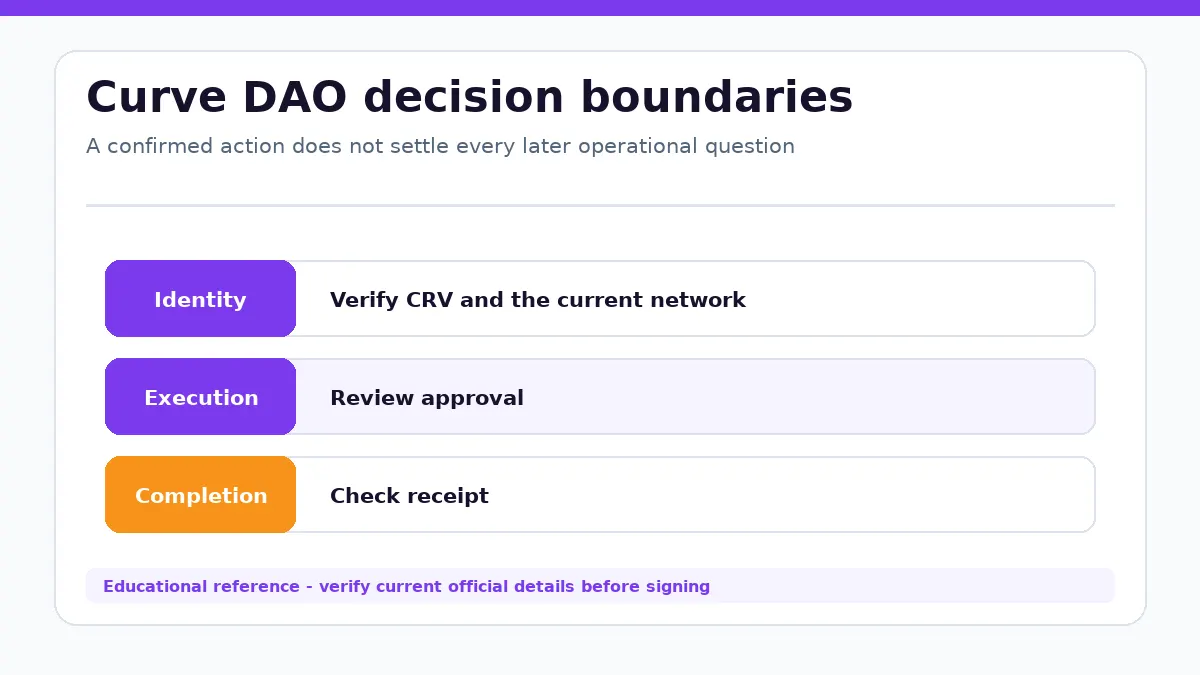
Curve DAO confirmation does not settle every later operational question.
For a swap
Verify the chain and token contracts, choose the exact pool or approved route, inspect the expected output and price impact, and retain enough native asset for gas. Confirm whether an asset is directly redeemable or only tradable through secondary liquidity, because similar symbols can hide different claims.
After signing, verify the received asset and any wrapper or pool token returned by the contract.
For liquidity
Review every pool asset, amplification and fee settings where relevant, gauge incentives, admin controls and dependency contracts. Monitor balance changes and depeg indicators. Withdrawing may return a different asset mix from the original deposit, particularly during stress.
CRV Governance, veCRV and the Limits of Incentives
CRV supports governance and incentive coordination. Locking mechanics can create vote-escrowed governance power, but neither token removes the risks inside a pool.
What CRV does not represent
CRV is not a stablecoin, a universal Curve LP token or the gas asset for every deployment. Holding it does not guarantee pool fee income, a fixed voting outcome or protection from a depeg. A liquidity position is represented by pool-specific contracts, and its economics depend on the assets supplied.
Locks and incentives can change a user's liquidity and time horizon. They should be evaluated independently from a swap or LP position.
Risks beyond impermanent loss
Curve users face depeg concentration, smart-contract dependencies, governance and admin changes, oracle interactions, thin exits and incentive shifts. Common mistakes include treating all stable assets as equivalent, ignoring base-pool exposure and chasing gauge rewards without modeling the loss if one asset breaks parity.
Why Curve DAO's Design Matters
The useful comparison begins with the expected price relationship between the assets.
What Curve DAO users should verify and why this design differs
Curve specializes in correlated-asset liquidity and can be efficient near an expected peg or exchange relationship. Uniswap supports a much broader set of pairs and lets liquidity providers choose ranges in concentrated-liquidity pools. Each can be more suitable for a particular pair and size.
Compare executable price, pool depth, asset dependencies and LP risk on the exact network. Protocol reputation alone cannot answer whether a specific pool is appropriate.
Curve DAO Swaps and liquidity FAQ
What should I verify before a Curve DAO transaction?
Check the official destination, current network, asset representation, amount, recipient and requested permissions. Users can time-lock CRV to receive non-transferable veCRV voting power. Gauge votes help direct future CRV emissions, while protocol decisions and fee-related rights depend on the active governance contracts and lock position. After confirmation, inspect the resulting balance or protocol state instead of relying only on a wallet success message.
Can a Curve DAO swap succeed at a worse price than the preview?
Yes. Pool state, routing, price impact, slippage settings, fees and transaction ordering can change execution.
Known Limitations
Gauge weights, emissions and governance contracts can change.
This page does not assess a pool, wrapper or proposal payload.
Market data does not estimate lock or liquidity-provider returns.
Market Data Methodology
The page uses a CoinGecko aggregated CRV/USD snapshot. No exchange chart is rendered for this entity.
Market Snapshot Source
CoinGecko aggregated market data (CRV/USD)
Cache
Snapshot cache is approximately 60 seconds.
Failure Handling
Verified cached data is labeled Cached or Delayed. Missing values remain unavailable.