Litecoin (LTC): What MWEB Changes and What It Does Not
Litecoin is a peer-to-peer digital-currency network derived from the Bitcoin codebase, and LTC is its native asset. It uses UTXOs and Scrypt proof of work. This page focuses on what MWEB Changes and What It Does Not and the checks users need before sending funds, paying fees or using the network.
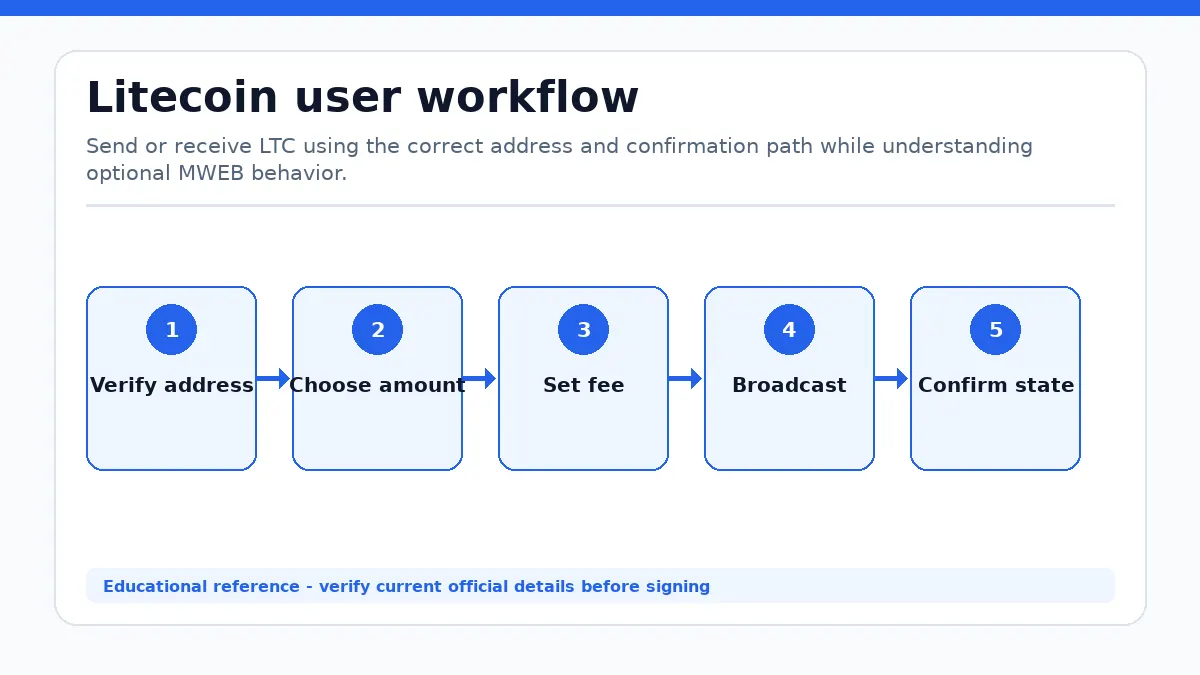
Send or receive LTC using the correct address and confirmation path while understanding optional MWEB behavior.
Subject:
Litecoin
Market mode:
Snapshot Only
Fee asset:
LTC
Timezone:
UTC
This page does not inspect a wallet, guarantee MWEB privacy, estimate mining profit or provide investment advice.
Content ownership: BitcoinToolkit Editorial TeamTechnical references: Official protocol and developer documentation.Review approach: Technical explanations are checked against primary sources and updated when the network or asset changes.Last content review: Data integration last tested:
What MWEB Changes and What It Does Not
MWEB improves optional transaction confidentiality and fungibility, but it does not make every Litecoin activity private.
Litecoin workflow from the first user decision to a verified outcome.
Optional privacy path
MimbleWimble Extension Blocks can conceal transferred amounts and reduce direct visibility of participant relationships inside the extension block. Users opt into compatible MWEB flows; ordinary canonical-chain transactions remain publicly observable. Entry and exit activity, timing, exchange records and wallet behavior can still reveal information.
MWEB is not a promise of anonymity and does not replace operational privacy. Reusing identifying accounts, exposing IP information, using a custodial service or pairing transactions with public activity can undermine privacy. Regulatory and exchange support also varies by jurisdiction and provider.
Compatibility first
Confirm that both the sender wallet and receiving service support MWEB and the intended transfer direction. If compatibility is uncertain, use a supported canonical Litecoin address and follow the receiving service instructions.
Litecoin Risks Before Completion
Litecoin payments spend previous outputs and create new outputs rather than editing one account balance.
Building an LTC payment
A wallet selects spendable UTXOs controlled by its keys, creates an output for the recipient and normally sends the remainder to a fresh change address. The fee is total input value minus total output value. It is paid in LTC and depends more on transaction data size and relay conditions than on the payment amount.
A wallet can combine many small outputs, making a modest payment larger and more expensive to relay than a payment built from one output. Review the fee, destination and change output before signing. Exchange withdrawal fees are set by the exchange and should not be mistaken for the Litecoin network fee.
Confirmations and timing
Litecoin targets a new block approximately every 2.5 minutes, but an individual block can arrive sooner or later. A transaction seen by peers is not yet confirmed. Receiving services set their own confirmation thresholds based on amount and risk, so a fast first block is not a universal promise of final settlement.
Each node independently validates scripts, value conservation and proof of work. Explorers can disagree temporarily or lag. High-value workflows should verify through a maintained wallet or node and should not accept a screenshot as proof of payment.
Litecoin has network-specific prefixes and several destination formats; compatibility must be checked before sending.
Standard and SegWit addresses
Litecoin wallets can expose Base58 and Bech32 destinations. Native SegWit addresses use the ltc1 human-readable prefix. Some old P2SH compatibility formats historically overlapped with Bitcoin-style prefixes, which is why a wallet should explicitly identify the selected network instead of relying on the first character alone.
Payment URIs use the litecoin scheme and can include amount or label fields. A QR code is only a transport for those fields; users should still compare the displayed address and amount on the signing device. Never assume an exchange supports every address or script type merely because a personal wallet does.
MWEB destinations
MWEB-capable destinations use the ltc1mweb prefix. Sending through MWEB requires compatible wallet and service support, and moving between the canonical chain and extension block follows protocol-specific peg-in or peg-out behavior. An unsupported exchange may reject or fail to credit an MWEB deposit.
Scrypt Mining and the Dogecoin Relationship
Litecoin miners use Scrypt proof of work, and compatible work can also support Dogecoin through merged mining.
Consensus and issuance
Miners assemble candidate Litecoin blocks and search for a Scrypt proof of work below the network target. Full nodes accept a block only when its transactions and header satisfy Litecoin consensus rules. The maximum supply is 84 million LTC, with issuance reduced through scheduled halvings.
Auxiliary proof of work allows eligible Scrypt miners to submit related proof to Dogecoin, but the chains remain independent. LTC and DOGE have separate addresses, UTXOs, blocks and monetary policies. Merged mining does not convert one asset into the other or make a cross-chain payment automatic.
Mining is an operating business
Modern competitive mining usually uses Scrypt ASIC hardware. Revenue depends on hashrate, difficulty, block rewards, merged-mining payouts, electricity, pool terms and downtime. A current LTC price is only one input and cannot by itself establish profitability.
Litecoin Transaction and Fee Checks
A short network and compatibility check prevents most avoidable Litecoin payment failures.
Payment checklist
Confirm Litecoin mainnet, the complete address, amount, fee, change output and receiving-service confirmation rule. For MWEB, verify explicit support at both ends. Start with a small payment when using a new exchange, wallet or address format.
Do not send native LTC to a wrapped-token address.
Treat exchange and network fees separately.
Back up keys before consolidating UTXOs.
Use current wallet software for newer formats.
What Litecoin users should verify and why this design differs
Compare Bitcoin for the closely related UTXO model or Dogecoin for the merged-mined Scrypt relationship. Use the tools directory for calculators and address utilities rather than treating this reference page as a transaction validator.
Litecoin Transactions FAQ
What pays Litecoin transaction fees?
Fees are paid in LTC and equal the difference between selected inputs and created outputs.
What prefix does a Litecoin SegWit address use?
Native SegWit addresses use ltc1; MWEB destinations use ltc1mweb.
Does MWEB make all Litecoin transactions private?
No. MWEB is optional and does not hide canonical-chain activity or external identifying information.
What should I verify before a Litecoin transaction?
Check the official destination, current network, asset representation, amount, recipient and requested permissions. Miners target roughly 2.5-minute blocks, while nodes validate Litecoin-specific consensus and address rules. MWEB adds an optional extension-block transfer path focused on fungibility and privacy. After confirmation, inspect the resulting balance or protocol state instead of relying only on a wallet success message.
Known Limitations
Wallet, exchange and MWEB support varies.
Target block time is not a guaranteed confirmation time.
The page does not inspect an address, transaction or mining operation.
Market Data Methodology
The page uses a CoinGecko aggregated LTC/USD snapshot. No exchange chart is rendered for this entity.
Market Snapshot Source
CoinGecko aggregated market data (LTC/USD)
Cache
Snapshot cache is approximately 60 seconds.
Failure Handling
Verified cached data is labeled Cached or Delayed. Missing values remain unavailable.