Skip to content
BitcoinToolkit

Dogecoin (DOGE): How Mining and Transactions Work

Dogecoin is a peer-to-peer payment blockchain, and DOGE is its native asset. Transactions spend and create UTXOs, while Scrypt proof-of-work miners build blocks. This page focuses on how Dogecoin Mining and Transactions Work and the checks users need before holding, transferring or verifying the token.

Send or receive DOGE while understanding fees, confirmations and the merged-mining security model.

Subject:
Dogecoin
Market mode:
Snapshot Only
Fee asset:
DOGE
Timezone:
UTC

This page does not inspect an address, estimate mining profit, verify a merchant or provide investment advice.

Content ownership: BitcoinToolkit Editorial Team Technical references: Official protocol and developer documentation. Review approach: Technical explanations are checked against primary sources and updated when the network or asset changes. Last content review: Data integration last tested:

How Dogecoin Mining and Transactions Work

Dogecoin security comes from miners and validating nodes, not staking or token voting.

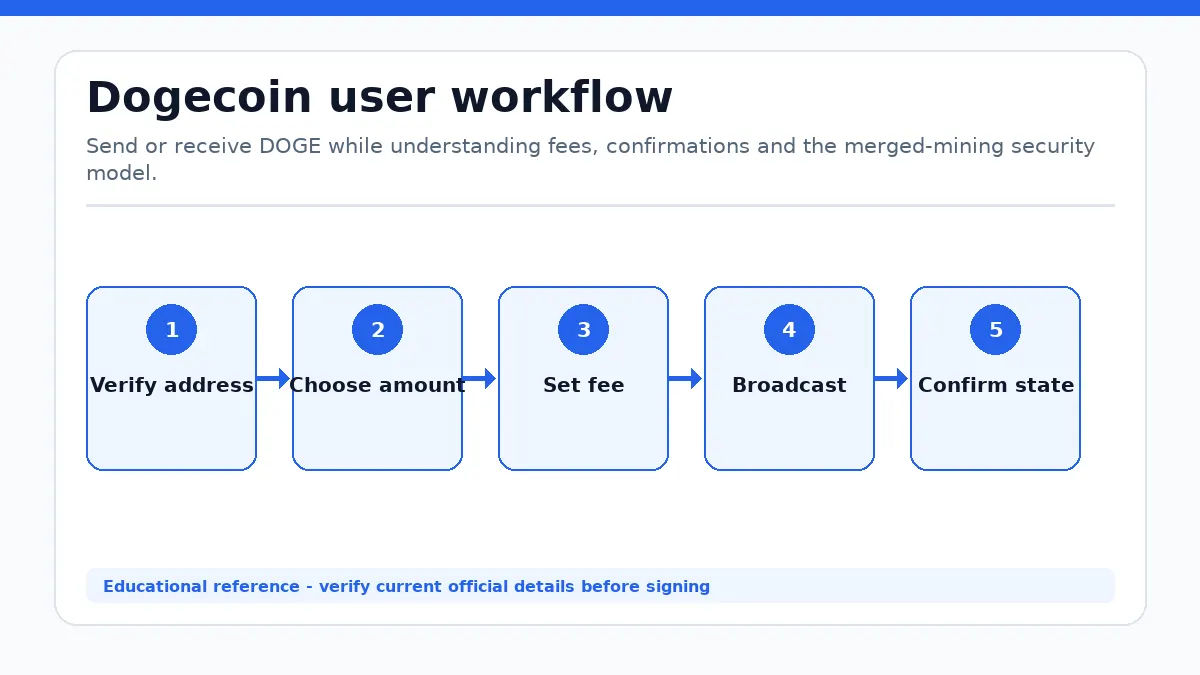
Dogecoin workflow showing Verify address, Choose amount, Set fee, Broadcast, Confirm state
Dogecoin workflow from the first user decision to a verified outcome.

One work stream, separate chains

Dogecoin uses Scrypt proof of work. Through auxiliary proof of work introduced in 2014, compatible miners can submit evidence derived from the same mining work to Dogecoin while mining Litecoin or another compatible parent chain. Dogecoin still has its own block history, difficulty, rewards and node validation rules.

Merged mining does not merge DOGE and LTC balances or make a Litecoin transaction valid on Dogecoin. It lets miners reuse eligible work. A Dogecoin full node still decides whether a Dogecoin block follows Dogecoin consensus rules, and ordinary users do not need Litecoin to send DOGE.
Mining economics

Current Dogecoin block rewards issue 10,000 DOGE per block, and issuance has no scheduled terminal cap. That predictable block issuance helps compensate miners alongside transaction fees. Profitability depends on Scrypt ASIC efficiency, electricity, pool terms, total difficulty and DOGE value; the market snapshot on this page is not a mining calculator.

Why Dogecoin's Design Matters

Dogecoin uses an unspent-output model rather than a single editable account balance.

Inputs, outputs and change

A wallet builds a payment by selecting previous unspent transaction outputs that it can authorize. The transaction creates new outputs for the recipient and usually a change output back to the sender. The visible wallet balance is therefore a sum of spendable outputs, not one number stored in a global DOGE account.

The fee is the difference between total inputs and outputs. It is paid in DOGE and is not a percentage of the payment. Wallet software should select a fee that satisfies current relay and mining policy without confusing the fee with a merchant charge or an exchange withdrawal fee.

Addresses and confirmations

Confirm the complete Dogecoin address and network before sending. A valid-looking address does not prove ownership or merchant identity, and a transaction cannot be reversed by the protocol after broadcast. Services choose their own confirmation requirements based on value and risk.

A wallet may show a transaction as pending after it reaches peers but before a miner includes it. Each later block adds another confirmation. Nodes validate the transaction and block independently; an explorer is a convenient view, not the consensus authority.

Where Dogecoin Fits

Dogecoin is primarily a payment and tipping network, not a general smart-contract platform.

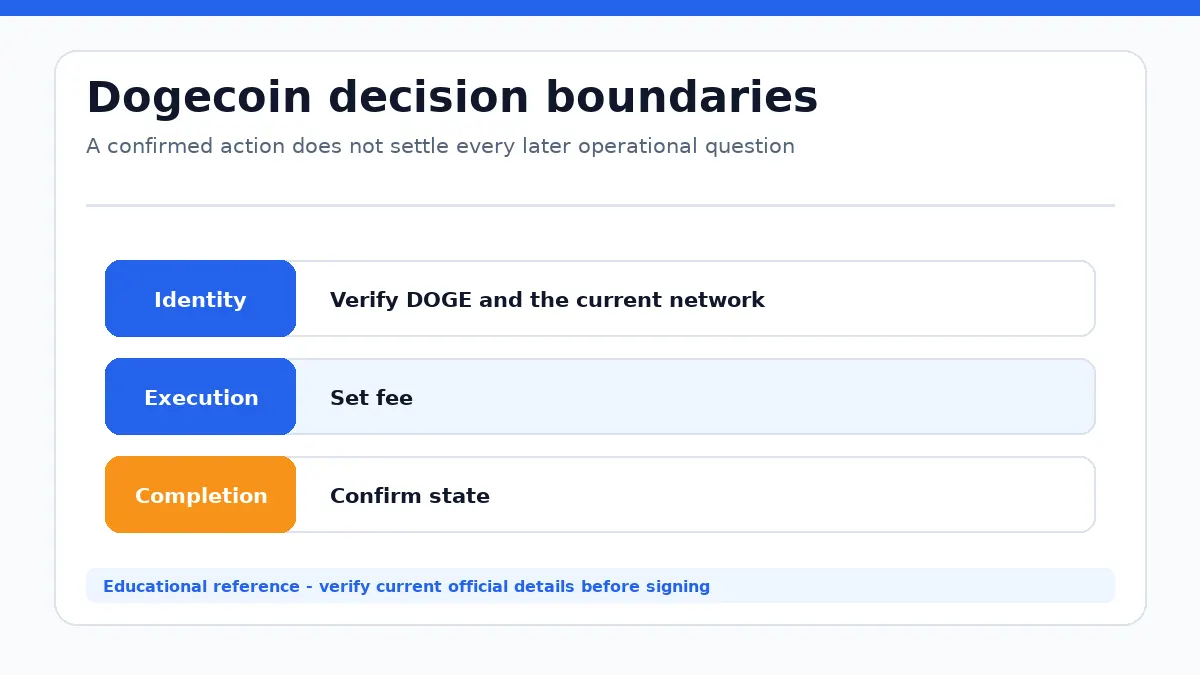
Dogecoin decision diagram separating identity, execution and completion checks
Dogecoin confirmation does not settle every later operational question.

Useful for straightforward transfers

DOGE can move directly between compatible wallets without a bank account. Its approximately one-minute target block interval can provide faster first inclusion than slower proof-of-work networks, but users should still match confirmation depth to the receiving service and not interpret a target interval as a guaranteed settlement time.

Dogecoin does not natively provide Ethereum-style arbitrary smart contracts, proof-of-stake yield or a token-holder governance right. Services can build custodial products or off-chain applications around DOGE, but those features add separate operators and risks.

Supply and custody

The absence of a final supply cap is not the same as unlimited issuance at any moment. Block issuance is bounded by the fixed reward schedule. Users should nevertheless understand dilution, custody, exchange withdrawal fees and wallet backup before treating DOGE as a long-term holding.

Common Dogecoin Mistakes

Most avoidable losses come from network confusion, custody or unrealistic mining assumptions.

Before moving DOGE

Check that both wallet and destination explicitly support native Dogecoin. Do not send DOGE to a similar address on another chain, treat a wrapped DOGE token as native DOGE, or assume an exchange deposit will credit before its required confirmations. Make a small test transfer when a destination or custody workflow is new.

  • Back up wallet recovery material offline.
  • Review the fee and change output.
  • Verify native DOGE versus a wrapped token.
  • Do not buy mining hardware from a profit estimate alone.

Security boundaries

Merged mining strengthens access to Scrypt hash power but does not protect a user from phishing, malware or a fraudulent merchant. A full node can verify consensus data; it cannot determine whether a recipient is trustworthy or recover a leaked private key.

Dogecoin Transaction and Fee Checks

Choose a next step based on whether you are paying, holding, mining or verifying.

Payment users

Use a maintained Dogecoin wallet, verify the address, fee and amount, then track the transaction until the receiving service reaches its required confirmation count. Compare Litecoin if you want to understand the Scrypt network most closely connected to Dogecoin mining.

What Dogecoin users should verify and why this design differs

Run or query a current Dogecoin node for consensus-aware data. Miners should model ASIC, electricity, pool and difficulty costs separately. The tools directory provides calculators and validators without pretending that one market price answers an operational question.

Dogecoin Transactions FAQ

Does Dogecoin use staking?

No. Dogecoin uses Scrypt proof of work and validating nodes.

Can Litecoin miners mine Dogecoin?

Auxiliary proof of work lets compatible Scrypt miners contribute work to Dogecoin while mining Litecoin.

Does DOGE have a final supply cap?

Dogecoin has fixed issuance per block but no scheduled end to block issuance.

What pays transaction fees when using Dogecoin?

Dogecoin (DOGE) pays the applicable network fee. DOGE pays transaction fees. Verify the selected network before signing because a later approval, bridge, claim or exit can require another transaction.

What should I verify before a Dogecoin transaction?

Check the official destination, current network, asset representation, amount, recipient and requested permissions. Dogecoin shares the Scrypt mining algorithm with Litecoin and supports auxiliary proof of work, allowing miners to contribute work to both networks while each chain keeps independent rules and blocks. After confirmation, inspect the resulting balance or protocol state instead of relying only on a wallet success message.

Known Limitations

Market Data Methodology

The page uses a CoinGecko aggregated DOGE/USD snapshot. No exchange chart is rendered for this entity.

Market Snapshot Source
CoinGecko aggregated market data (DOGE/USD)
Cache
Snapshot cache is approximately 60 seconds.
Failure Handling
Verified cached data is labeled Cached or Delayed. Missing values remain unavailable.
Snapshot Status
Delayed
Report Issue
Report a market-data problem →

Technical Sources

Selected primary sources support the operational explanations. Market-provider attribution remains separate.

Editorial Information

Verified technical content, reviewed sources and update history.

Published
Last Review
Data Verification
Sources
Official documentation