Skip to content
BitcoinToolkit

PancakeSwap (CAKE): How Swaps and Pools Work

PancakeSwap is a decentralized exchange and on-chain finance protocol deployed across multiple supported networks. CAKE is its protocol token for incentive, tokenomic and governance functions; it is not the gas currency of those networks and does not represent every liquidity position. This page focuses on how PancakeSwap Swaps and Pools Work and the checks users need before using the protocol or evaluating the token role.

Understand CAKE utility and PancakeSwap product risks across supported chains.

Subject:
PancakeSwap
Market mode:
Snapshot Only
Fee asset:
Varies
Timezone:
UTC

This page does not quote a swap, rank a farm, forecast CAKE emissions or audit a liquidity pool.

Content ownership: BitcoinToolkit Editorial Team Technical references: Official protocol and developer documentation. Review approach: Technical explanations are checked against primary sources and updated when the network or asset changes. Last content review: Data integration last tested:

How PancakeSwap Swaps and Pools Work

PancakeSwap began by making automated exchange and liquidity provision accessible in the BNB Chain ecosystem and later extended products across additional networks.

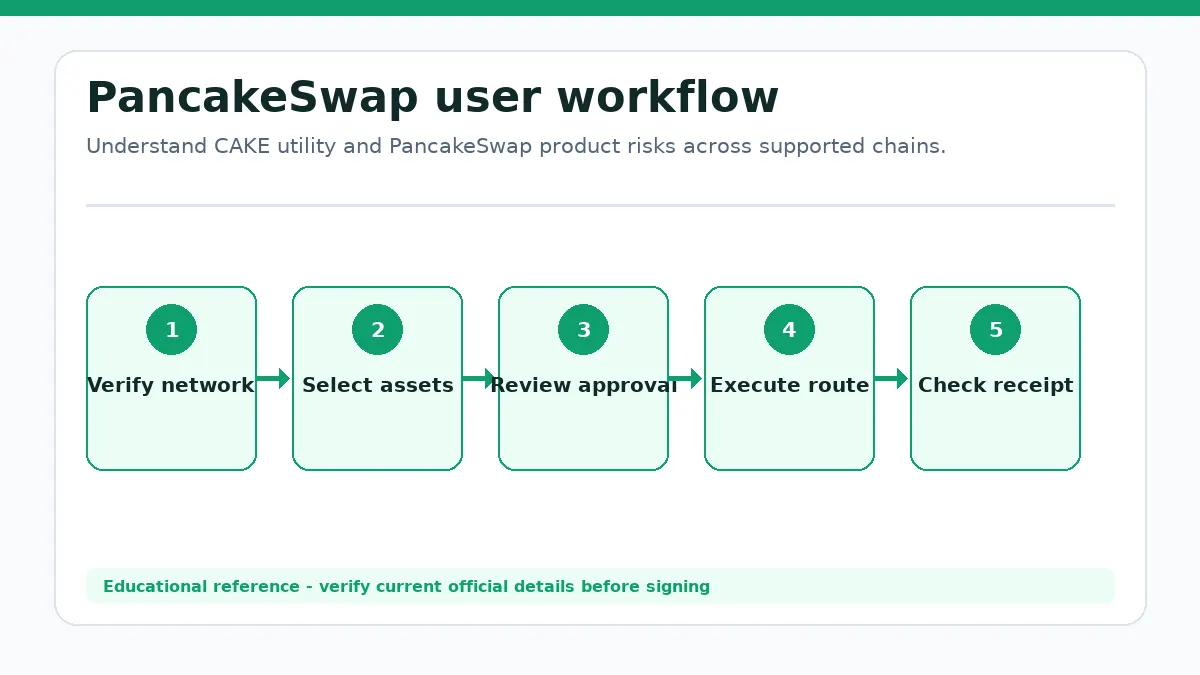
PancakeSwap workflow showing Verify network, Select assets, Review approval, Execute route, Check receipt
PancakeSwap workflow from the first user decision to a verified outcome.

Shared pools coordinate traders and providers

Automated market maker contracts quote trades against deposited token inventories. Traders pay fees and accept price impact; providers supply inventory and receive pool economics while bearing changes in token composition. Multiple pool designs and fee tiers allow different liquidity strategies.

Expansion across networks gives users a familiar interface, but liquidity is not one global pool. A pair on BNB Chain can have different depth, contracts and execution costs from the same symbols on Ethereum or another supported network.

Permissionless access has a cost

A listed market is not an endorsement. Users remain responsible for verifying token contracts and understanding whether liquidity can support the intended trade or exit.

Which PancakeSwap Product Are You Actually Using?

PancakeSwap is a multichain decentralized exchange ecosystem. A token swap, liquidity position and CAKE governance decision create different exposures and should not be evaluated as one product.

Match the workflow to the goal

Swappers should focus on chain selection, token contracts, routing, price impact and received amount. Liquidity providers must evaluate pool version, fee tier, range settings, asset correlation and incentive durability. Governance or staking participants must review the current CAKE mechanism separately from either activity.

The platform can suit users who need self-custody access to supported onchain liquidity. It is not a substitute for a protected brokerage account, guaranteed execution, audited token quality or a fixed-income product.

Multichain does not mean chain-neutral

Every deployment inherits its host network's gas token, finality, bridge and contract risks. Confirm the selected chain before signing.

How to Evaluate a PancakeSwap Transaction Before Signing

The chain and contract checks come before the displayed exchange rate.

Swap workflow

After confirmation, check the actual received balance and revoke unnecessary approvals when appropriate. A failed or delayed transaction should be investigated by chain state and transaction hash, not by repeatedly increasing slippage.

Liquidity workflow adds inventory risk

Providers must choose a pool and range where applicable, record initial token amounts, monitor fees and incentives, and compare the position with holding. The withdrawal returns the current pool mix, not a guaranteed starting balance.

What CAKE Does and Which Risks It Cannot Cover

CAKE supports ecosystem governance and incentive mechanisms, while swaps and liquidity positions rely on their own assets and contracts.

Token role boundaries

CAKE does not pay gas on every supported chain, does not represent every liquidity position and does not guarantee a claim on trading volume. Users can trade pairs that do not include CAKE. Governance, emissions, burns and reward programs can change, so current rules matter more than historical descriptions.

Buying CAKE is therefore different from using PancakeSwap as an exchange or providing liquidity to one of its pools.

Material risks

Risks include malicious token contracts, smart-contract defects, price impact, impermanent loss, out-of-range liquidity, incentive dilution, bridge exposure and network-specific failures. A common mistake is selecting by headline APR without checking whether the reward token, pool liquidity and exit route are sustainable.

The Next PancakeSwap Step

Both ecosystems use automated liquidity, but users should compare the exact chain, pool version and route rather than brand names alone.

What PancakeSwap users should verify and why this design differs

PancakeSwap has deep roots in BNB Chain and offers a broad multichain product set. Uniswap is strongly associated with Ethereum and its scaling ecosystem while also deploying across networks. For a swap, compare executable output, token contract and gas. For liquidity, compare pool mechanics, fee tier, range management and depth.

Neither interface removes the need to verify assets and approvals. The better venue can change by pair, size, chain and time.

PancakeSwap Swaps and liquidity FAQ

Can a PancakeSwap swap succeed at a worse price than the preview?

Yes. Pool state, routing, price impact, slippage settings, fees and transaction ordering can change execution.

Known Limitations

Market Data Methodology

The page uses a CoinGecko aggregated CAKE/USD snapshot. No exchange chart is rendered for this entity.

Market Snapshot Source
CoinGecko aggregated market data (CAKE/USD)
Cache
Snapshot cache is approximately 60 seconds.
Failure Handling
Verified cached data is labeled Cached or Delayed. Missing values remain unavailable.
Snapshot Status
Delayed
Report Issue
Report a market-data problem →

Technical Sources

Selected primary sources support the operational explanations. Market-provider attribution remains separate.

Editorial Information

Verified technical content, reviewed sources and update history.

Published
Last Review
Data Verification
Sources
Official documentation