Artificial Superintelligence Alliance (FET): Why FET and ASI Names Appear Together
The Artificial Superintelligence Alliance combines organizations and token communities around decentralized AI systems. Current official materials and live Fetch mainnet activity still use FET or FET (ASI), while earlier merger plans describe a staged move toward ASI naming. Users must verify the representation and venue instead of assuming every label has switched. This page focuses on why FET and ASI Names Appear Together and the checks users need before using the current asset or handling a legacy representation.
Resolve FET and ASI naming, then choose the correct network, migration or staking action.
Subject:
Artificial Superintelligence Alliance
Market mode:
Snapshot Only
Fee asset:
FET
Timezone:
UTC
This page does not predict a final exchange rename date, operate a migration contract, recommend a validator or validate an unofficial token.
Content ownership: BitcoinToolkit Editorial TeamTechnical references: Official protocol and developer documentation.Review approach: Technical explanations are checked against primary sources and updated when the network or asset changes.Last content review: Data integration last tested:
Why FET and ASI Names Appear Together
Brand consolidation and token migration have not always moved at the same pace across networks and venues.
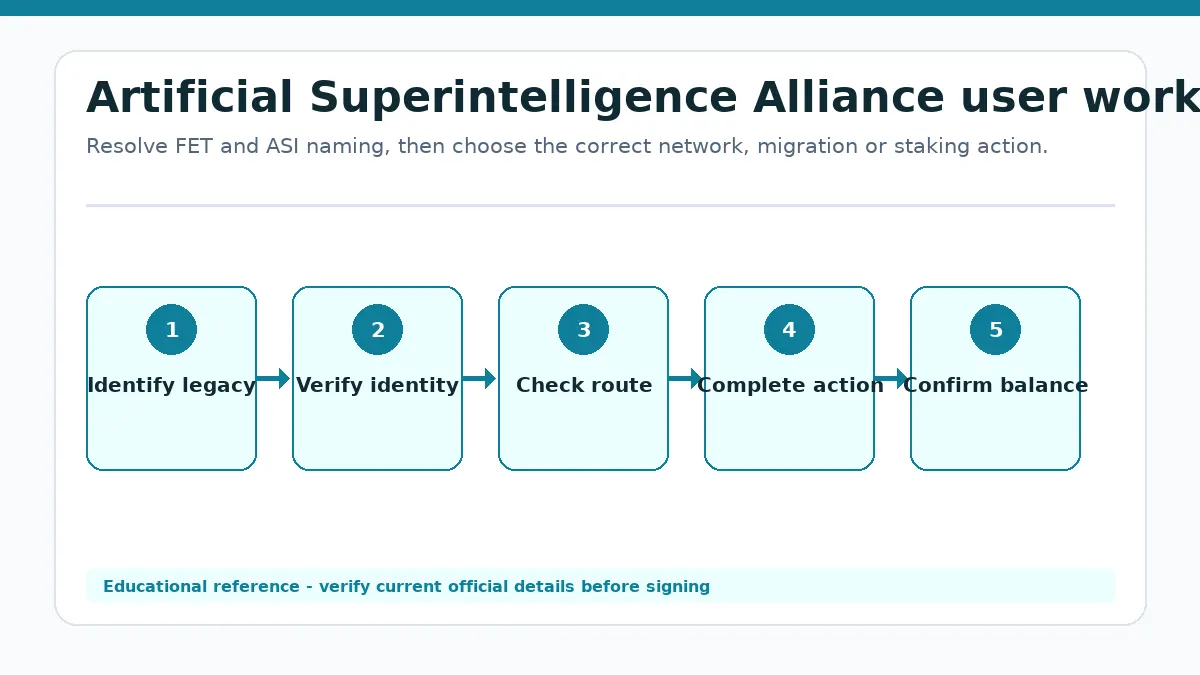
Artificial Superintelligence Alliance workflow from the first user decision to a verified outcome.
Current labels must be verified in context
Alliance documentation describes a staged merger beginning with AGIX and OCEAN conversions into FET, followed by an intended transition to ASI naming. Current official governance materials commonly use FET (ASI), and Fetch mainnet records still denominate balances and fees in FET. This makes a blanket statement that all FET has already disappeared inaccurate.
An exchange may display FET, ASI or an Alliance brand according to its own support schedule. Self-custody users should identify the network and contract before acting. A name change in a market interface does not by itself migrate an Ethereum token or alter a native mainnet balance.
Where Artificial Superintelligence Alliance Differs for Users
The same economic asset can follow different transaction systems.
Mainnet fees versus host-chain gas
Native FET lives on the Fetch mainnet, pays transaction fees and can be delegated to validators. Addresses, staking and governance follow the network's Cosmos-SDK-based account model. Native transfers require FET for fees and should use a wallet and destination that support the mainnet.
Represented FET on Ethereum or another supported chain is a token whose transfer requires that host chain's gas asset. Bridging or migration is an explicit transaction, not an automatic consequence of holding the same ticker. Exchanges can support only selected networks, so users must match deposit and withdrawal rails.
How the Alliance Token Merger Works
Conversions use published ratios and official contracts or network upgrades.
AGIX, OCEAN and later integrations
Alliance materials publish conversion ratios for AGIX and OCEAN into the shared tokenomic system and describe migration contracts for self-custody holders. Native-network migrations can occur through a coordinated upgrade, while exchange-held balances depend on the exchange implementing support. These paths should not be mixed.
The availability and naming of a migration route can change. Users should rely on current Alliance documentation, verify contract addresses and avoid deadlines or links supplied only through direct messages. No legitimate migration needs a seed phrase. Liquidity-provider positions often require separate handling from an ordinary wallet balance.
FET and ASI Checks Before You Act
Start with the actual balance, not the label used in a social post.
A migration and staking checklist
Identify whether the asset is native FET, an Ethereum token or an exchange balance. Confirm the destination network, current ticker support, fee currency and official migration instructions. For native staking, review the validator, commission, unbonding period and slashing risk before delegating.
For AGIX, OCEAN or another merger participant, verify the published conversion ratio and supported contract. Do not send tokens directly to a Fetch address unless the documented workflow instructs it. Treat future ASI-chain plans separately from current production behavior until official deployments and wallet support are confirmed.
The Next Artificial Superintelligence Alliance Step
A familiar FET ticker can refer to a legacy representation, a current asset or an unsupported migration route.
The FET result needs context
Native FET secures the Fetch mainnet through delegated proof of stake and pays its fees. Ethereum and other represented tokens follow host-chain rules. AGIX, OCEAN and later participants use official migration mechanisms with fixed or proposal-defined conversion terms rather than becoming identical through a ticker label alone.
FET is the current market-profiled Alliance asset. FET pays Fetch mainnet transaction fees; represented tokens use their host-chain gas asset.
What Artificial Superintelligence Alliance users should verify and why this design differs
Exchange naming and migration support differ. Alliance plans can change.
For Artificial Superintelligence Alliance, the practical sequence is Identify legacy asset, Verify current identity, Check route, Complete action, Confirm balance. Confirm the official destination and current network, then inspect the final balance, position, receipt or documented exit state that actually completes the task: Resolve FET and ASI naming, then choose the correct network, migration or staking action.