Jupiter (JUP): How a Jupiter Route Becomes a Solana Transaction
Jupiter is a Solana trading and on-chain finance platform whose products include token routing and additional financial applications. JUP is its governance and ecosystem token; it is not Solana's gas currency and is not required merely to hold another Solana token. This page focuses on how a Jupiter Route Becomes a Solana Transaction and the checks users need before using the protocol or evaluating the token role.
Understand JUP token utility, Jupiter product risks and SOL fee requirements.
Subject:
Jupiter
Market mode:
Snapshot Only
Fee asset:
SOL
Timezone:
UTC
This page does not quote a swap, recommend a route, calculate perpetual risk or guarantee staking rewards.
Content ownership: BitcoinToolkit Editorial TeamTechnical references: Official protocol and developer documentation.Review approach: Technical explanations are checked against primary sources and updated when the network or asset changes.Last content review: Data integration last tested:
How a Jupiter Route Becomes a Solana Transaction
Jupiter is a Solana trading and routing platform. Its aggregator can compare available liquidity paths, but users still decide which token, route and execution settings are acceptable.
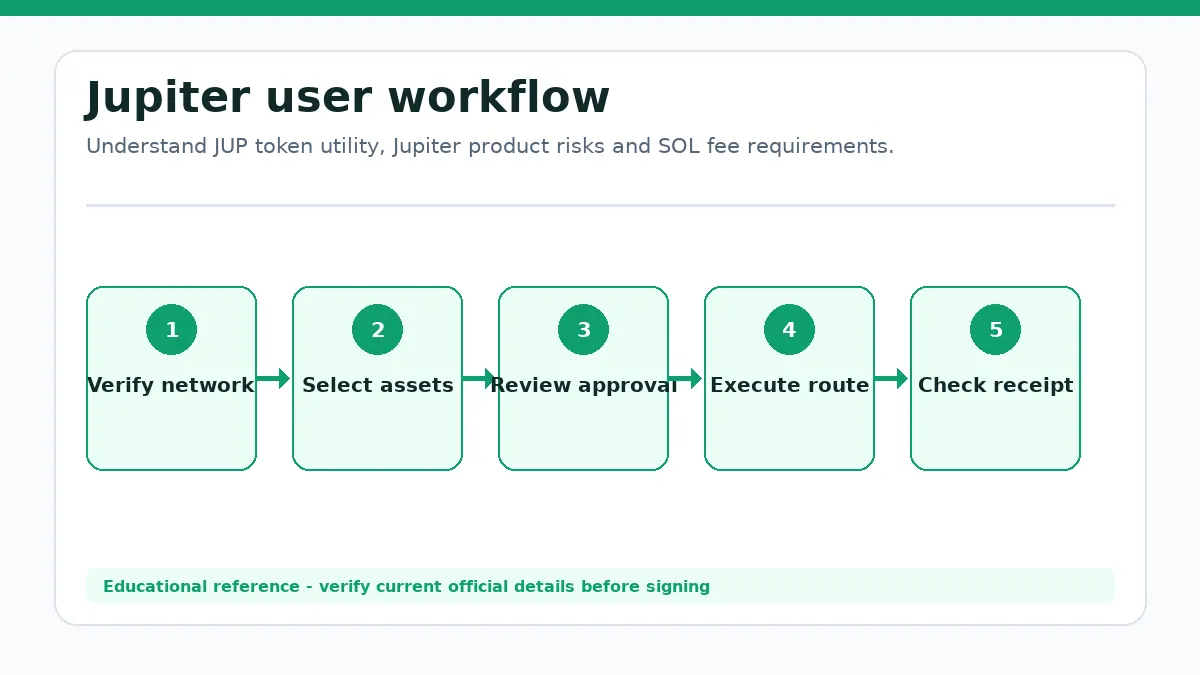
Jupiter workflow from the first user decision to a verified outcome.
Useful for fragmented liquidity
Jupiter can be useful when the same token pair trades across several Solana liquidity sources. The routing engine can evaluate direct and multi-hop paths and return a quote that reflects the selected amount and current conditions. This reduces manual venue comparison, especially for pairs where one pool alone does not provide the best route.
It is not a guarantee of the final price or token quality. A route can change before execution, price impact can increase with order size, and a correctly routed swap can still purchase a malicious or unsuitable token.
Who should pause
Users unfamiliar with Solana token mints, slippage or wallet approvals should verify the asset and simulate a small transaction first. Advanced order or derivatives features add separate risks beyond a simple swap.
Why Jupiter Aggregates Solana Liquidity
Solana liquidity is distributed across automated market makers and other venues, which can make the best execution path difficult to identify manually.
Routing is the core product problem
An aggregator requests or calculates routes across supported liquidity sources, compares expected output and constructs the transaction needed to complete the selected path. The route may split an order or pass through intermediate assets when that improves the quote after price impact and fees.
This design competes on routing quality and integration breadth rather than requiring all liquidity to sit in a single Jupiter-owned pool. It also means execution depends on Jupiter components, Solana programs and the underlying venues included in the route.
A quote is time-sensitive
Other trades can move pool balances between quote and confirmation. Slippage settings define an execution boundary, not a promise that the displayed estimate will remain available.
From Token Selection to a Confirmed Jupiter Swap
A safer swap workflow begins with token identity and ends with onchain confirmation rather than the interface success message.
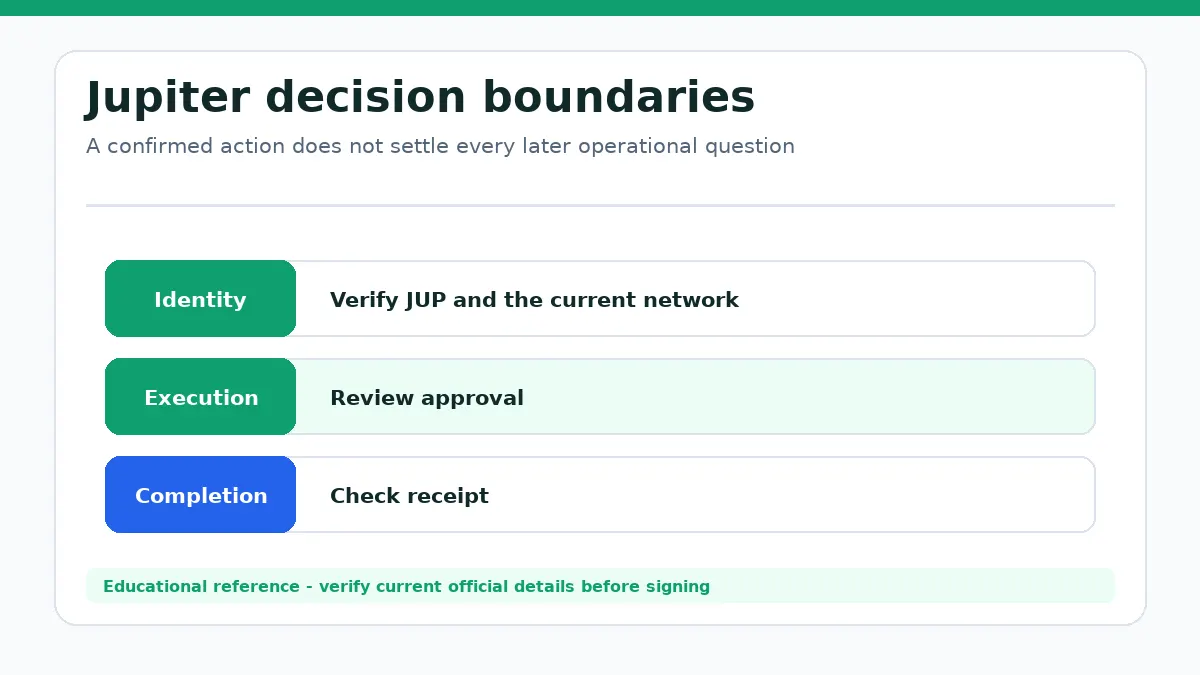
Jupiter confirmation does not settle every later operational question.
Build and verify the route
Keep enough SOL for transaction fees and account creation.
After submission, confirm the transaction and resulting token balance in the wallet or explorer. If an order fails, obtain a new quote instead of repeatedly signing stale transactions.
Mistakes that routing cannot correct
Jupiter cannot determine a user's investment suitability, recover a compromised wallet or turn an unofficial token mint into the intended asset. Very loose slippage, copied token names and insufficient SOL remain common avoidable errors.
What JUP Does and Which Risks Stay With Traders
JUP is connected to the Jupiter ecosystem and governance; it is not the gas token or automatic settlement asset for every Jupiter trade.
Token role boundaries
Solana transaction fees are paid in SOL. Users can use Jupiter routing without making JUP the asset on either side of a swap. Holding JUP does not guarantee a better route, eliminate slippage, create ownership of underlying liquidity or insure a failed transaction.
Governance and ecosystem programs can evolve. Token utility should be checked against current official proposals and product rules rather than inferred from market price.
Execution dependencies
Risks include malicious token mints, liquidity shocks, price impact, underlying program defects, route complexity, RPC problems, network congestion and wallet compromise. Limit orders, recurring purchases or perpetual products add product-specific execution and collateral risks that should not be generalized from the swap interface.
Jupiter Operating Context
The products can appear in the same transaction without serving the same role.
What Jupiter users should verify and why this design differs
Jupiter searches supported sources and constructs routes. Raydium operates automated market maker programs and pools that can supply liquidity to a route. A swapper may prefer aggregation for route discovery, while a liquidity provider must evaluate a specific Raydium pool, fee tier and price range.
The comparison should therefore follow the user's task: routing quality for a swap, or pool mechanics and inventory risk for liquidity provision.
Jupiter Swaps and liquidity FAQ
What pays transaction fees when using Jupiter?
Solana (SOL) pays the applicable network fee. SOL pays Solana transaction and account-creation fees. Verify the selected network before signing because a later approval, bridge, claim or exit can require another transaction.
Can a Jupiter swap succeed at a worse price than the preview?
Yes. Pool state, routing, price impact, slippage settings, fees and transaction ordering can change execution.
Known Limitations
Products and governance rules change.
The page does not verify a live route.
Listed tokens require separate due diligence.
Market Data Methodology
The page uses a CoinGecko aggregated JUP/USD snapshot. No exchange chart is rendered for this entity.
Market Snapshot Source
CoinGecko aggregated market data (JUP/USD)
Cache
Snapshot cache is approximately 60 seconds.
Failure Handling
Verified cached data is labeled Cached or Delayed. Missing values remain unavailable.